

On this page
In September 2022, a NASA spacecraft intentionally crashed into an asteroid. The Double Asteroid Redirection Test (DART) was not trying to destroy the asteroid. Instead, it was testing whether a kinetic impact—hitting a space rock with a fast-moving mass—could change its path enough to miss Earth in the future (NASA, 2022).
The mission targeted Dimorphos, a small asteroid that orbits a larger one named Didymos. By tracking these near-Earth objects, scientists map their orbits and calculate where they will be decades from now. If an asteroid is on a collision course, tracking it early gives us time to act.
Why do scientists track asteroids near Earth?
We cannot wait until an asteroid is close to try and move it. By cataloguing near-Earth asteroids, astronomers are checking if any will cross our path in the next century.
A kinetic impactor like DART only works if we hit the asteroid years or even decades before it is due to arrive. Because Kepler's second law and orbital mechanics dictate that a small shift magnifies over time, a push of just a few millimetres per second is enough to make a rock miss Earth—provided we have the time to let that new orbit carry it to safety.
This is why telescopes scan the sky every night. We are finding the rocks now, so we never have to scramble if one heads our way.
How do you move an asteroid?
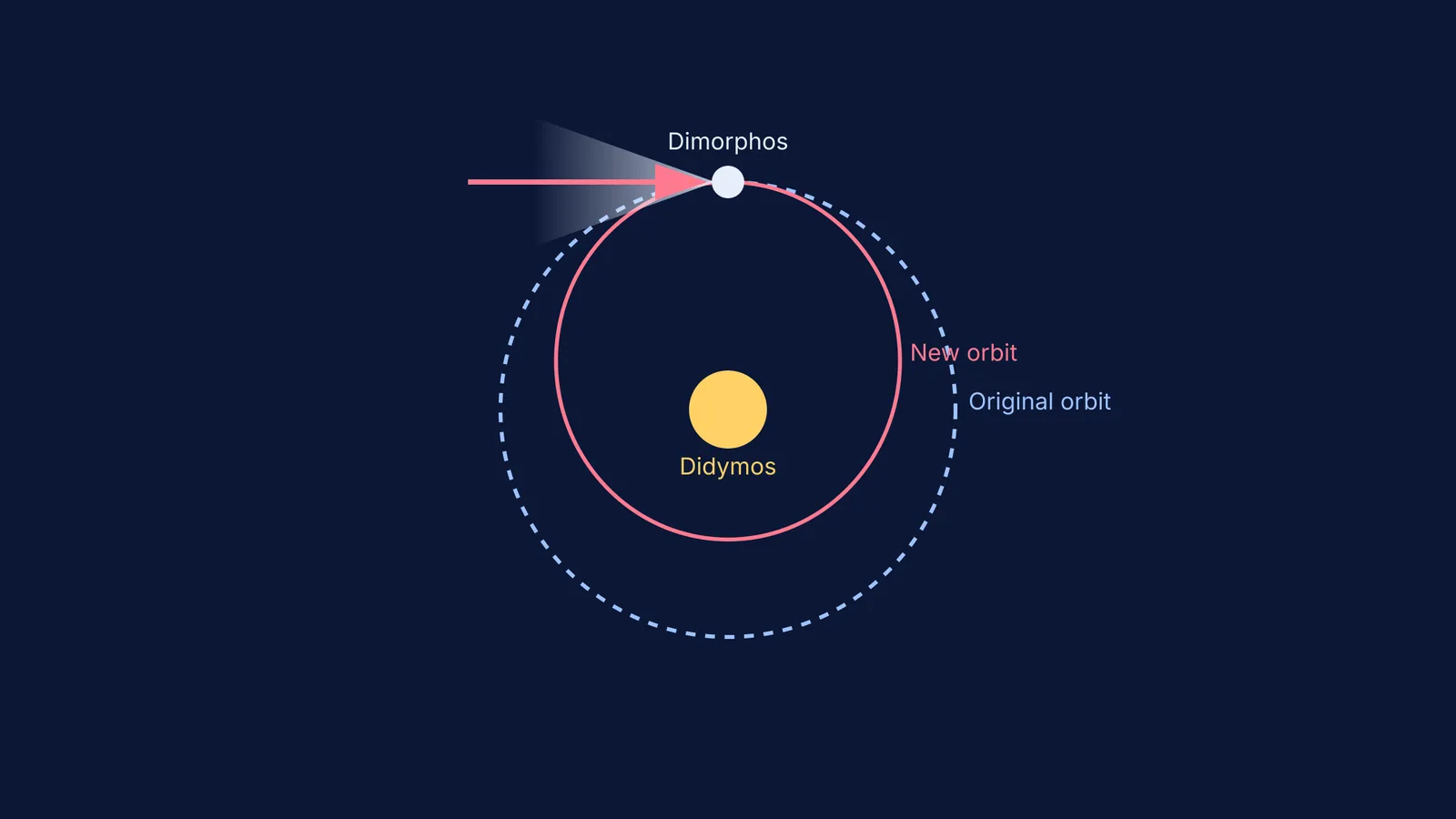
The physics of moving an asteroid relies on the conservation of momentum. When the DART spacecraft struck Dimorphos, it transferred its momentum to the asteroid.
Before the impact, Dimorphos orbited Didymos every 11 hours and 55 minutes (NASA, 2022). After the collision, telescopes on Earth measured the new orbit and found it had shortened to 11 hours and 22 minutes. The impact reduced the orbital period by 33 minutes, proving that kinetic deflection works (Thomas et al., 2023).
If you are trying to picture how a small change in velocity shifts an entire orbit, the Fermi Simulation Lab lets you adjust a moving body's speed and watch how its path changes in real time.
The kinetic impact framework
To change an asteroid's path, scientists rely on three steps:
Track early: Map the orbit decades in advance to find the exact intersection point with Earth.
Apply momentum: Hit the asteroid head-on to slow it down, using p = m × v.
Let time multiply the effect: A tiny change in velocity alters the orbital period. Over years, this small delay means the asteroid reaches the intersection point after Earth has already passed by.
Will hitting it break it?
Scientists expected a direct hit to change the orbit by about 7 minutes (Thomas et al., 2023). However, the 33-minute change showed that Dimorphos received a massive momentum enhancement.
When DART hit, it did not just bury itself in the rock. The collision excavated a crater and blasted a huge cloud of dust and rock into space. As this ejecta shot backwards, it pushed the asteroid forwards in the opposite direction, much like a shell exploding midair pushes its fragments apart. This recoil effect contributed more momentum to the asteroid than the spacecraft itself carried (Daly et al., 2023).
To master the physics of collisions and recoil, you can bring a set of momentum problems to Fermi's AI tutor. The tutor will work out what you already know and build a plan for the session, writing out the equations board by board until the concept clicks.


