On this page
Hang a weight on a string and set it swinging from side to side in front of you. Now hold a piece of dark sunglass lens over one eye and keep both eyes open. The bob no longer swings in a straight line: it seems to move in a loop, coming towards you on one pass and going away on the other. Nothing about the pendulum has changed. The trick is in your eye's timing, and you can work out the size of the loop with the same geometry you use for parallax.
What is the Pulfrich effect?
The Pulfrich effect is the illusion that an object moving sideways is nearer or farther than it really is when one eye sees a darker image than the other. It was first described in 1922 by the German physicist Carl Pulfrich, who worked on stereoscopic instruments (EyeWiki, American Academy of Ophthalmology).
Your brain judges depth by comparing where an object appears to each eye. How that comparison works, and why one eye is not enough, is covered in why we need two eyes to judge depth. Here we only need one fact: if the two eyes report the object at slightly different sideways positions, the brain places it where the two lines of sight cross.
Why does a dark filter delay what one eye sees?
It is tempting to say the filter slows the light. It does not, in any way that matters. A 2 mm sheet of glass with refractive index 1.5 delays light by (n − 1)L/c = 0.5 × 0.002 / (3 × 10⁸) = 3.3 × 10⁻¹² s, a few picoseconds.
The delay is in the eye and brain. In dimmer light, photoreceptors collect light for longer before they signal, and the signal takes longer to build up, so the darker eye's message arrives later. The cells involved and their dim-light behaviour are described in rods and cones in the retina.
How long is the delay? It depends on how dark the filter is and on the person. EyeWiki gives about 15 ms for a tenfold drop in light to one eye. In a laboratory study, moving a filter that cuts light tenfold from one eye to the other shifted the measured delay by about 16 ms in total (Reynaud and Hess, Scientific Reports, 2017). Below we use a round, illustrative 10 ms.
How does a time delay turn into depth?
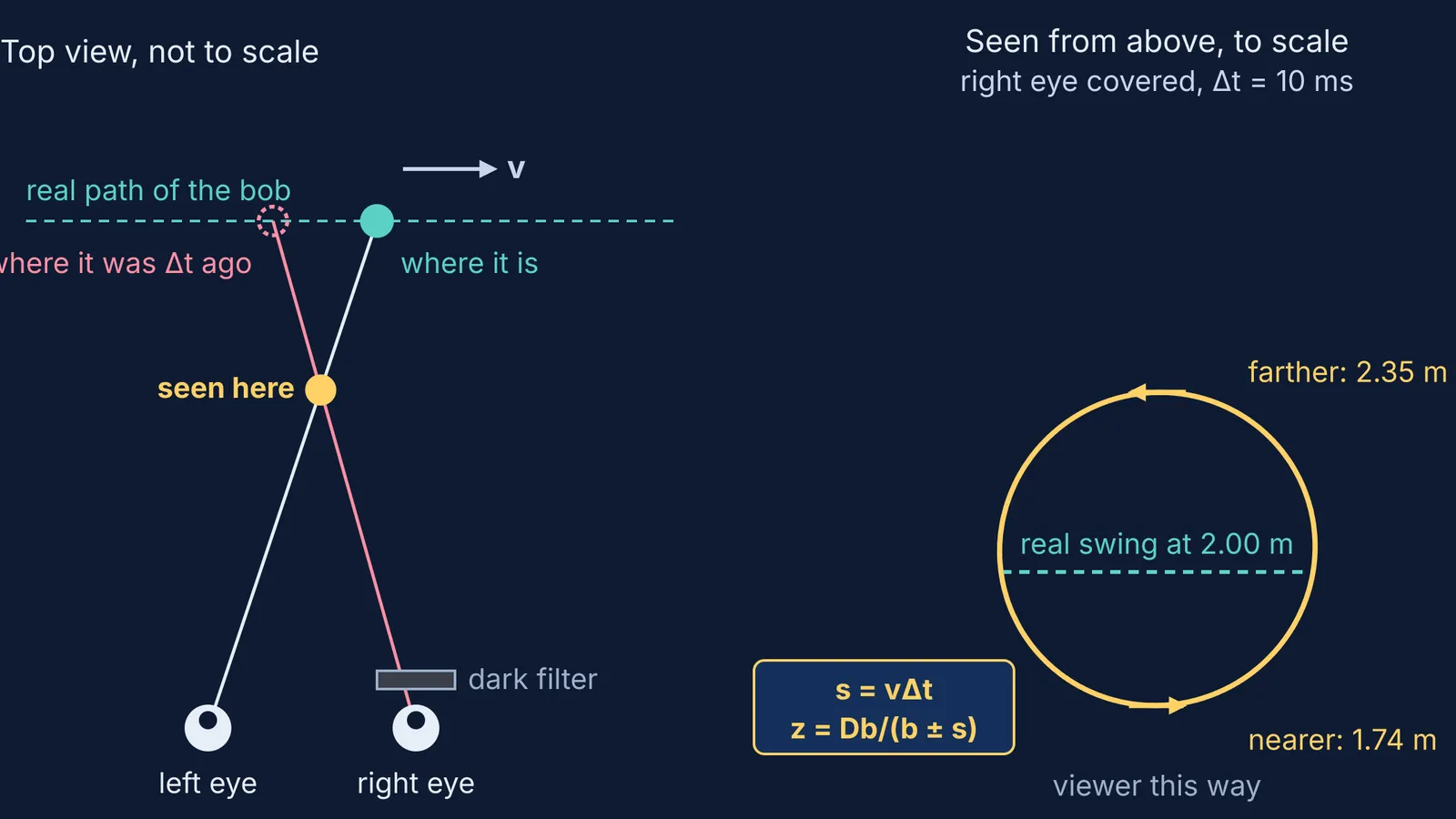
Put the eyes a distance b apart and the pendulum a distance D in front of them. Say the right eye is covered and the bob is moving to the right at speed v.
The left eye sees the bob where it is now.
The right eye, running Δt behind, sees it where it was Δt ago: a distance s = vΔt to the left.
The two lines of sight now cross in front of the real path. Similar triangles give the crossing distance z = Db/(b + s).
When the bob swings back to the left, the lag points the other way and the lines cross behind the path, at z = Db/(b − s).
So the depth error depends on speed. At the ends of the swing the bob stops, s = 0 and there is no error. At the centre it moves fastest and the error is largest. Nearer on one pass, farther on the other: the straight swing looks like a closed loop seen from above.
Worked example: a pendulum 2 m away
Take eyes b = 64 mm apart, a pendulum D = 2.0 m away swinging with amplitude A = 0.30 m and period T = 2.0 s, and Δt = 10 ms.
Top speed. For simple harmonic motion, v = Aω = A × 2π/T = 0.30 × π = 0.94 m/s at the centre.
Lag. s = vΔt = 0.94 m/s × 0.010 s = 9.4 mm. At 2 m this is an angle of 0.0047 rad, about 16 arcminutes, which the visual system easily detects.
Nearer pass. z = Db/(b + s) = 2.0 × 64/(64 + 9.4) = 1.74 m, so the bob seems about 26 cm nearer.
Farther pass. z = Db/(b − s) = 2.0 × 64/(64 − 9.4) = 2.35 m, about 35 cm farther.
Units check. s has units m/s × s = m, and Db/(b ± s) is m × mm/mm = m.
The loop is not symmetric: the far side bulges more than the near side, because b − s shrinks faster than b + s grows. A slower or gentler case gives much less. At 0.5 m/s with a 5 ms delay, s = 2.5 mm and the bob seems only about 7.5 cm nearer.
Which way does the pendulum seem to go round?
Use the rule from the derivation: the bob seems nearer while it moves towards the side of the covered eye. With the right eye covered, it comes closer while moving right and recedes while moving left. Seen from above, with you at the bottom, that is an anticlockwise loop. Move the filter to the left eye and the loop reverses.
You can check this with the figure: the dark eye's line of sight always points to where the bob was, behind it in its motion.
Where else does the Pulfrich effect show up?
The same timing difference can be made by blur instead of darkness, but in the opposite direction: a blurred image is processed slightly faster. Some people correct their eyesight with monovision, one eye set for near and the other for far, so one eye sees a blurrier image. A 2019 study showed this can produce a reverse Pulfrich effect, with moving objects misjudged in depth, and that darkening the blurrier lens can cancel it (Burge and colleagues, Current Biology, 2019). Decisions about lenses are for an eye doctor, not a physics formula.
The effect has also been used as a cheap form of 3D video. Unlike the cinema glasses in how 3D movie glasses work, which send two different pictures to the two eyes, Pulfrich viewing uses one ordinary picture and relies on sideways camera motion plus a dark lens to create the difference.
To see how similar triangles turn a small sideways shift into a large depth change, work through parallax problems in the Fermi Problem Library, which has a step-by-step solver that explains the reasoning.
Quick checklist
The filter does not slow light; dim light slows the retina's response.
Lag distance: s = vΔt, with v the sideways speed.
Apparent distance: z = Db/(b + s) on one pass, Db/(b − s) on the other.
0.94 m/s and 10 ms give s = 9.4 mm: about 26 cm nearer and 35 cm farther at 2 m.
No sideways motion means no effect; zero speed at the ends closes the loop.
The bob seems nearer while moving towards the covered eye's side.