On this page
The buddhi ke baal seller pours a spoon of sugar into a spinning metal head, and a few seconds later pink clouds start to wrap round his stick. Nothing is added. The fluffy cloud is ordinary sugar, melted, thrown out through tiny holes and cooled in the air. The physics question is not why it flies out, but why the threads come out as a clear, brittle glass instead of the white sugar crystals you started with. The answer is speed: each thread is so thin that it cools before its molecules can line up.
How does a candy floss machine spin sugar into threads?
The machine has a small metal head with a heater ring inside and fine holes or slots round its rim. The head is spun by a motor. Paragon, a US maker of these machines, lists the motor of its Classic Floss model at 3,450 rpm in the owner's manual. Sugar poured into the centre melts against the heater and is flung out through the holes as fine streams that harden into threads. The threads collect on the inside of the big bowl round the head, and the seller winds them onto a stick.
The worked numbers below use a round illustrative head: radius 4 cm, turning at 3,000 rpm, a little slower than that rated motor speed.
How strongly does the head throw the molten sugar out?
First turn rpm into an angular speed. The method is set out in how to convert rpm to radians per second.
Angular speed. ω = 3,000 × 2π / 60 = 314 rad/s.
Rim speed. v = ωR = 314 × 0.04 = 12.6 m/s, about 45 km/h.
Centripetal acceleration. ω²R = 314² × 0.04 = 3,950 m/s², which is 402 times g.
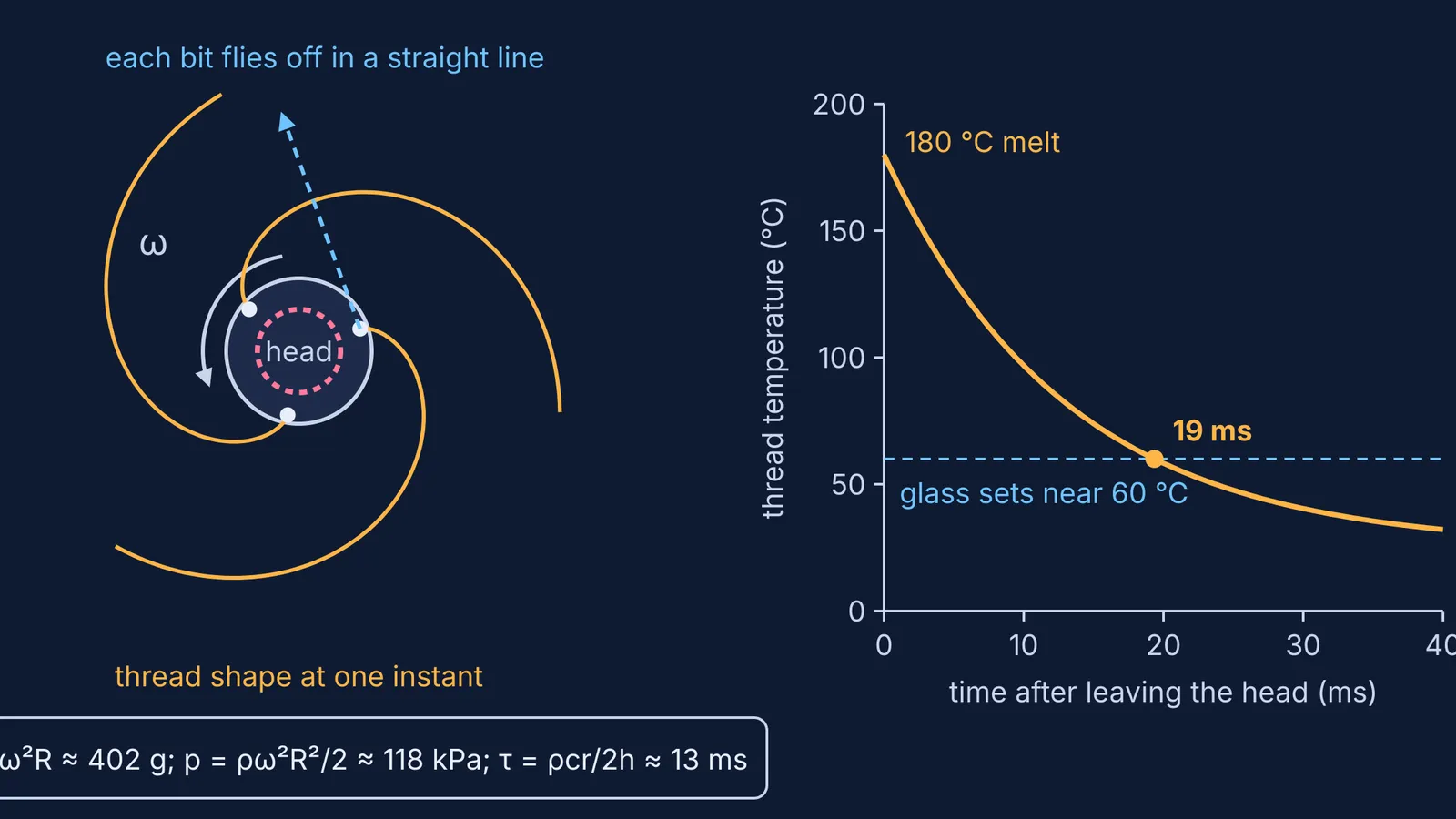
Pressure at the holes. Molten sugar fills the head from the axis to the rim. In a fluid turning as a rigid body, pressure grows outwards as dp/dr = ρω²r. Integrate from 0 to R: p = ρω²R²/2. With ρ ≈ 1,500 kg/m³, p = 1,500 × 314² × 0.04² / 2 ≈ 118 kPa, more than one extra atmosphere pushing the melt through the holes.
That pressure is what forces a thick, sticky liquid through holes far narrower than a pin. The same ω²R idea is used to separate blood in a lab, worked in how a centrifuge separates blood by spin speed, so it is not repeated here.
Does centrifugal force throw the sugar outwards?
Only in the frame of the spinning head. In the room frame there is no outward force at all. While the sugar is inside the head, the walls push it inwards to keep it going round. Once a bit of sugar leaves a hole, nothing pushes it sideways, so it flies off in a straight line, tangent to the rim, with a little extra outward speed from the pressure.
Why then do the threads look curved? Because the hole keeps moving. Sugar leaving now and sugar that left a moment ago started from different points on the rim. Join them up at one instant and you get a spiral, like the water from a rotating lawn sprinkler. Each bit moves straight; the thread as a whole is curved.
Why does the sugar become a glass and not crystals?
Table sugar is crystalline sucrose: its molecules sit in a regular, repeating pattern. Melt it at around 180 °C and the pattern is lost; the molecules tumble about in a liquid. To crystallise again they must line up, and that takes time, because molten sugar is very viscous and gets stiffer as it cools.
If the liquid cools slowly, the molecules find their places and you get crystals, as in fudge. If it cools fast, the liquid stiffens before they can line up. The disorder is frozen in place and you get an amorphous solid, a glass. A boiled sweet is the same kind of sugar glass. Food scientists Leinen and Labuza describe cotton candy as a pure amorphous sucrose system in the Journal of Zhejiang University Science B.
Worked example: how fast does a 50 µm thread cool?
Take a round illustrative thread 50 µm across (r = 25 µm), leaving at 12.6 m/s into room air at 25 °C. Treat it as a hot cylinder losing heat by convection, which is Newton's law of cooling. The exponential form is derived in Newton's law of cooling: the exact law and the average shortcut.
Heat-transfer coefficient. For air flowing past a thin cylinder, the Hilpert correlation used in heat-transfer textbooks gives h ≈ 1,800 W/m² K at this size and speed (Reynolds number about 42). Treat it as an estimate.
Time constant. For a long cylinder, volume / surface area = r/2. The time constant is τ = ρc(r/2)/h. With ρ ≈ 1,500 kg/m³ and c ≈ 1,250 J/kg K (approximate for sugar), τ = 1,500 × 1,250 × 12.5 × 10⁻⁶ / 1,800 ≈ 0.013 s, or 13 ms.
Cooling to 60 °C. T − 25 = 155 e^(−t/τ). Set T = 60: t = τ ln(155/35) = 13 × 1.49 ≈ 19 ms.
Distance travelled. At 12.6 m/s, a thread moves about 24 cm in 19 ms (less in reality, because air drag slows it). It is solid before it reaches the bowl.
About 20 milliseconds from melt to solid is far too short for the molecules to line up, so the thread sets as a glass. The air spaces between the threads are what make the cloud so large; the threads themselves are solid sugar.
Why does candy floss go sticky and shrink on a humid day?
A glass is only stable below its glass transition temperature, Tg. Above Tg it softens into a very thick liquid, and the molecules can move enough to crystallise. For dry amorphous sucrose, Tg is roughly 60 °C, though Jawad and colleagues in Food & Function note that published values range from 48 °C to 78 °C, depending on how samples were made.
Water changes this. Amorphous sugar soaks up water from the air, and water lowers Tg sharply; a 2022 study in Foods describes water as a plasticiser that greatly lowers the glass transition temperature. On a humid day, Tg can fall below room temperature. Leinen and Labuza note that amorphous sucrose held above its Tg collapses and crystallises. The threads go sticky, the cloud shrinks into a dense lump, and later it turns grainy as crystals form. That is why candy floss is sold fresh or in sealed bags.
Molten sugar at 180 °C sticks to skin and causes deep burns. Do not try to build a home spinner from a drill and a heater.
If rotating frames are hard to picture, the Simulation Lab has interactive simulations for ideas that are easier to see than read.
Quick checklist
ω = 2π × rpm / 60; rim speed ωR; acceleration ω²R.
Pressure at the rim of a spinning fluid: p = ρω²R²/2.
In the room frame, sugar leaving the head moves in a straight line.
Thin cylinder: τ = ρcr/2h, proportional to the radius.
A 50 µm thread cools to 60 °C in about 20 ms, too fast for crystals.
Candy floss is sugar glass; humidity lowers Tg and it collapses.