On this page
Push the end of an aquarium air hose into the bottom of a vertical pipe standing in water, switch on the air, and water starts spilling out of the top of the pipe, even though the top is above the water level. Nothing spins. This is an airlift pump, and it needs only hydrostatic pressure, density and Boyle's law to explain.
How does an airlift pump work?
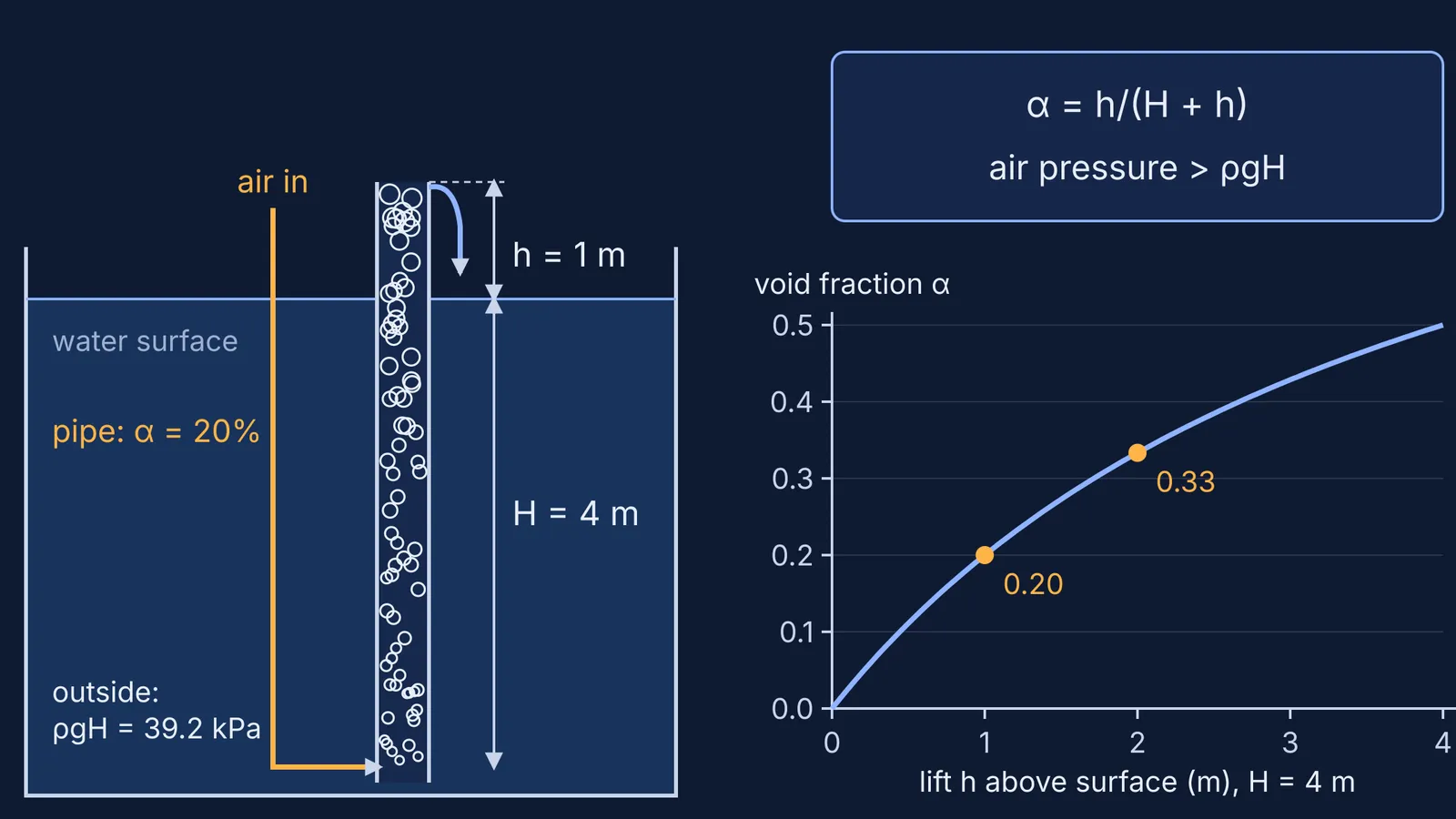
A vertical pipe (the riser) stands in a tank, bottom open, top above the water surface. Air blown in near the bottom fills the pipe with bubbly water, while the water around it has no bubbles.
The bubbles do not carry the water up like a lift. They make the mixture inside the pipe lighter than the water outside. At the bottom of the pipe, the pressure from the outside water is larger than the weight per unit area of the light column inside. That pressure difference pushes the mixture up, and if the mixture is light enough it overflows from the top.
It is the same balance as a U-tube with two liquids of different density, where the lighter liquid stands taller. The airlift makes its lighter liquid on demand.
How much air must be in the pipe to lift water?
Call the depth of the air inlet below the water surface H (the submergence), and the height of the pipe outlet above the surface h (the lift). Write α for the fraction of the pipe's volume taken up by air, the void fraction. The mixture then has density ρ_mix = (1 − α)ρ, where ρ is the density of water.
At the level of the inlet, the outside water gives a gauge pressure ρgH. The inside column reaches all the way to the outlet, a height H + h, so it gives ρ_mix g(H + h). Water just reaches the outlet when these are equal:
ρ_mix g(H + h) = ρgH, so (1 − α)(H + h) = H, so α = h/(H + h)
Two things follow at once.
The void fraction depends on the ratio of lift to pipe length, not on the pipe's width.
For a fixed lift, a shallow pipe needs much more air. With h = 1 m, H = 1 m needs α = 0.5, and H = 0.25 m needs α = 0.8. As H shrinks toward zero, α heads to 1 and the pump stops working. Engineers describe this with the submergence ratio H/(H + h).
Worked example: a pipe sunk 4 m that discharges 1 m above the surface
Take H = 4 m, h = 1 m, ρ = 1000 kg/m³, g = 9.8 m/s², atmospheric pressure p₀ = 101.3 kPa. Assume no friction and no slip, meaning the bubbles move up at the same speed as the water.
Void fraction. α = h/(H + h) = 1/5 = 0.20. A fifth of the column, on average, must be air. The submergence ratio is 4/5 = 0.8.
Air pressure needed. The air must enter against the outside water: ρgH = 1000 × 9.8 × 4 = 39.2 kPa gauge, whatever the lift. Any less and no air gets in.
Absolute pressure at the inlet. p₁ = 101.3 + 39.2 = 140.5 kPa, which is 1.39 atm.
Air flow (Boyle's law). Bubbles grow as they rise, because the pressure falls. Integrating the pressure balance up the pipe with pV constant gives a simple result: for each cubic metre of water lifted, the free air needed (measured at atmospheric pressure) is V₀ = ρgh/[p₀ ln(p₁/p₀)] = 9800/(101 325 × 0.327) = 0.296 m³.
Bubbles grow on the way up. At the inlet that air is squeezed to 0.296/1.39 = 0.213 m³, so the local void fraction is 0.213/1.213 = 17.6%. At the outlet it is 0.296/1.296 = 22.8%. The average over the height is exactly 20%, as step 1 demanded.
Energy check. Compressing 0.296 m³ of air isothermally from p₀ to p₁ takes p₀V₀ ln(p₁/p₀) = 9.8 kJ. Lifting 1 m³ (1000 kg) of water by 1 m takes mgh = 9.8 kJ. They are equal: the ideal airlift wastes nothing.
A bigger lift. Raising the outlet to h = 2 m from the same depth needs α = 2/6 = 0.33 and 0.591 m³ of free air per cubic metre of water, twice as much. The inlet pressure is still 39.2 kPa gauge.
The growing bubble in step 5 is the same Boyle's law sum as in an air bubble that doubles in volume as it rises through a lake, applied to a whole stream of bubbles.
Why are real airlift pumps much less efficient?
The 100% in step 6 is an ideal-model result, not a real figure. Real pumps lose energy in three main ways.
Slip. Bubbles rise through water on their own, so the air moves faster than the water. For the same void fraction you must push more air through the pipe, and that extra air does no lifting.
Flow pattern. Small scattered bubbles merge into long slugs as air flow rises, then into a churning froth. Each pattern slips differently.
Friction and exit losses. The mixture rubs on the pipe wall and leaves the top still moving.
In one laboratory study of a 2 m riser, published in FME Transactions in 2020, the highest efficiency was about 19%, reached at the largest submergence ratio they tested, 0.3, in the slug and slug-churn flow patterns (Fayyadh, Mahdi and Mohammed, 2020). An earlier study found that efficiency rises as the submergence ratio rises, that a wider riser does better, and that the maximum efficiency came in slug flow (Awari, Bhuyar and Wakde, 2007). Both fit the simple model: deep submergence helps.
Where are airlift pumps used?
An airlift has no moving parts in the water, so sand and sludge pass through without jamming anything.
Aquarium filters. An undergravel filter uses an air stone at the bottom of a tube to draw water down through the gravel and up the tube.
Wastewater treatment. Airlifts move sludge and slurries that would clog or wear a pump with spinning blades.
For a motorless pump driven by falling water instead of air, see how a hydraulic ram pump lifts water 20 m.
To see the pressure balance change as you vary H, h and α, try the interactive fluids models in the Simulation Lab.
What mistakes cost marks on airlift problems?
Saying the bubbles drag the water up. The column rises because it is lighter than the water around it.
Writing the inside column as height H. The mixture fills the pipe to the outlet, so its height is H + h.
Thinking a higher air pressure lifts water higher. Pressure only needs to exceed ρgH; the lift depends on how much air goes in.
Quick checklist
Pressure balance at the inlet: (1 − α)(H + h) = H, so α = h/(H + h).
Air supply pressure must exceed ρgH (39.2 kPa gauge for H = 4 m).
Free air per cubic metre of water: ρgh/[p₀ ln(p₁/p₀)], about 0.3 m³ for the 4 m, 1 m case.
Bubbles grow on the way up, so the void fraction is lower at the bottom than the top.
Real airlifts lose energy to slip and friction; ideal efficiency is 100%, measured peaks are far lower.