

On this page
Picture a farm on a hillside with a stream at the bottom of the slope and a tank on the ridge 20 m above. There is no grid power and no fuel. A hydraulic ram pump, or hydram, can still fill that tank, day and night, using only the stream. It does not break energy conservation. It lets a lot of water fall a little way so that a little water can be pushed a long way up.
How does a hydraulic ram pump work without a motor?
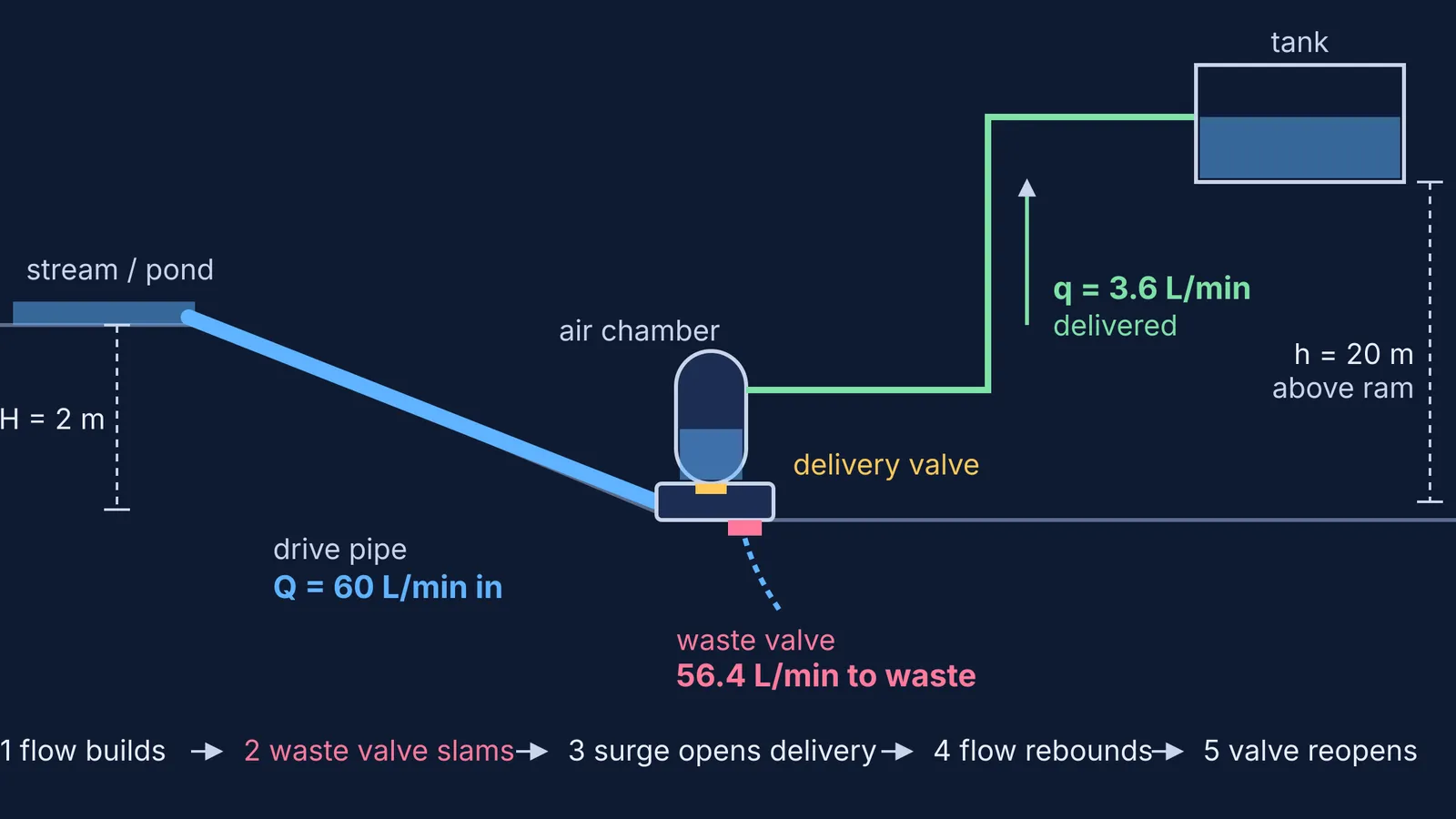
A hydram has a drive pipe, two one-way valves and an air chamber. Water from the stream runs down the drive pipe into the pump body. The cycle then repeats on its own:
Flow builds. The waste valve is open. Water rushes down the drive pipe and out of it, speeding up.
The waste valve slams. Once the flow is fast enough, the drag of the moving water pushes the waste valve shut.
The surge opens the delivery valve. A whole column of water is stopped almost at once. Its momentum has to go somewhere, so the pressure in the pump spikes. This is water hammer, the same effect that makes household pipes bang. The spike forces open the delivery valve and pushes a small slug of water into the air chamber and up the delivery pipe.
The flow rebounds. The pressure wave reflects back up the drive pipe, the pressure in the pump drops, and the delivery valve closes.
The waste valve reopens under its own weight or a spring, and the cycle restarts.
The physics of step 3, including the Joukowsky surge Δp = ρcv, is worked out in why water pipes bang when a tap is shut fast, so it is not repeated here. What matters for the pump is that the surge is a short peak, large enough to beat the steady pressure in the delivery pipe for a moment.
Where does the energy to lift the water come from?
From the water that falls down the drive pipe and leaves through the waste valve. Every cycle, a large mass of water drops through the small height H (stream to pump). A small part of it is lifted through the large height h (pump to tank). The rest flows away.
So the energy balance per second is:
Power in = ρgQH, where Q is the drive flow.
Power out = ρgqh, where q is the delivered flow.
Efficiency η = qh / QH, so q = ηQH / h.
Because η is always less than 1, qh is always less than QH. The ram trades flow for height; it never makes energy.
How much water does a ram pump deliver? A worked example
A stream supplies a drive flow Q = 60 L/min down a pipe with a fall H = 2 m to the pump. The tank is h = 20 m above the pump. Take η = 0.6.
Write the energy balance. q = ηQH / h.
Substitute. q = 0.6 × 60 L/min × 2 m / 20 m = 3.6 L/min.
Per day. 3.6 L/min × 1440 min = 5,184 L, about 5,200 L a day.
Waste flow. 60 − 3.6 = 56.4 L/min goes back to the stream.
Check with power. Q = 60 L/min = 0.001 m³/s. Power in = 1000 × 9.81 × 0.001 × 2 = 19.6 W. q = 6.0 × 10⁻⁵ m³/s. Power out = 1000 × 9.81 × 6.0 × 10⁻⁵ × 20 = 11.8 W. And 11.8 / 19.6 = 0.60, as it should be.
Units. L/min × m / m leaves L/min, so the formula is dimensionally right.
About 12 W out sounds tiny, but it runs all day, every day.
Why does a higher tank mean less water?
With Q, H and η fixed, q = ηQH / h, so q ∝ 1/h. Halve the lift to h = 10 m and the delivery doubles to 7.2 L/min. Double it to 40 m and you get 1.8 L/min.
Even a perfect ram (η = 1) could lift only QH / h = 60 × 2 / 20 = 6 L/min to 20 m. That is the ceiling set by energy conservation, and it is worth checking against any claim you read.
In practice η also falls as the lift ratio h/H grows. A paper in Drinking Water Engineering and Science (Manohar and others, 2019) quotes about 60% as typical for commercial rams, with up to 80% possible. Their own small test pump averaged 26% at a lift of 2 times the drive head, 16.6% at 4 times and 6.4% at 6 times. Our example has a lift ratio of 10, so treat η = 0.6 as an optimistic, well-made pump. At η = 0.3 the same stream would deliver 1.8 L/min. Some books also measure the lift from the stream instead of from the pump (Rankine's definition), so quoted efficiencies are not always comparable.
The same paper credits John Whitehurst with a hand-operated ram in the 1770s, and the Montgolfier brothers with the first automatic ram in the 1790s.
What does the air chamber do?
Water is nearly incompressible. Without the air chamber, every surge would slam straight into the delivery pipe, which then takes the shocks. The air chamber holds a pocket of trapped air above the water. Each surge squeezes the air a little; between surges the air expands and keeps pushing water up the pipe. Delivery becomes steadier, and the pump sees gentler pressure swings.
The air slowly dissolves into the water under pressure, so rams use a small snifter valve to let air back in; the same paper credits Pierre Montgolfier with this valve.
When does a ram pump make sense?
You need a reliable fall: a stream or spring that gives a steady drive head.
The stream must be able to spare the waste water. Most of the flow passes through the pump and returns downstream.
The demand is steady and modest: a tank, a trough, a garden.
There is no power at the site. A ram's only moving parts are its two valves, and it needs no fuel.
Compare this with lifting the same water with an electric motor, worked out in pump power for lifting water to a rooftop tank. The motor pump delivers far more water per minute, but someone pays for the electricity. Why no machine, ram or motor, gets past 100% is covered in why a machine's efficiency is always less than 100%.
If you want to practise energy-balance problems like this one, the Fermi Problem Library has a step-by-step solver that explains the reasoning at each stage.
Quick checklist
A hydram uses water hammer: stopping a moving column of water gives a short pressure surge.
Energy balance: q·h = η·Q·H, so q = ηQH / h.
60 L/min falling 2 m, lifted 20 m at η = 0.6: 3.6 L/min, about 5,200 L a day.
Delivery is inversely proportional to lift: q ∝ 1/h.
η = 1 sets the ceiling (6 L/min here); real η falls as h/H rises.
The air chamber smooths delivery and protects the pump from shocks.


