

On this page
Push a trolley up a ramp or hoist a bucket with a pulley, and a little of your effort always slips away as heat, sound and wear. That missing bit is why efficiency is always below 100 percent, and why it is worth understanding rather than memorising for Class 11 and JEE Main.
What is the efficiency of a machine?
Efficiency is useful work or energy out divided by total energy in, written η = W_out / E_in (OpenStax College Physics). Multiply by 100 for a percentage. It has no unit, because it is a ratio of two energies.
Real machines vary: the same OpenStax table lists a gasoline engine at about 30%, a diesel engine at 35%, a coal power plant at 42% and an electric motor at 98% (OpenStax). Even the best of them stops short of 100.
Why is the efficiency of a machine always less than 100 percent?
Two ideas work together.
Energy is conserved. Total energy is constant in any process: it may change form or move from one system to another, but the total stays the same (OpenStax, conservation of energy). So output can at most equal input. OpenStax puts it plainly in its chapter on simple machines: "a machine cannot do more work than the energy put into it" (OpenStax, simple machines).
Some energy always leaks out. Wherever surfaces rub (axles, gear teeth, a rope over a pulley), friction turns part of the input into thermal energy. Add air drag, sound and electrical resistance. That energy is not destroyed; it ends up in a form you cannot fully gather back.
For heat engines, the second law makes this strict. It is impossible for heat from a reservoir to convert completely into work in a cycle, and 100% efficiency would need zero heat passed to the surroundings (OpenStax, second law).
So 100% is the frictionless ideal of textbook diagrams, and more than 100% is ruled out altogether.
Where does the missing energy go? A worked example
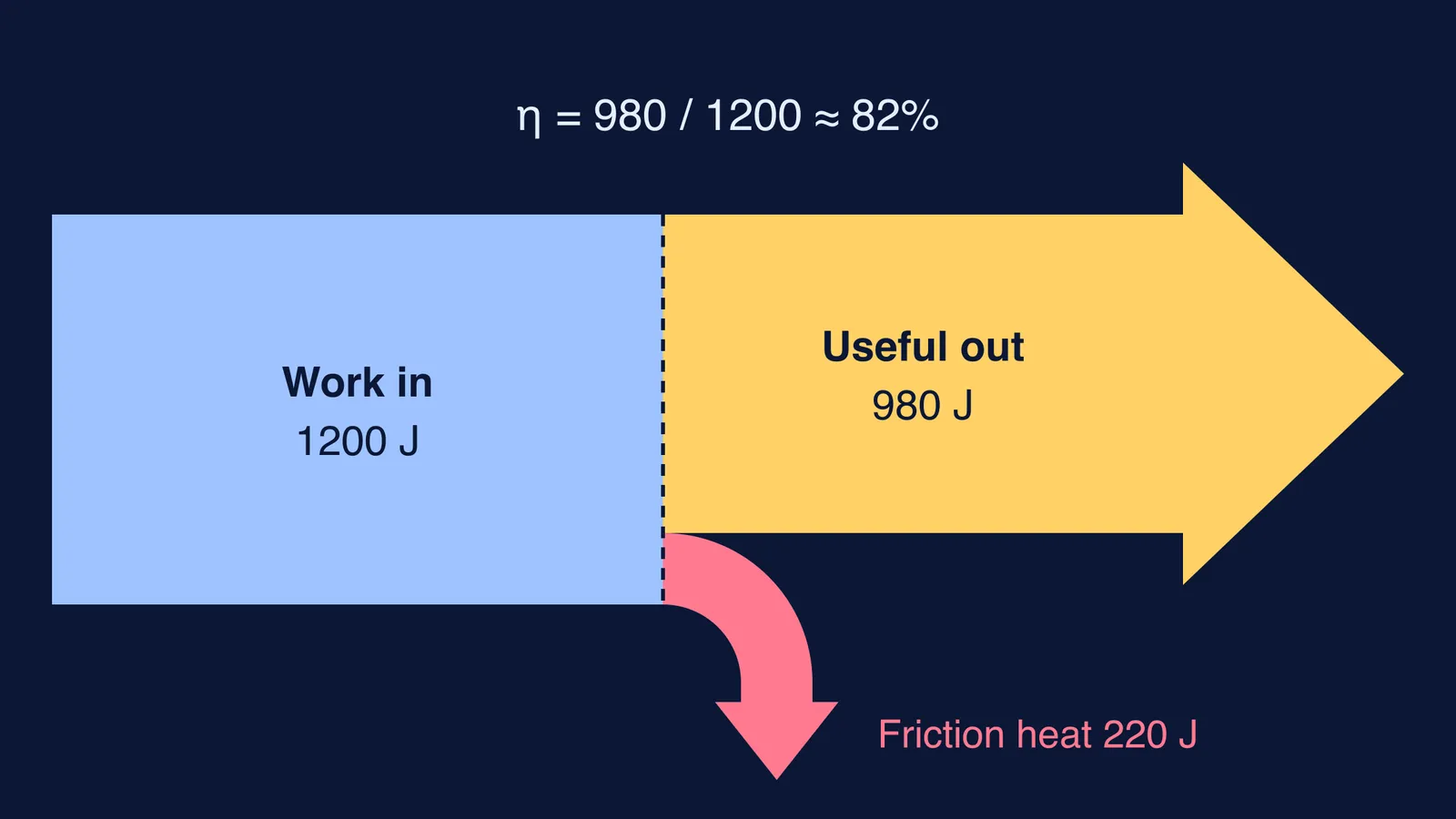
Rahul pushes a 50 kg sack of rice up a 4 m ramp onto a platform 2 m high, with a steady force of 300 N along the ramp. Take g = 9.8 m/s².
Work in = force × distance along the ramp = 300 N × 4 m = 1200 J.
Useful work out = gain in potential energy = mgh = 50 × 9.8 × 2 = 980 J.
Efficiency = 980 / 1200 ≈ 0.82, or about 82%.
Energy lost = 1200 − 980 = 220 J, which went into warming the sack and the ramp through friction.
Step 4 is a built-in check: the loss must come out positive. If your working ever gives a negative loss, you have a sign or unit slip, not a discovery. Our post on efficiency of an inclined plane with friction works through more versions, and mechanical advantage in pulley systems shows the force-for-distance trade.
If a step like this trips you up, the Fermi Problem Library has worked problems with a step-by-step solver that explains the reasoning rather than printing an answer.
What would efficiency above 100 percent break?
Imagine Rahul's ramp somehow returned 1300 J for every 1200 J he put in. Now connect the output back to the input. Each cycle, the machine pays for itself and has 100 J to spare. Let it run and you get unlimited energy from nothing: a perpetual motion machine.
That breaks conservation of energy, and with it the energy bookkeeping behind almost every mechanics problem you solve. The US Patent and Trademark Office's examination manual lists a perpetual motion machine among the cases where courts upheld a rejection because the invention's claimed usefulness was not credible (USPTO MPEP 2107).
Do ACs and heat pumps beat 100 percent?
An AC, fridge or heat pump can move more heat than the electrical energy it uses, and nothing breaks. The US Department of Energy explains that heat pumps move heat from one place to another using electricity, with ACs and refrigerators as common examples (US DOE). Because they "transfer — rather than generate — heat" (US DOE), the extra heat is moved in from outside air or the ground, not created. That is why these devices are rated by a coefficient of performance (COP), not an efficiency. See why a refrigerator's COP depends on the temperature gap.
A 60-second checklist for efficiency questions
Write energy in and useful energy out in the same unit, joules or watts.
For work in, use the distance the force actually moves through, not the height gained.
Check that η lies between 0 and 1 before turning it into a percentage.
Name where the losses went: friction, drag, sound or resistance.
For fridges, ACs and heat pumps, switch to COP.
If the idea of energy conservation itself still feels shaky, the Fermi Concept Library gives every physics concept its own lesson and its place in the map.


