

On this page
An inclined plane makes lifting heavy objects easier by spreading the required work over a longer distance. But as you push a block up a ramp, you don't just work against gravity—you also work against friction.
Because friction dissipates some of your input energy as heat, the useful work you get out is always less than the total work you put in. The ratio of this useful work to your total effort is the plane's efficiency.
How do you find the efficiency of an inclined plane?
In physics, efficiency (η) is defined as the ratio of useful work output to total work input (Wikipedia).
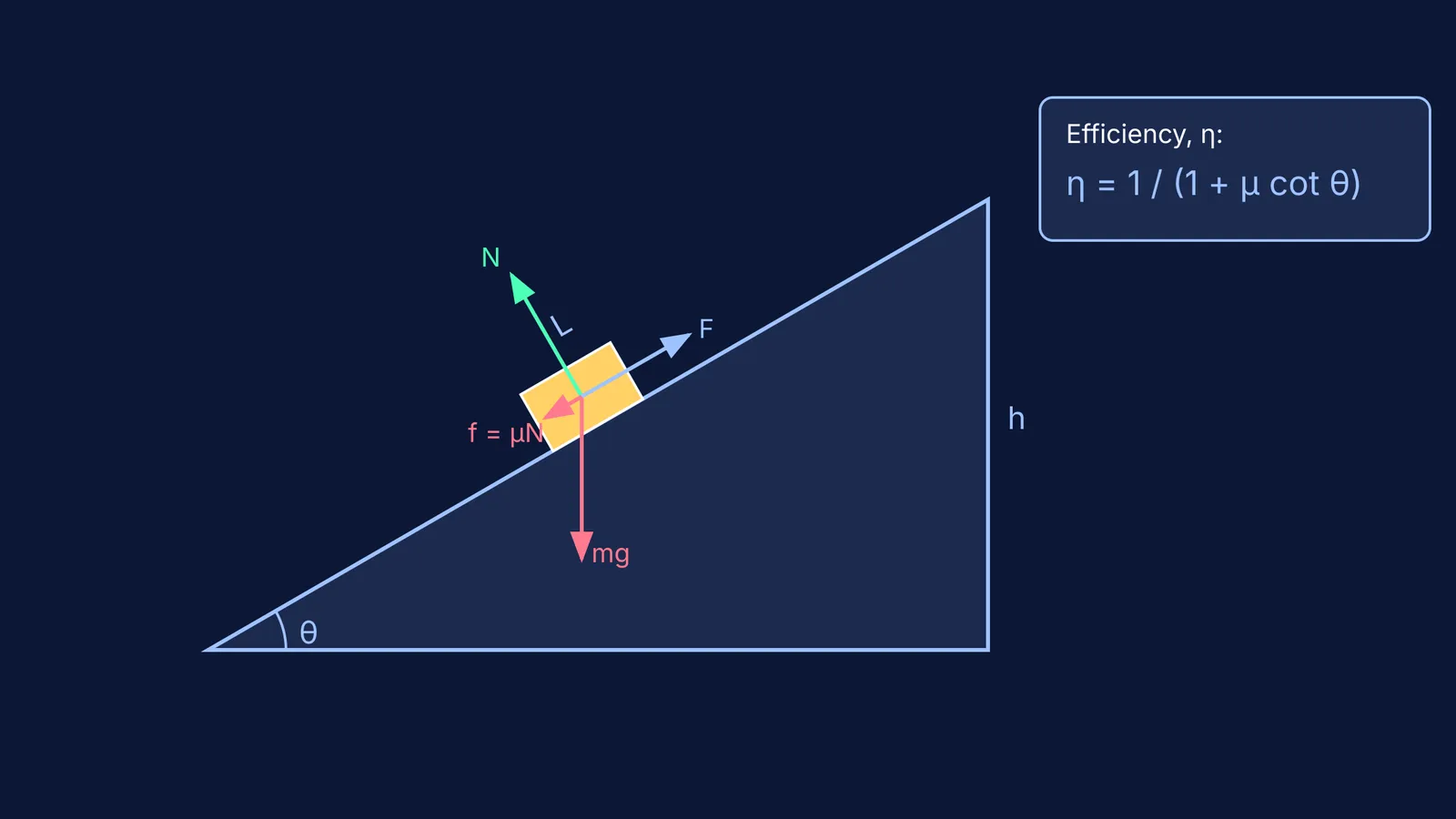
To find it, imagine pushing a block of mass m up a ramp of length L that rises to a height h, inclined at an angle θ. (If you are watching the block slide down under its own weight instead, the setup is similar; see our worked example on the time for a block to slide down a rough incline).
The useful work done is simply the energy gained by lifting the block straight up:
Work output = mgh
To move the block up the ramp, you must apply a force F to overcome both the downhill pull of gravity and the force of friction.
Downhill gravity component = mg sin θ
Friction = μ mg cos θ (where μ is the coefficient of kinetic friction)
Because you apply this combined force over the full length L, the total energy you spend is:
Work input = (mg sin θ + μ mg cos θ) L
The efficiency is therefore: η = mgh / ((mg sin θ + μ mg cos θ) L)
Because the height h and the length L are related by a right-angled triangle (h = L sin θ), we can substitute L sin θ for h: η = (mg L sin θ) / (mg L (sin θ + μ cos θ))
Cancelling out mg and L leaves: η = sin θ / (sin θ + μ cos θ)
Dividing the top and bottom by sin θ gives the standard formula: η = 1 / (1 + μ cot θ)
Why does efficiency fall on a shallower slope?
A shallow slope requires less pushing force, which is the whole point of a ramp. But it is much less efficient. As θ gets smaller, the cotangent (cot θ) becomes very large, making the denominator (1 + μ cot θ) large, which drives the efficiency down.
Here is why that happens physically:
Higher normal force: On a shallow slope, the block presses harder into the surface. The normal force (mg cos θ) is close to its maximum, meaning the friction force (μ N) is also large. This relationship is why the angle of repose and angle of friction are closely connected.
Longer pushing distance: To reach the same vertical height, a shallow slope requires you to push over a much longer path.
Because you fight high friction over a long distance, the wasted work becomes massive compared to the useful work (mgh).
Mechanical advantage vs efficiency
The Ideal Mechanical Advantage (IMA) tells you how much the machine multiplies your force without friction (IMA = 1 / sin θ). A shallower slope gives a higher IMA, but because it extends the distance over which friction acts, it lowers the efficiency.
If you are struggling to picture how these effects balance out, the Fermi Concept Library has a lesson for every concept in physics, chemistry and mathematics, each with its place in the map.
Worked example: Pushing a box up a ramp
Suppose you need to lift a 50 kg box up a 1 m high ramp that is 5 m long (sin θ = 1/5 = 0.2). The coefficient of kinetic friction μ is 0.3.
1. Useful work output You lift the box 1 m against gravity (g = 9.8 m/s²). Work output = mgh = 50 × 9.8 × 1 = 490 Joules
2. Total work input First, find cos θ. If sin θ = 0.2, then cos θ ≈ 0.98.
Downhill gravity force = mg sin θ = 98 N
Friction force = μ mg cos θ = 0.3 × (50 × 9.8 × 0.98) = 144.1 N
Your applied force is 98 + 144.1 = 242.1 N. Over 5 m, the total work input is 242.1 × 5 = 1210.5 Joules.
3. Efficiency η = 490 / 1210.5 ≈ 0.405 (or 40.5%)
Over half of your energy (720.5 Joules) is wasted scraping the box against the wood.
How can you improve a ramp's efficiency?
Since efficiency depends only on θ and μ, there are two ways to improve it:
Reduce friction: Polishing the surfaces, using lubricants, or adding wheels dramatically lowers μ, pushing efficiency closer to 100%.
Steepen the slope: A steeper angle reduces the normal force and shortens the path, cutting the total work wasted on friction. The trade-off is that you need more raw force to push the object up.


