On this page
Stand at the foot of the El Castillo pyramid at Chichén Itzá in Mexico, clap once, and what comes back is not a single echo but a short chirp that slides downwards in pitch. The physics behind it is a JEE and NEET waves idea you already know, path difference, applied to a staircase. Each step sends back its own small echo, the echoes arrive in a steady stream, and the stream is heard as a tone whose pitch changes as you look higher up the stairs.
Why does a clap in front of steps come back as a tone?
A single clap is a sharp pulse. It hits every step on the staircase, and each step edge reflects a little of it back to you. The echo from a step that is farther away arrives later.
If the extra distance to the next step is Δr, the sound has to cover it twice, going and coming back. So neighbouring echoes arrive Δt = 2Δr/c apart, where c is the speed of sound. Clicks spaced Δt apart reach your ear as a buzz with frequency
f = 1/Δt = c/2Δr.
Your ear turns any regular train of clicks into a pitch; acousticians call this repetition pitch. It is the same reason evenly spaced grooves give a hum, which is covered for a moving tyre in why a rumble strip's hum is speed divided by spacing. The difference here is that nothing moves: the spacing in time comes from the spacing of the steps in space. A single reflection from one wall, and why it needs about 17 m to be heard separately, is in minimum distance for an echo.
Why does the pitch fall during the echo?
Δr is not simply the depth of a step. Each step moves the reflecting edge by a tread t forwards and a riser h upwards. The extra distance you see is the part of that step vector along your line of sight. If the line from your ear to the step rises at an angle θ above the horizontal, then, roughly,
Δr ≈ t cos θ + h sin θ.
Bottom steps first. The lowest steps are below your ears, so θ is slightly negative and Δr is a bit less than t. The echoes come close together and the pitch is high.
Higher steps later. Echoes from higher steps arrive later, and θ grows. Δr grows towards the full step diagonal √(t² + h²), so the echoes spread out and the pitch falls.
That is the chirp: a falling tone, because time and viewing angle increase together as the echo climbs the stair.
Worked example: the chirp from a 91-step staircase
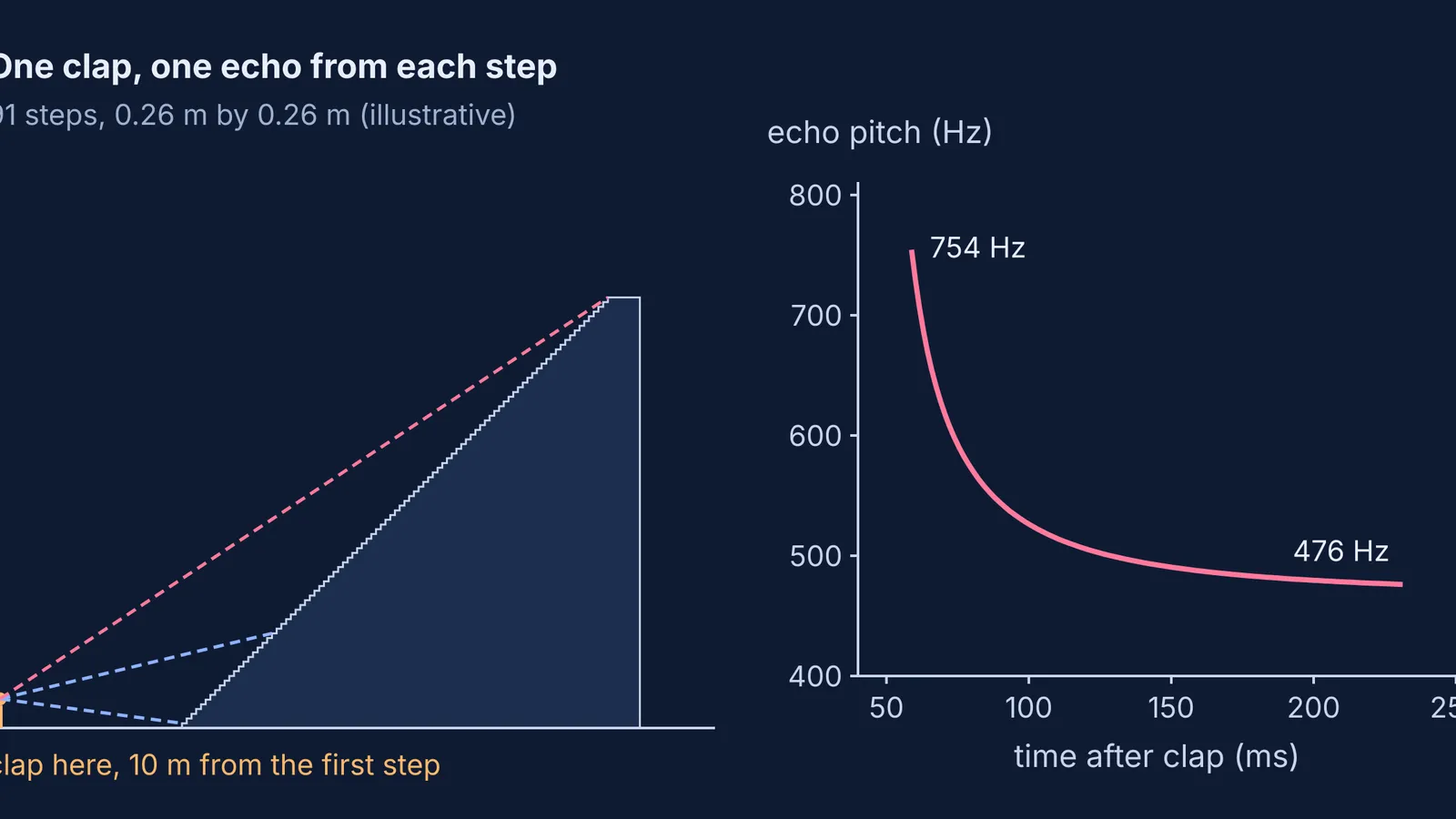
The pyramid has about 91 steps on each side and is about 24 m high (Nature news, 2004). Its exact step size is not given in the sources we checked, so take round illustrative values: tread t = 0.26 m and riser h = 0.26 m (91 × 0.26 ≈ 23.7 m, close to the height). You stand 10 m from the bottom step with your ears 1.6 m above the ground. Use c = 343 m/s, and model each step edge as a point reflector.
First echo. The first step edge is 10 m away and 0.26 m up. r₁ = √(10² + (0.26 − 1.6)²) = 10.09 m. Echo delay = 2 × 10.09/343 = 0.0588 s, about 59 ms.
Second step. It is 10.26 m away and 0.52 m up, so r₂ = 10.32 m. Δr = r₂ − r₁ = 0.227 m, so f = 343/(2 × 0.227) ≈ 754 Hz.
Step 10. r₁₀ = 12.38 m (delay 72 ms) and the gap to step 11 is 0.282 m, so f ≈ 607 Hz.
Step 40. r₄₀ = 21.98 m (delay 128 ms), gap 0.343 m, f ≈ 500 Hz.
Top step. r₉₁ = 40.03 m (delay 233 ms), gap 0.360 m, f ≈ 476 Hz.
Length of the chirp. It runs from 59 ms to 233 ms, about 175 ms, while the pitch falls from about 750 Hz to about 480 Hz.
Check the limits. Very far away, θ → 0 and Δr → t, so f → 343/(2 × 0.26) ≈ 660 Hz. Looking straight up the slope, Δr → √(0.26² + 0.26²) = 0.368 m, so f → 466 Hz. All our values above 660 Hz come from steps below ear level, and the top of the chirp stays above 466 Hz, as it should.
These numbers are close to a published model. Frans Bilsen treated the echo as exactly this sequence of reflections and predicted a pitch falling from about 796 Hz to 471 Hz over about 177 ms (J. Acoust. Soc. Am., 2006). The small differences come from where the listener stands and the step size assumed.
Did the Maya design the pyramid to chirp?
Nobody knows. The acoustic consultant David Lubman drew attention to the chirp in 1998 and argued that it resembles the call of the quetzal, a bird sacred in Maya culture. He described his acoustic argument as something that "may suggest, but does not and cannot prove intent by its ancient designers".
Nico Declercq and colleagues modelled the staircase in J. Acoust. Soc. Am. (2004) and reproduced the main features of the echo. According to Nature's report on that work, Declercq became sceptical of the quetzal idea, since staircases at other sites give similar effects, and the report notes that it will be virtually impossible to prove that any echo effect was intended. The scientists also disagree on which model fits: Declercq's team used diffraction from the steps as a grating, while Bilsen argued that a simple sequence of reflections explains the falling pitch better.
So the physics is solid, and the chirp is real and easy to hear. Whether it was planned is still an open question.
Can you hear the same effect elsewhere?
Any long, even flight of steps or seating will do it, as long as there is open space in front so that one clap is not swamped by other echoes. Because f = c/2Δr, deeper steps give lower tones. Stadium terraces about 0.8 m deep give at most 343/(2 × 0.8) ≈ 214 Hz, a low hum rather than a chirp. Repeated echoes from a curved surface are a different effect, explained in how the Gol Gumbaz whispering gallery works.
Real steps are not point reflectors. Sound also diffracts around each edge, so the real chirp is broader and rougher than the model. The frequencies also change with where you stand and with the air temperature, through c.
If you want more echo and path-difference problems worked through, the Fermi Problem Library has a step-by-step solver that explains the reasoning at each stage.
Quick checklist
Each step reflects a small echo; neighbouring echoes arrive Δt = 2Δr/c apart.
A regular stream of echoes is heard as a tone f = c/2Δr.
Δr ≈ t cos θ + h sin θ grows as you look higher, so the pitch falls.
Illustrative 0.26 m steps, 10 m away: about 750 Hz falling to 480 Hz over about 175 ms.
The limits are c/2t (far away) and c/2√(t² + h²) (looking up the slope).
Whether the Maya intended the chirp is unproven; present it as a claim, not a fact.