On this page
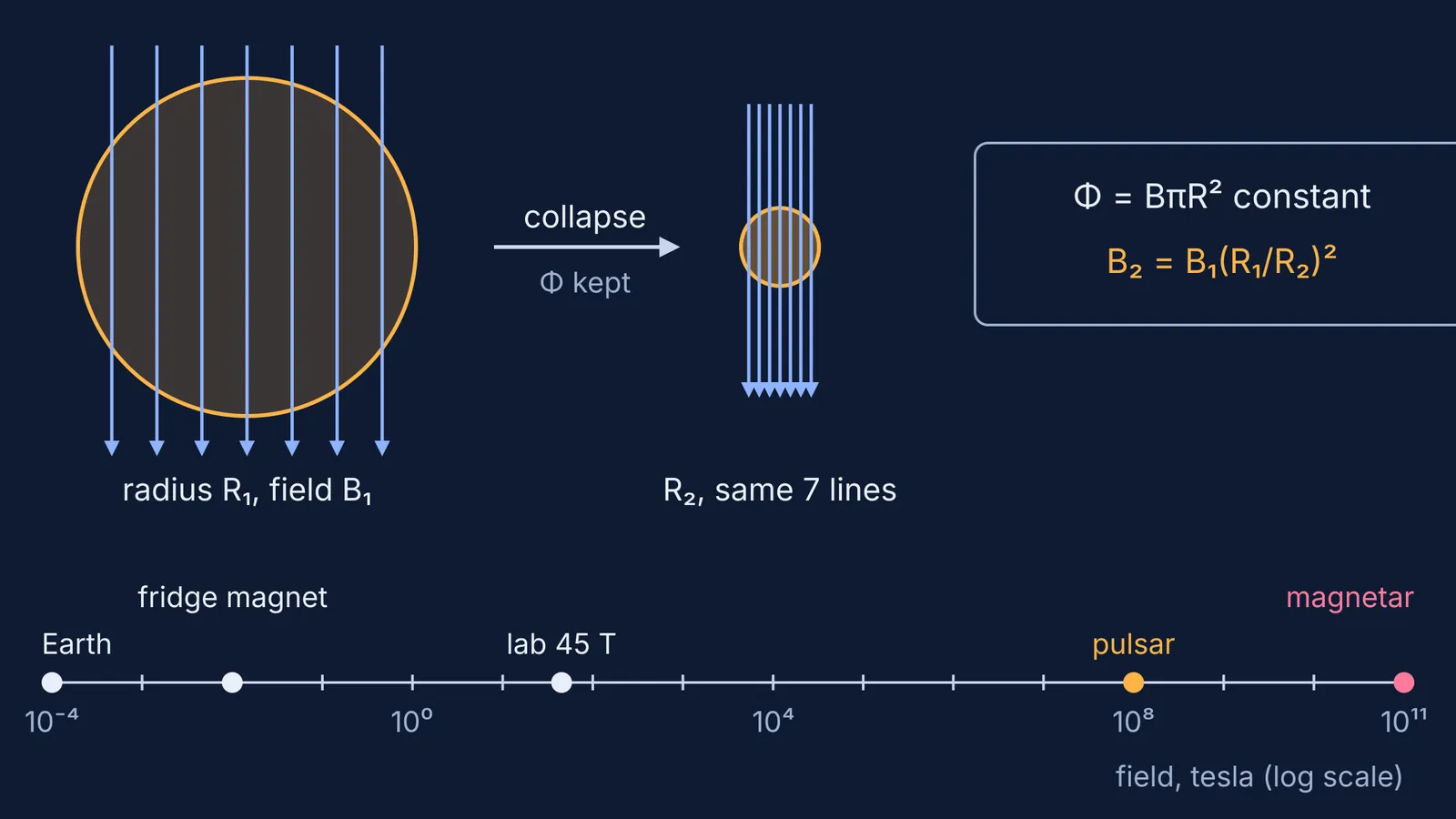
A fridge magnet is about 0.01 T. The strongest steady magnets in laboratories reach about 45 T. A typical neutron star has a field of around 10⁸ T, and magnetars go a thousand times higher. Nothing we build comes close. Yet the main reason for these fields fits in one line of Class 12 physics: when a star collapses, it keeps its magnetic flux, so its field grows as the inverse square of its radius. This post works that out with numbers, shows where the simple picture breaks, and checks the result against what astronomers report.
How strong is a neutron star's magnetic field?
Astronomers usually quote these fields in gauss, where 1 T = 10⁴ G. NASA's Imagine the Universe page says that in a typical neutron star the field is "trillions of times that of the Earth's magnetic field" and that a magnetar's is "another 1000 times stronger". The same page gives the size: about 20 km across, so a radius of about 10 km.
Turn that into tesla. Earth's field is about 1 G, or 10⁻⁴ T (NASA's Chandra team uses this round value and gives a fridge magnet as about 100 G, here). A trillion times that is 10¹² G, or 10⁸ T. The same Chandra page puts magnetars at "about a million billion Gauss", which is 10¹⁵ G or 10¹¹ T.
Keep the units straight, because exam questions and articles mix them:
10⁸ T = 10¹² G (typical pulsar)
10¹¹ T = 10¹⁵ G (magnetar)
For comparison, the 45 T hybrid magnet at the US National High Magnetic Field Laboratory has held the record for a steady field since 1999.
Why is magnetic flux conserved when a star collapses?
Magnetic flux through a surface is Φ = BA. The difference between B and Φ is covered in magnetic field versus magnetic flux; here we only need the idea that Φ counts the field lines passing through.
The gas inside a star is a plasma: hot, ionised, and an extremely good conductor. Faraday's law says that if the flux through a loop of conductor tried to change, an emf would drive a current to oppose the change (Lenz's law). In a perfect conductor this current meets no resistance, so the flux through any loop moving with the material cannot change at all. Astronomers say the field lines are "frozen in" to the plasma. Squeeze the plasma and you squeeze the field lines together with it.
So as a star's core shrinks from radius R₁ to R₂, the flux through its cross-section stays the same:
B₁ × πR₁² = B₂ × πR₂²
B₂ = B₁ (R₁/R₂)²
Halve the radius and the field goes up four times. Shrink it by a factor of 70,000 and the field goes up by 70,000², nearly five billion.
Worked example: shrinking a Sun-sized star to 10 km
Take a star with the Sun's radius, R₁ = 7 × 10⁸ m. The weak background field on the Sun's surface is "a gauss or so", according to NASA's Scientific Visualization Studio, so take B₁ = 10⁻⁴ T as a round value.
Ratio of radii. R₁/R₂ = 7 × 10⁸ / 10⁴ = 7 × 10⁴.
Square it. (7 × 10⁴)² = 4.9 × 10⁹.
New field. B₂ = 10⁻⁴ × 4.9 × 10⁹ = 4.9 × 10⁵ T.
Check the flux. Φ = 10⁻⁴ × π × (7 × 10⁸)² ≈ 1.5 × 10¹⁴ Wb before, and 4.9 × 10⁵ × π × (10⁴)² ≈ 1.5 × 10¹⁴ Wb after. Same, as it should be.
That is already ten thousand times the strongest lab magnet, but still a few hundred times short of 10⁸ T. Now try a round illustrative starting value of 10⁻² T (100 G): B₂ = 10⁻² × 4.9 × 10⁹ = 4.9 × 10⁷ T, within a factor of two of a typical pulsar.
Shrink the same star only to a white dwarf's radius of about 7,000 km. Now the ratio is 100, the square is 10⁴, and the field becomes 1 T to 100 T for the two starting values. The neutron star, with a radius 700 times smaller still, gains another factor of about 490,000.
Does the same collapse make the star spin faster?
Yes, by the same square law. Angular momentum L = Iω is conserved, and for a sphere I ∝ MR², so ω ∝ 1/R². This is the skater pulling in her arms, explained with a chair test in why a skater spins faster when pulling arms in.
The Sun turns once in about 25 days, which is 2.16 × 10⁶ s. Divide by 4.9 × 10⁹ and the period becomes 4.4 × 10⁻⁴ s, or 0.44 ms. Real stars lose angular momentum on the way, so treat this as an upper limit on the spin, but it shows why neutron stars can turn many times a second. A spinning magnet this strong sweeps beams of radiation round the sky, which is why we see these stars as pulsars.
How much energy is stored in such a field?
The energy density of a magnetic field is u = B²/2μ₀. At B = 10⁸ T:
u = (10⁸)² / (2 × 4π × 10⁻⁷) ≈ 4.0 × 10²¹ J/m³
By E = mc², energy has mass. Dividing by c² = 9.0 × 10¹⁶ m²/s² gives about 4.4 × 10⁴ kg/m³. Every cubic metre of empty space near the star holds about 44 tonnes' worth of energy in its magnetic field alone, nearly four times the density of lead (about 11,300 kg/m³).
Where does this simple picture break down?
Flux conservation explains why the fields are huge, but it is an order-of-magnitude argument, not a prediction. Be clear about four points.
Only the core collapses. A neutron star forms from the collapsing iron core of a massive star, which is far smaller than the whole star. The outer layers are thrown off. How this happens is the story of Fritz Zwicky and his idea of neutron stars. Using the whole Sun's radius, as we did, is a simplification.
The starting field is not known. Nobody can measure the field inside a core before it collapses, so B₁ is a guess.
Magnetars need more. NASA's magnetar history page describes the proposal by Duncan and Thompson that a dynamo in a rapidly spinning newborn neutron star builds the field up further. Flux conservation alone does not reach 10¹¹ T.
Pulsar fields are inferred, not measured directly. The same page explains that the field is estimated from how fast the spin is and how fast it is slowing: a stronger field brakes the star harder.
For more practice on flux, Faraday's law and Lenz's law, the Fermi Concept Library covers each idea from the basics.
Quick checklist
Φ = BA; in a highly conducting plasma, field lines are frozen in and Φ stays constant.
B₂ = B₁(R₁/R₂)², so the field scales as 1/R².
Sun-sized star to 10 km: factor 4.9 × 10⁹; 10⁻⁴ T becomes 4.9 × 10⁵ T, 10⁻² T becomes 4.9 × 10⁷ T.
Typical pulsar about 10⁸ T (10¹² G); magnetar about 10¹¹ T (10¹⁵ G).
Spin scales the same way: ω ∝ 1/R².
Energy density B²/2μ₀ is about 4 × 10²¹ J/m³ at 10⁸ T.