

On this page
A neutron star packs more mass than the Sun into a ball about the size of a city. Today it is textbook astronomy. In 1934, two years after the neutron itself was discovered, it was a guess made in a few lines at the end of a short paper. The guess came from Walter Baade and Fritz Zwicky, and it was right. This post covers what they saw, how they reasoned, the numbers behind their claim, and what Zwicky's unusual way of thinking can teach you.
Who was Fritz Zwicky?
The MacTutor biography from the University of St Andrews gives his dates as 14 February 1898 in Varna, Bulgaria, to 8 February 1974 in Pasadena. He was Swiss through his father, studied mathematics and physics at ETH Zurich, and in 1925 went to Caltech on a Rockefeller fellowship. He became Caltech's first professor of astrophysics in 1942. He later refused to give up his Swiss citizenship, even when it cost him his rocket research job at Aerojet in 1955.
He is also known for the 1933 argument that the Coma cluster of galaxies must contain far more mass than we can see, an early case for dark matter, which our post on Vera Rubin takes further. Here we stay with exploding stars.
What is the difference between a nova and a supernova?
In their paper On Super-Novae, published in the Proceedings of the National Academy of Sciences in May 1934, Baade and Zwicky separated "new stars" into two well-defined types. Common novae are fairly frequent; ten to twenty flare up each year in our galaxy, and at peak each gives about 20,000 times the radiation of the Sun.
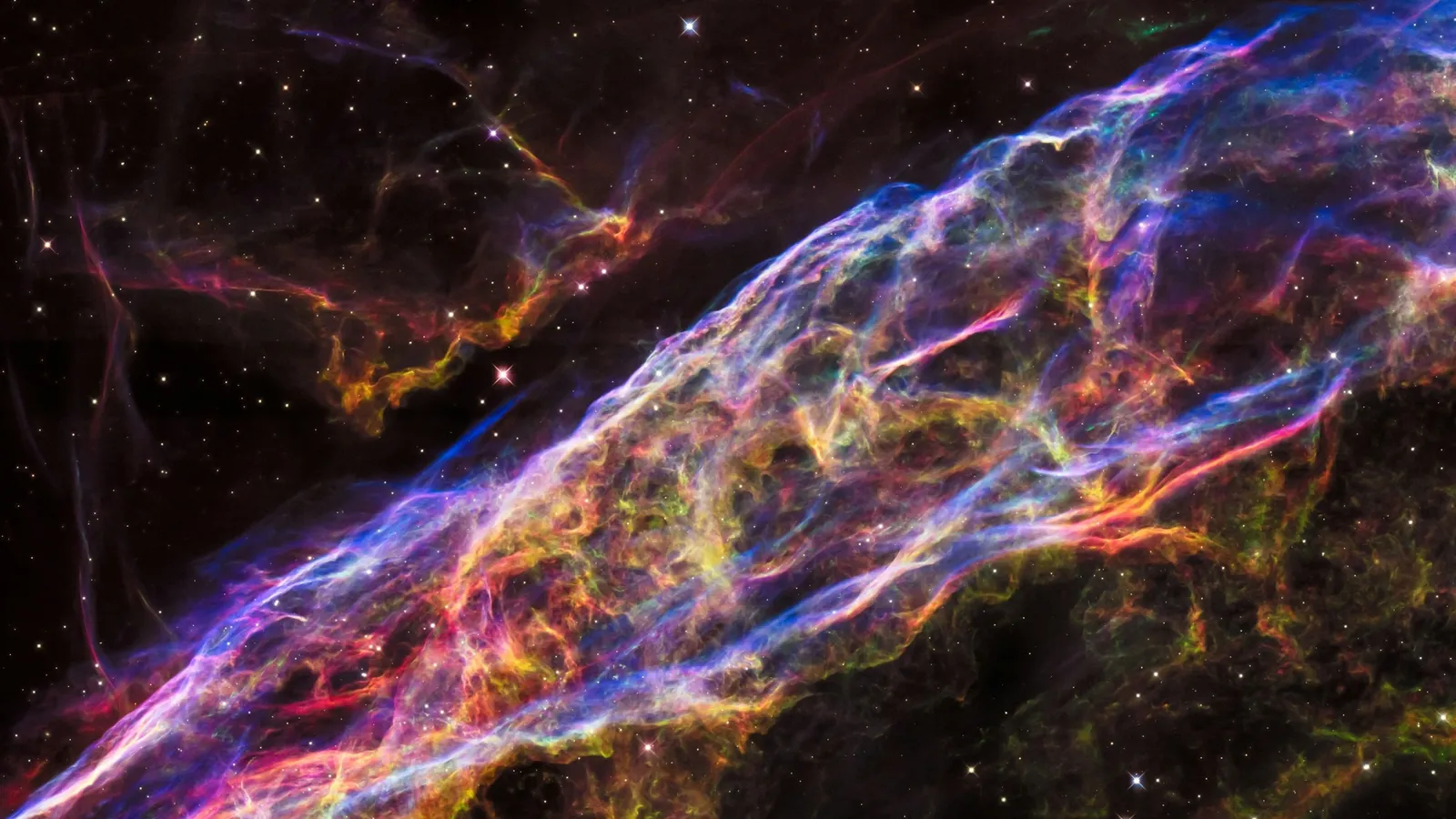
The second kind, which they named super-novae, were much rarer, about one per galaxy every few centuries, and far brighter. At maximum such a star could emit "nearly as much light as the whole nebula in which they originate". Their example was the bright nova of 1885 in the Andromeda galaxy. They also suggested that Tycho Brahe's nova of 1572 belonged to this class.
Worked example 1: how bright was the 1885 star?
Baade and Zwicky give the star's peak apparent magnitude as m = 7.5 and the distance modulus of the Andromeda galaxy as m − M = 22.2.
Absolute magnitude. M = m − 22.2 = 7.5 − 22.2 = −14.7, the value in the paper.
Compare with a common nova. The paper puts the supernova's peak visible output at 6.3 × 10⁷ Suns, against about 20,000 Suns for a common nova.
Ratio. 6.3 × 10⁷ / 2.0 × 10⁴ = 3,150. A supernova at peak outshines a common nova about three thousand times.
Treat these as the 1934 values. The method, using a known distance to turn apparent into absolute brightness, is unchanged. It is the same idea our post on Henrietta Leavitt explains for Cepheid stars.
Where did the neutron star idea come from?
If a supernova releases that much energy, what powers it? In the companion paper, Cosmic Rays from Super-Novae, they wrote: "With all reserve we advance the view that a super-nova represents the transition of an ordinary star into a neutron star, consisting mainly of neutrons. Such a star may possess a very small radius and an extremely high density."
The reasoning was that neutrons, having no charge, can be "packed much more closely than ordinary nuclei and electrons", so a collapsing star could release a vast "gravitational packing" energy. The same paper proposed that supernovae are a source of cosmic rays.
Proof came 33 years later. The Nobel facts page for Antony Hewish says the pulsars he and Jocelyn Bell discovered in 1967 turned out to be neutron stars, and "their discovery allowed scientists to prove these stars exist." Our post on Jocelyn Bell and pulsars tells that story.
Worked example 2: how dense is a neutron star?
Sample numbers for a typical neutron star: mass 1.4 Suns, radius 10 km. The NASA Sun fact sheet gives the Sun's mass as 1.9884 × 10³⁰ kg.
Mass. 1.4 × 1.9884 × 10³⁰ = 2.78 × 10³⁰ kg.
Volume. (4/3)π(1.0 × 10⁴ m)³ = 4.19 × 10¹² m³.
Density. 2.78 × 10³⁰ / 4.19 × 10¹² = 6.6 × 10¹⁷ kg/m³.
That is about 6.6 × 10¹⁴ times the density of water. The NCERT Class 12 Nuclei chapter gives the density of nuclear matter as about 2.3 × 10¹⁷ kg/m³, the same order of magnitude, as our post on nuclear radius and density shows. A neutron star is, roughly, one giant nucleus.
How did Zwicky hunt for supernovae?
Supernovae are rare, so you need to watch many galaxies at once. MacTutor records that Zwicky persuaded Caltech to build an 18-inch Schmidt telescope, a wide-field camera, which began work in September 1936. With it he discovered 129 supernovae in distant galaxies.
Which mistakes does this help you avoid?
Mixing up apparent and absolute magnitude. Apparent is how bright it looks from Earth; absolute is how bright it really is.
Treating a supernova as a big nova. Baade and Zwicky's point was that they are different events, not the same event at different strengths.
Losing powers of ten. Write 20,000 as 2.0 × 10⁴ before dividing.
The JEE (Main) 2026 syllabus includes the composition and size of the nucleus and gravitation; neutron stars themselves are enrichment. Check the syllabus for your exam year.
If the jump from nuclear density to a star's density feels like magic, the Fermi Concept Library covers every concept in physics, chemistry, biology, mathematics and computing, so you can follow each idea back to its roots.
What can a student take from Zwicky's way of working?
Connect new facts quickly. The neutron was found in 1932; within two years Zwicky and Baade had used it to explain exploding stars.
State a bold idea with care. "With all reserve" is how they introduced it.
Build the tool your question needs. Rare events called for a telescope that sees a wide sky.
Next step: redo worked example 2 for a white dwarf with the Sun's mass and Earth's radius, 6,371 km, and compare the two densities.


