On this page
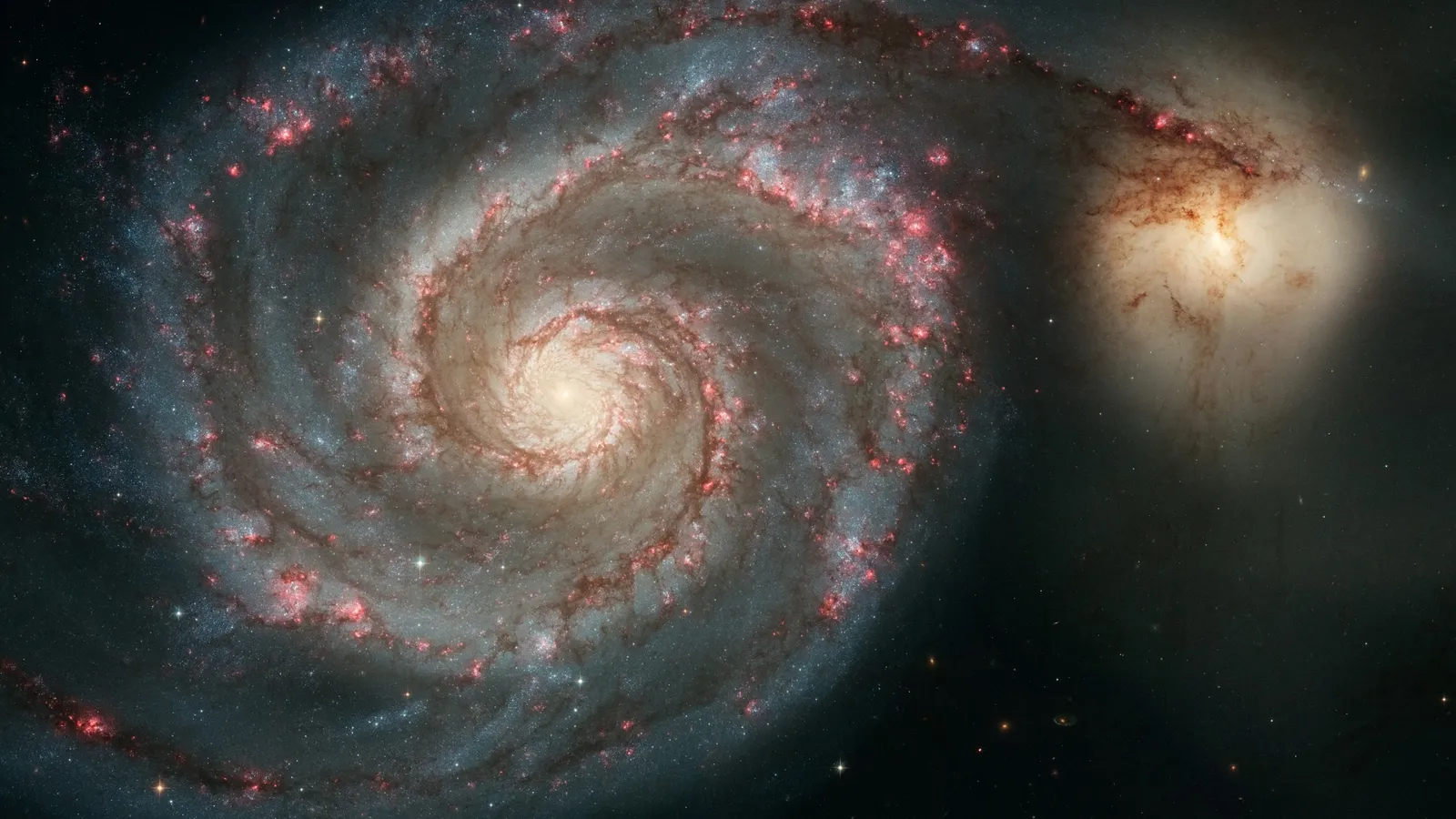
If almost all of a galaxy's mass sat in its bright centre, stars at the edge should orbit slowly, the way Neptune crawls round the Sun compared with Earth. Vera Rubin measured those outer speeds and found that they did not drop. That simple observation, repeated across dozens of galaxies, became some of the strongest evidence that most of the matter in the universe does not shine. This post explains what she measured, works through the physics with Class 11 gravitation, and draws out what a student can learn from how she worked.
Who was Vera Rubin?
The American Astronomical Society's obituary records that she was born in Philadelphia on 23 July 1928, graduated in astronomy from Vassar College in 1948, took a master's degree at Cornell and earned her PhD at Georgetown University in 1954. In 1965 she joined the Department of Terrestrial Magnetism of the Carnegie Institution of Washington, where she worked closely with Kent Ford, who built the image-tube spectrograph they used. The same obituary notes that she was denied observing time on the 200-inch Hale Telescope at Palomar until the mid-1960s, when women were finally allowed access.
Carnegie Science notes that she was elected to the National Academy of Sciences in 1981 and received the National Medal of Science in 1993. She died on 25 December 2016. The Vera C. Rubin Observatory on Cerro Pachón in Chile is named after her.
What is a rotation curve?
A rotation curve is a graph of orbital speed against distance from a galaxy's centre. Rubin and Ford measured it by taking spectra of glowing gas clouds across a galaxy. Light from the side moving towards us is shifted to shorter wavelengths, and light from the side moving away is shifted to longer wavelengths, so the Doppler shift gives the speed at each distance.
Their first target was the Andromeda galaxy. In Rotation of the Andromeda Nebula from a Spectroscopic Survey of Emission Regions (1970), they measured 67 emission regions from 3 to 24 kiloparsecs from the centre. They found that beyond about 4 kpc the total mass of the galaxy increases approximately linearly with distance out to 14 kpc, and more slowly after that. Mass that keeps growing with distance, in a region where the light is fading, was the first sign of trouble.
Why should orbital speed fall with distance?
For a star in a circular orbit, gravity supplies the centripetal force. If M(r) is the mass inside radius r:
GM(r)m / r² = mv² / r, so v = √(GM(r)/r).
If nearly all the mass is inside r, M is fixed and v falls as 1/√r. The Solar System shows this. NASA's planetary fact sheet gives Earth an orbital speed of 29.8 km/s at 149.6 million km from the Sun, and Neptune 5.4 km/s at 4515 million km. Neptune is about 30.2 times farther out, and 29.8/√30.2 ≈ 5.4 km/s, exactly as the formula predicts. Our guide to gravitation and satellite problems uses the same equation.
A worked example: weighing a galaxy from its speed
Rearrange the formula to get the mass inside radius r: M(r) = v²r / G.
Suppose a star orbits at v = 200 km/s at r = 10 kpc. With 1 kpc = 3.086 × 10¹⁹ m:
r = 3.086 × 10²⁰ m and v = 2.0 × 10⁵ m/s, so v² = 4.0 × 10¹⁰ m²/s².
v²r = 4.0 × 10¹⁰ × 3.086 × 10²⁰ = 1.23 × 10³¹.
M = 1.23 × 10³¹ / 6.674 × 10⁻¹¹ ≈ 1.85 × 10⁴¹ kg.
Dividing by the Sun's mass, 1.989 × 10³⁰ kg, gives about 9.3 × 10¹⁰ solar masses.
Now look 10 kpc further out. If no extra mass lay beyond 10 kpc, the speed at 20 kpc would drop to 200/√2 ≈ 141 km/s. If the speed is still 200 km/s, then M(r) = v²r/G has doubled: there is as much mass between 10 and 20 kpc as inside 10 kpc, even though that outer region gives off far less light.
What did the 1980 study show?
Rubin, Ford and their colleague Thonnard extended the work in Rotational properties of 21 Sc galaxies (1980). Their galaxies ranged from 4 to 122 kpc in radius. All the curves rose quickly to about 125 km/s by 5 kpc and then rose more slowly, and most were still rising slowly at the farthest point measured. Neither bright nor faint galaxies had falling rotation curves. Their conclusion was direct: these galaxies "must have significant mass located beyond the optical image."
Rubin herself kept the interpretation open. The AAS obituary quotes her saying, "I don't know if we have dark matter or need a change in gravity or need something else." The measurement was firm; the explanation was a separate question.
What can a student take from how she worked?
Measure the thing everyone assumes. Astronomers expected falling curves. Rubin measured them. When a textbook result feels obvious, test it with one problem where the assumption might fail.
Use simple physics on a big question. The argument above needs only circular motion and Newton's law of gravitation, both from your syllabus.
Separate data from interpretation. She reported what the spectra showed and stayed careful about what caused it. Do the same in lab reports: result first, explanation second.
Build on collaboration. Ford's instrument made the measurements possible.
If it helps to see orbits change as you vary the mass, the Fermi Simulation Lab has interactive simulations for ideas that are easier to see than read. For more on how astronomers measured the universe, read our profile of Edwin Hubble and the expanding universe.
Redo the worked example for a star at 30 kpc still moving at 200 km/s, and work out how much mass lies between 20 and 30 kpc.