On this page
Most radiation treatments aim a beam at a tumour and try to keep the dose low in the healthy tissue around it. Boron neutron capture therapy (BNCT) works differently. A boron compound that collects more in tumour cells is given first, and then the region is exposed to slow neutrons. Wherever a neutron is captured by a boron-10 nucleus, the nucleus splits into two charged particles that stop within about one cell. This post is about the nuclear physics behind that idea: the Q value, how momentum shares the energy, how far the fragments go, and how much energy they leave behind. It is not medical advice. Whether BNCT suits any patient is a decision for doctors.
What happens when boron-10 captures a slow neutron?
The reaction is
¹⁰B + n → ⁴He + ⁷Li
Boron-10 is unusually good at catching slow (thermal) neutrons. Its capture cross-section for thermal neutrons is about 3,840 barns, where 1 barn = 10⁻²⁴ cm² (a review gives 3,838 b: Cheng, Li and Liang, Current Oncology, 2022). The common elements in tissue capture slow neutrons far less readily. This is the same property that makes boron useful in the control rods of a nuclear reactor, where it soaks up neutrons to slow the chain reaction.
How much energy does the boron-10 reaction release?
Use atomic masses from the 2020 Atomic Mass Evaluation (IAEA AMDC):
¹⁰B: 10.0129369 u
n: 1.0086649 u
⁷Li: 7.0160034 u
⁴He: 4.0026033 u
The method is the one in how to calculate the Q value of a nuclear reaction, so here is just the result.
Mass before: 10.0129369 + 1.0086649 = 11.0216018 u.
Mass after: 7.0160034 + 4.0026033 = 11.0186067 u.
Mass lost: 0.0029951 u.
Q = 0.0029951 × 931.494 MeV = 2.79 MeV.
Atomic masses work here because the electron counts balance (5 electrons on each side).
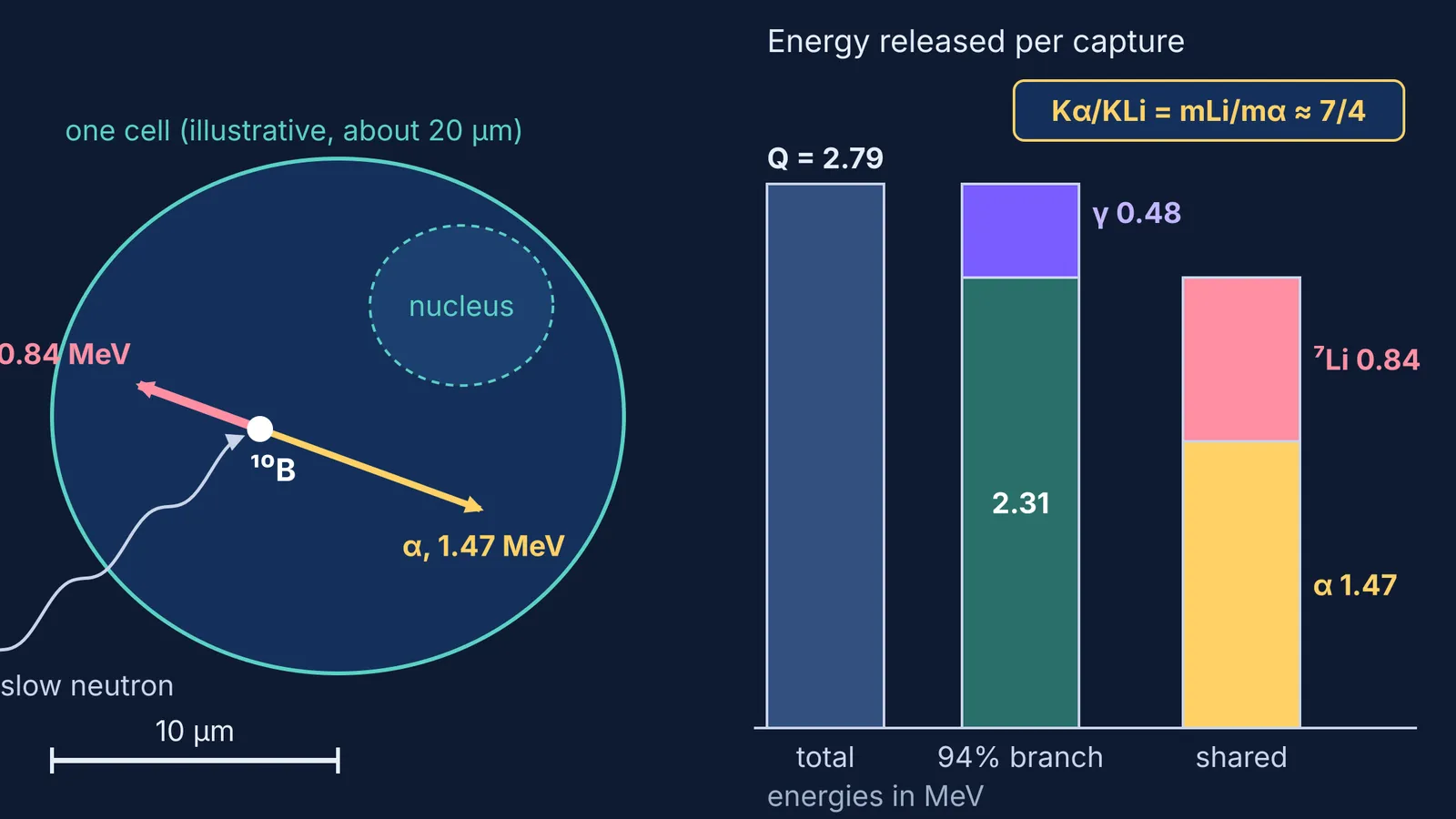
In most captures not all of this goes into motion. In about 94% of them (93.7% in the review above), the lithium nucleus is left in an excited state 0.48 MeV above its ground state, and it drops down by giving off a 0.48 MeV gamma ray. The excited level is listed at 0.48 MeV in the NNDC evaluated nuclear data for this reaction. That leaves 2.79 − 0.48 = 2.31 MeV as kinetic energy of the two fragments. The gamma ray is penetrating and mostly leaves the cell.
How is the energy shared between the alpha and the lithium?
A thermal neutron has about 0.025 eV of energy and almost no momentum. So the momentum before the reaction is essentially zero, and the two fragments must fly apart in opposite directions with equal and opposite momenta, p.
Kinetic energy is K = p²/2m. With the same p for both,
Kα / K_Li = m_Li / mα ≈ 7/4
The lighter alpha gets the larger share.
Worked example: fragment energies
Energy to share. K_total = 2.79 − 0.48 = 2.31 MeV.
Alpha. Kα = 2.31 × m_Li/(m_Li + mα) = 2.31 × 7.016/11.019 = 1.47 MeV.
Lithium. K_Li = 2.31 × mα/(m_Li + mα) = 2.31 × 4.003/11.019 = 0.84 MeV.
Check. 1.47 + 0.84 = 2.31 MeV, and 1.47/0.84 = 1.75 = 7/4.
Is non-relativistic fine? The alpha's speed is v = √(2K/m) ≈ 0.028c, so yes.
In the other 6% of captures, the lithium is left in its ground state and the full 2.79 MeV is shared in the same 7 : 4 ratio, giving 1.78 MeV and 1.01 MeV.
How far do the alpha and lithium nuclei travel in tissue?
Heavy, slow, doubly and triply charged ions lose energy very quickly to the electrons around them. NIST's ASTAR table gives a range of about 8 µm in water for a 1.47 MeV alpha particle (NIST ASTAR). The lithium nucleus has less energy and more charge, so it stops sooner. Reviews quote path lengths of 5 to 9 µm for the two fragments (Barth and colleagues, Radiation Oncology, 2012).
A typical cell is roughly 10 to 20 µm across. So the energy of the two fragments is dumped within about one cell of the boron atom that captured the neutron. This is a different way of confining dose from the one in proton therapy and the Bragg peak, where the beam's own energy decides the depth at which it stops.
How much dose does boron-10 capture deliver?
Here is an order-of-magnitude estimate with illustrative round values: 20 µg of ¹⁰B per gram of tissue and a total of 10¹² thermal neutrons per cm² passing through.
Boron atoms per gram. N = (20 × 10⁻⁶ g / 10.01 g mol⁻¹) × 6.022 × 10²³ mol⁻¹ = 1.20 × 10¹⁸.
Captures per gram. Captures = Nσφ = 1.20 × 10¹⁸ × 3,840 × 10⁻²⁴ cm² × 10¹² cm⁻² = 4.6 × 10⁹.
Energy kept locally per capture. 0.937 × 2.31 + 0.063 × 2.79 = 2.34 MeV (the gamma ray leaves).
Energy per gram. 4.6 × 10⁹ × 2.34 MeV × 1.602 × 10⁻¹³ J/MeV = 1.7 × 10⁻³ J per gram.
Dose. 1.7 × 10⁻³ J/g = 1.7 J/kg = 1.7 Gy, delivered where the boron is.
Units check: σφ is cm² × cm⁻², a pure number, the chance that one boron atom captures a neutron. Here it is 3.8 × 10⁻⁹, so only a tiny fraction of the boron reacts.
This number is physical dose only. The neutrons also deposit some dose without boron, for example through capture by hydrogen and nitrogen in all tissue, and alpha and lithium tracks do more biological damage per gray than X-rays, so real treatment planning uses weighting factors. Japan began covering accelerator-based BNCT for certain head and neck cancers in its public health insurance in June 2020 (Cancer Medicine, 2024). The physics above does not tell you who should be treated or how well it works.
To practise more Q value and momentum-sharing problems like this, use the Fermi Problem Library, which has a step-by-step solver that explains the reasoning.
Quick checklist
¹⁰B + n → ⁴He + ⁷Li, Q = 2.79 MeV from atomic masses.
About 94% of captures emit a 0.48 MeV gamma, leaving 2.31 MeV to share.
Zero initial momentum: Kα/K_Li = m_Li/mα ≈ 7/4, giving 1.47 MeV and 0.84 MeV.
Ranges of about 5 to 9 µm keep the energy within about one cell.
Captures = Nσφ; dose = captures × energy per capture ÷ mass.
Treatment decisions belong to doctors, not to a physics estimate.