

On this page
A nuclear power station boils water like a coal plant. The difference is the heat source: uranium nuclei splitting billions of billions of times a second, in a chain reaction held exactly steady. Here are the four parts that make it work, India's own design, and a numerical for boards and JEE Main.
How does a nuclear reactor work?
A reactor is a controlled chain reaction that produces heat. When a neutron is absorbed by a uranium-235 nucleus, the nucleus splits into two lighter nuclei and releases energy. One fission of U-235 releases about 200 MeV, or 3.2 × 10^-11 joule, according to the World Nuclear Association's physics of nuclear energy page. The same source says fission of U-235 typically releases 2 or 3 neutrons, with an average of almost 2.5.
Those neutrons split more nuclei, which release more neutrons: the chain reaction. The energy appears because the middle-sized fragments are more tightly bound than uranium, as the binding energy per nucleon curve shows.
The rest is an ordinary power station. A coolant is a fluid circulating through the core to carry its heat away, as the World Nuclear Association's reactor guide defines it. That heat raises steam, and the steam turns a turbine and generator, the same cycle explained in our post on how steam power plants make electricity.
What does the moderator do in a nuclear reactor?
Neutrons leave a fission very fast, but fission in U-235 is most readily caused by slow neutrons, notes the World Nuclear Association. A moderator is the material in the core that slows the neutrons released from fission so that they cause more fission (World Nuclear Association). It does this through elastic collisions, without absorbing too many. For why neutrons are the bullets at all, see why neutrons are used to cause nuclear fission.
How do control rods control the chain reaction?
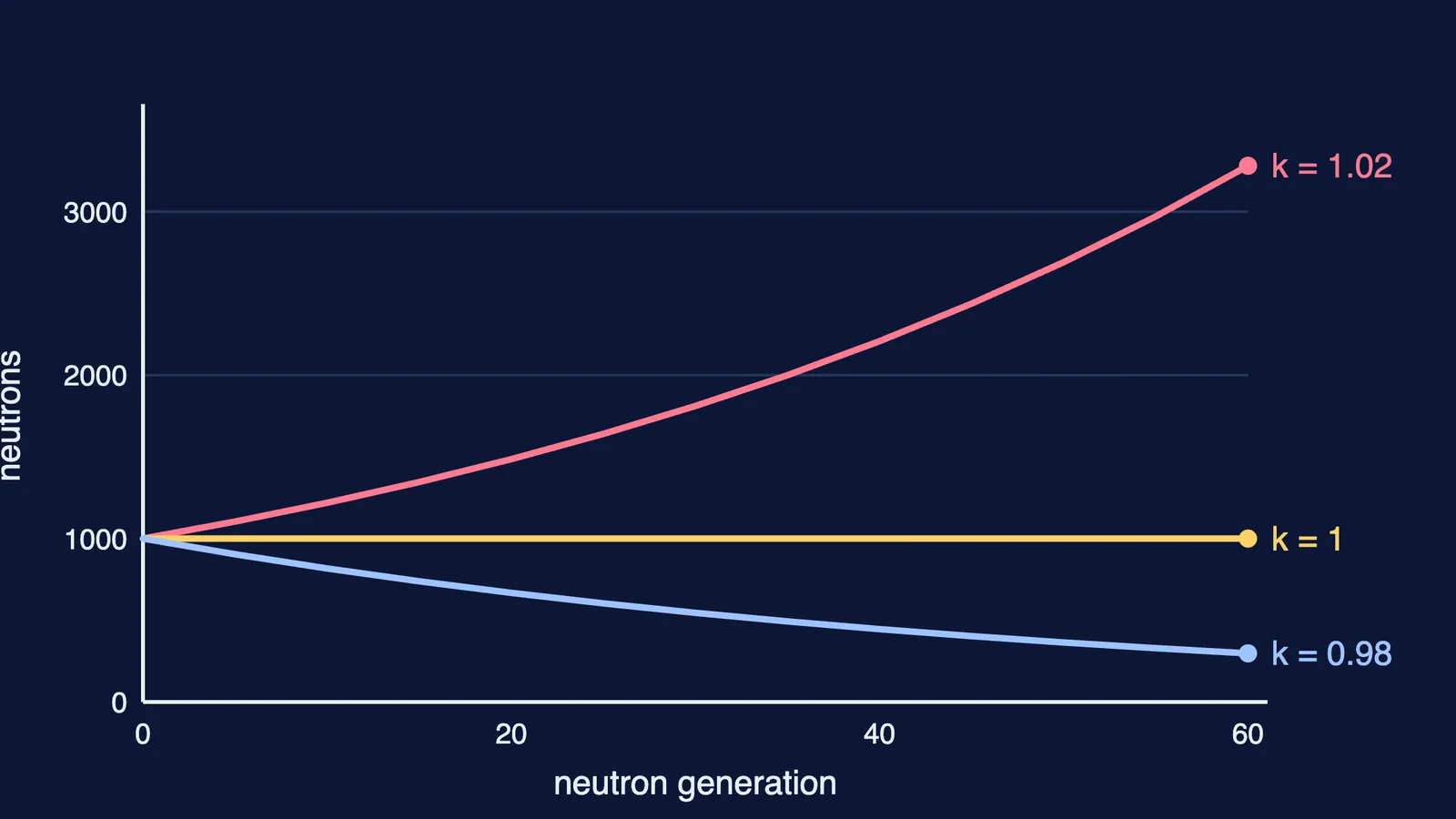
Call k the average number of neutrons from one fission that go on to cause another fission. If k = 1, every fission triggers exactly one more and the power stays level; the World Nuclear Association describes this point, criticality, as the system being exactly in balance (physics of nuclear energy). If k is above 1 the reaction grows; below 1 it dies away.
Control rods are made with neutron-absorbing material such as cadmium, hafnium or boron, and are inserted or withdrawn from the core to control the rate of reaction, or to halt it (World Nuclear Association reactor guide).
Why must k stay so close to 1? Start with 1,000 neutrons and let k = 1.01, just 1% too high. After 100 generations you have 1,000 × 1.01^100, about 2,705 neutrons, so the power has nearly tripled.
Operators get time to react because some neutrons arrive late: 0.66% of U-235 fission neutrons are delayed, and the World Nuclear Association calls delayed neutron release the crucial factor that makes a chain-reacting system controllable.
How is India's PHWR different?
India adopted the pressurised heavy water reactor (PHWR) design in 1964 partly because it needed no enrichment, according to the World Nuclear Association's India profile.
PHWRs generally use natural uranium (0.7% U-235) oxide as fuel, with heavy water (D2O) as both moderator and coolant (World Nuclear Association reactor guide). The moderator fills a tank called a calandria, crossed by several hundred horizontal pressure tubes holding the fuel and coolant at about 100 times atmospheric pressure, so the reactor can be refuelled without shutting down.
The early 220 MWe units were designed and built in India by NPCIL, based on a Canadian design, and Kakrapar 3, the first of the 700 MWe units to reach criticality, did so in July 2020 and joined the grid in January 2021 (World Nuclear Association). The NPCIL plant table lists 24 NPCIL reactors with a total installed capacity of 8,780 MWe, and 20 of them are PHWRs. Nuclear supplied about 2% of India's electricity in 2023, 47.9 TWh out of 1,987 TWh (World Nuclear Association).
Worked example: how much uranium does a reactor use in a day?
Take a core making 700 MW of heat and the World Nuclear Association's figure of 3.2 × 10^-11 J per fission.
Power: 700 MW = 7 × 10^8 J every second.
Fissions per second: (7 × 10^8) ÷ (3.2 × 10^-11) ≈ 2.2 × 10^19.
Fissions per day: multiply by 86,400 s to get about 1.9 × 10^24.
Moles of U-235: divide by 6.022 × 10^23 to get about 3.1 mol.
Mass: 3.1 mol × 235 g/mol ≈ 740 g.
So under a kilogram of U-235 splits per day. One trap: a "700 MWe" unit is rated in electricity, and the steam cycle converts only part of the heat, so its core makes more than 700 MW of heat. As a check, redo it for 220 MW: the answer scales to roughly 230 g a day.
If a step like this trips you up, the Fermi Problem Library has a step-by-step solver that explains the reasoning. And if you are unsure where your gaps in modern physics are, Fermi's AI tutor can work out what you already know and build a plan for the session.


