On this page
Revising Nuclei for Class 12, JEE Main or NEET-UG? Two questions keep coming back: why fire neutrons at uranium rather than protons, and why does a slow neutron work better than a fast one? Both come down to charge and to the cross-section.
Why are neutrons used to cause nuclear fission?
Every nucleus is positively charged, so it repels any positive particle that comes near it. Enrico Fermi explained the neutron's advantage in his Nobel lecture of 12 December 1938: neutrons, "having no electric charge, can reach the nuclei of all atoms, without having to overcome the potential barrier, due to the Coulomb field that surrounds the nucleus."
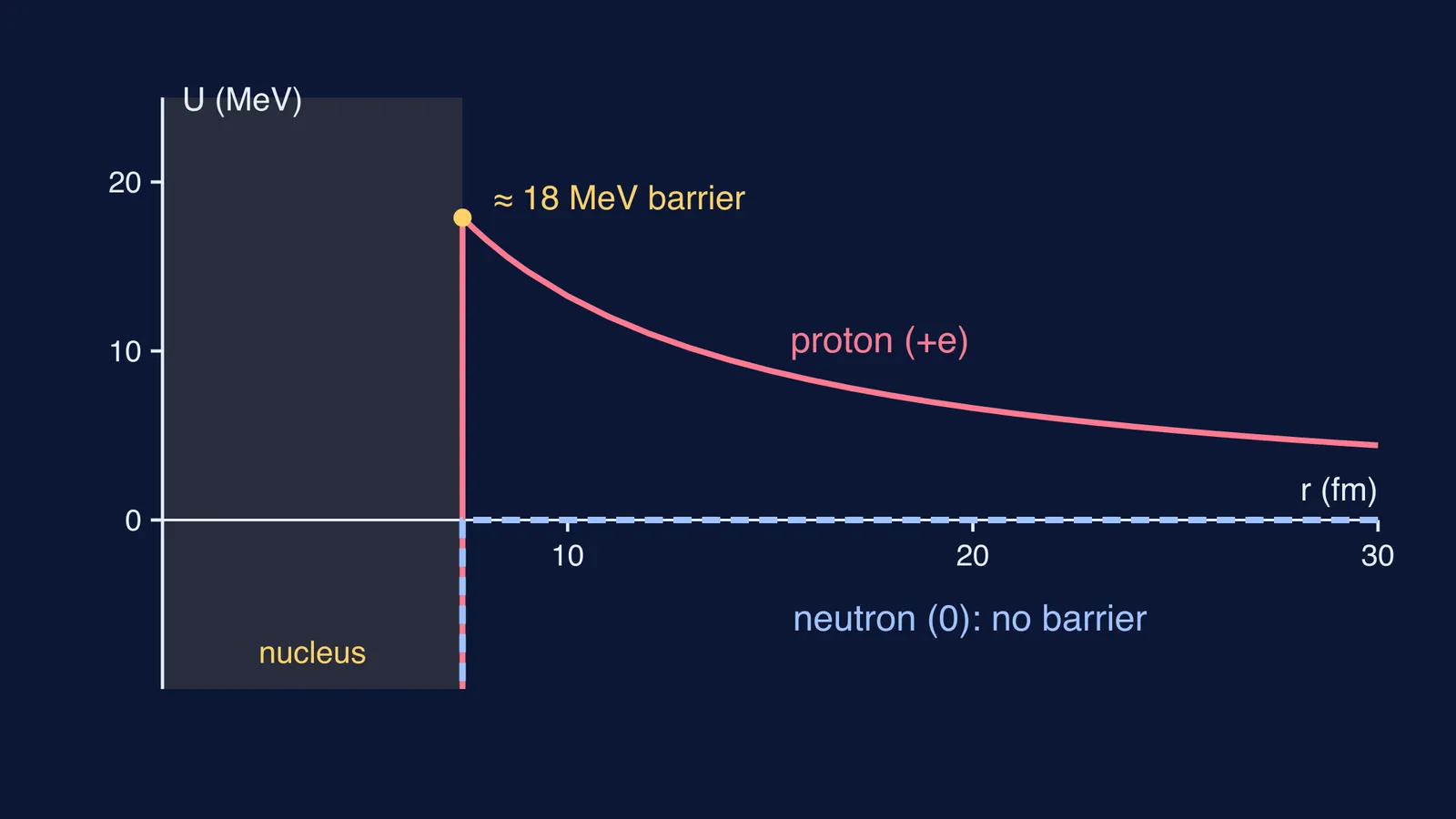
A proton or alpha particle must climb that Coulomb barrier before the short-range nuclear force can take hold. A neutron faces no such barrier.
How high is the Coulomb barrier for uranium-235?
Class 12 formulas give a quick estimate:
Radius of the nucleus: NCERT gives R = R0 A^(1/3) with R0 = 1.2 fm (NCERT Physics Part 2, chapter on Nuclei). For A = 235, R ≈ 1.2 × 6.17 ≈ 7.4 fm.
The constant: using the CODATA values of the elementary charge and the vacuum permittivity, e²/(4πε0) works out to 1.44 MeV fm.
Barrier for a proton touching the surface (Z = 92): U = 1.44 × 92 / 7.4 ≈ 18 MeV.
Barrier for a neutron: zero, because its charge is zero.
This treats the proton as a point, so 18 MeV is rough. An alpha particle, with twice the charge, faces twice the barrier at the same distance. The diagram at the top plots this calculation.
Why do slow neutrons work better for U-235?
For uranium-235, slower is better.
The chance of a reaction is measured by its cross-section, an effective target area. The World Nuclear Association gives the unit as 1 barn = 10⁻²⁸ m², and says fission and other cross-sections "increase greatly as the neutron velocity reduces from around 20,000 km/s to 2 km/s".
The IAEA thermal neutron constants list the fission cross-section of U-235 as 587.3 barns for neutrons of 0.0253 eV. For fast neutrons in the MeV range, a Los Alamos paper by Mark Chadwick in Nuclear Technology puts today's best value at about 1.2 barns. So, nucleus for nucleus, a thermal neutron is roughly 490 times more likely to cause fission than a fast one.
How slow is thermal? Use KE = ½mv² with E = 0.0253 eV and the neutron mass of 1.6749 × 10⁻²⁷ kg from the NCERT Nuclei chapter: v = √(2E/m) ≈ 2,200 m/s. One simple picture: a slow neutron spends longer near each nucleus, so it is more likely to be captured.
One fission event can yield over 200 million times the energy of the neutron that triggered it, according to HyperPhysics at Georgia State University.
Fermi's group found this effect by accident: surrounding the source with paraffin raised the activation "by a very large factor (up to 100)", he said in the Nobel lecture, because collisions with hydrogen slow the neutrons. Read the story in Fermi's paraffin discovery and why slow neutrons react more, and work the collision maths in how much kinetic energy a head-on elastic collision transfers.
Why can't slow neutrons split uranium-238?
The World Nuclear Association says slow neutrons cause fission only in uranium and plutonium isotopes with odd numbers of neutrons, such as U-233, U-235 and Pu-239, while for even-neutron nuclei fission "can only occur if the incident neutrons have energy above about one million electron volts (MeV)". U-238 has 238 − 92 = 146 neutrons, so it is in the second group. The Chadwick paper gives U-238's fission cross-section as just 14 millibarns at 1 MeV, rising to 538 millibarns at 2 MeV.
Fission neutrons are born fast, at about 7% of the speed of light according to the same WNA page, and each U-235 fission caused by a thermal neutron releases 2.425 of them on average (IAEA). So reactors surround the fuel with a moderator of light atoms that slows them down. Our explainer on why nuclear fission releases two or three neutrons covers where they come from.
How do you write this in a board or JEE answer?
A four-point answer:
Neutrons are electrically neutral, so the positively charged nucleus does not repel them.
Protons and alpha particles must first overcome the Coulomb barrier; neutrons need no such energy.
For U-235, slow (thermal) neutrons have a far larger fission cross-section than fast ones, so they are much more likely to be captured.
Fission releases fast neutrons, so reactors use a moderator to slow them down and sustain the chain reaction.
If a numerical here goes wrong, the Fermi Problem Library has a step-by-step solver that explains the reasoning rather than printing an answer, so you can see which step slipped. If cross-sections still feel shaky, the Fermi Concept Library gives each concept its own lesson.
Next time a paper asks "why neutrons?", start with the charge, then the cross-section.