

On this page
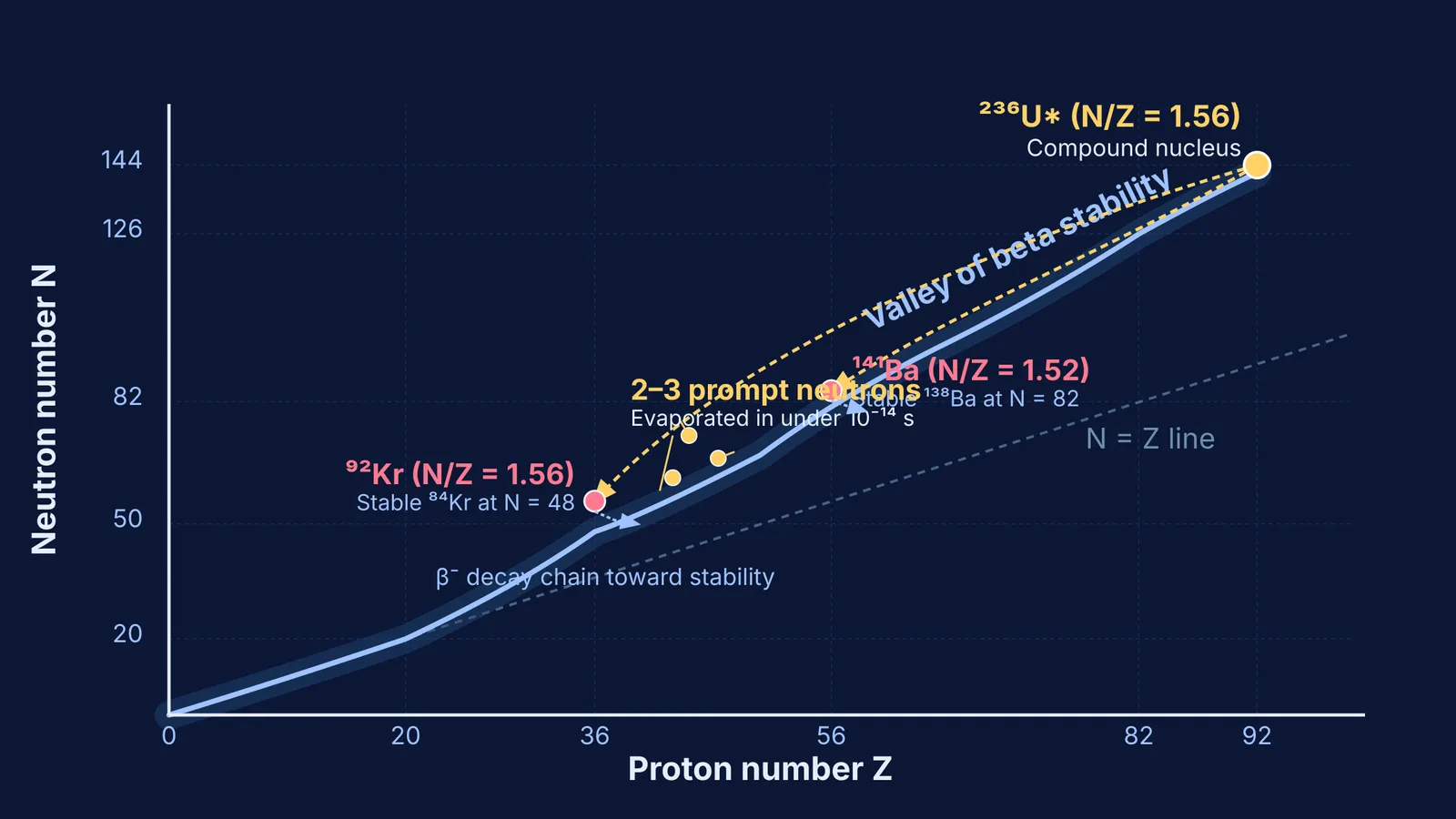
When a thermal neutron triggers the fission of Uranium-235, the nucleus does not split into tranquil halves. Instead, it cleaves into two lighter fragments while casting off two or three fast neutrons. For students preparing for JEE Main and NEET-UG, this release is the exact physical mechanism that sustains nuclear chain reactions. The explanation lies in the nuclear stability curve: heavy nuclei need an excess of neutrons to remain stable, but lighter fragments require far fewer.
Why do heavy nuclei need more neutrons than protons?
As Niels Bohr and John Archibald Wheeler formulated in the Physical Review, an atomic nucleus represents a delicate balance between the attractive short-range strong nuclear force (acting across 1 to 2 femtometres) and disruptive electrostatic Coulomb repulsion. Electrostatic repulsion has infinite range, meaning every proton repels every other proton in the nucleus.
In light nuclei with 20 or fewer protons, the strong force easily dominates, yielding nuclear stability near a neutron-to-proton ratio of 1.0. As a nucleus grows heavier, total Coulomb repulsion scales quadratically with proton number. Heavy nuclei must add extra neutrons to dilute proton charge and supply attractive strong bonds without extra repulsion. For Uranium-235 (92 protons and 143 neutrons), the neutron-to-proton ratio reaches 1.554. Capturing a thermal neutron to form compound Uranium-236 raises that ratio to 144 / 92 ≈ 1.565.
What happens to the neutron ratio when a heavy nucleus splits?
Evaluated nuclear data compiled by the IAEA Nuclear Data Services shows that when Uranium-236 splits, it typically divides into two intermediate fragments: a lighter nucleus near mass 95 and a heavier one near 140.
These medium fragments experience far less proton repulsion, requiring a lower neutron-to-proton ratio between 1.25 and 1.40 for stability. For instance, stable Krypton-84 (Z = 36) has 48 neutrons (ratio 1.333), and stable Barium-138 (Z = 56) has 82 neutrons (ratio 1.464).
At scission, nascent fragments inherit the parent's high ratio of ~1.56, saddling them with 7 to 9 more neutrons than stable nuclei of their size need. Moving to medium fragments raises binding energy per nucleon from roughly 7.6 MeV to 8.5 MeV, releasing roughly 200 MeV of reaction energy, as covered in our guide on mass defect and nuclear binding energy. The Fermi Concept Library maps how this balance between Coulomb repulsion and the strong nuclear force governs stability across the periodic table.
Why are neutrons released instead of protons?
As David G. Madland and J. Rayford Nix demonstrated in Nuclear Science and Engineering, nascent fragments fly apart under mutual electrostatic repulsion, severely distorted and carrying 20 to 40 MeV of internal excitation energy that they must shed immediately.
Two physical rules dictate why de-excitation boils off neutrons rather than protons:
No Coulomb barrier: Protons face an electrostatic barrier of 8 to 12 MeV to escape a medium nucleus. Electrically neutral neutrons face no Coulomb barrier.
Lower separation energy: In neutron-rich fragments, neutron separation energy is low (4 to 6 MeV), whereas proton separation energy exceeds 12 MeV.
Because neutrons experience no electrostatic barrier, the hot fragments evaporate neutrons in flight within 10⁻¹⁴ seconds of scission, with each prompt neutron carrying an average kinetic energy near 2.0 MeV. Once excitation energy falls below the neutron separation threshold, neutron emission stops, and fragments emit prompt gamma rays.
How many neutrons are released per fission on average?
The liberation of free neutrons during uranium fission was first shown experimentally by Hans von Halban, Frédéric Joliot, and Lew Kowarski in 1939 in Nature.
Evaluated nuclear standards by Allan D. Carlson and colleagues in Nuclear Data Sheets, maintained by the IAEA Nuclear Data Services, establish an average yield of 2.4355 total neutrons for thermal-neutron fission of Uranium-235. Of these, an average of approximately 2.42 are prompt neutrons evaporated directly from fragments, while individual fission events release discrete integers—most frequently 2 or 3 neutrons.
A standard reaction illustrates the bookkeeping:
²³⁵₉₂U + ¹₀n → ²³⁶₉₂U* → ⁹²₃₆Kr + ¹⁴¹₅₆Ba + 3 ¹₀n
Charge balance: 92 = 36 + 56 + 0 (conserved).
Mass number balance: 235 + 1 = 92 + 141 + 3(1) = 236 (conserved).
Neutron balance: Compound Uranium-236 has 144 neutrons. Krypton-92 retains 56, Barium-141 retains 85, and 3 prompt neutrons are freed.
These neutrons sustain the chain reaction, as explored in our guide on energy release in nuclear fission and fusion. The Fermi Problem Library provides worked problems with a step-by-step solver that explains the reasoning rather than printing an answer, helping you master nuclear conservation equations.
Why are fission fragments radioactive even after releasing neutrons?
Even after evaporating prompt neutrons, fragments remain neutron-heavy. Krypton-92 still has 56 neutrons, whereas stable Krypton-84 has 48. Lacking excitation energy to evaporate further neutrons, the fragments reach stability through successive beta-minus (β⁻) decays:
¹₀n → ¹₁p + e⁻ + ν̄_e
Each step converts a neutron into a proton, emitting an electron and an antineutrino. Krypton-92 decays through Rubidium-92, Strontium-92, and Yttrium-92 to stable Zirconium-92. Identifying these decay products enabled Otto Hahn and Fritz Strassmann in Die Naturwissenschaften to detect barium in 1939, confirmed theoretically in Lise Meitner's discovery of nuclear fission.


