On this page
Look closely at the glass stem inside an old filament bulb and you will see two thin wires running straight through solid glass. Air must never leak in along them, or the hot filament burns out. Push an ordinary copper wire through hot glass, let it cool, and the glass cracks or the seal leaks. The reason is thermal expansion, and the size of the problem comes straight out of the thermal stress formula you already know.
How the bulb itself works is covered in how an incandescent bulb works, and why it fuses. Here we look only at the seal where the lead-in wires pass through the glass.
Why does a copper wire crack the glass it is sealed into?
A seal is made while the glass is soft enough to flow round the wire and wet it. As the joint cools, the glass becomes rigid somewhere near its transformation temperature. For SCHOTT's AR-GLAS, a soda-lime glass, that is listed as 525 °C (AR-GLAS data sheet). From then on, glass and wire are locked together.
Both keep shrinking as they cool to room temperature. If the wire wants to shrink more than the glass, or less, neither can do it freely. Each pulls or pushes on the other, and stress builds up. This is the same blocked-expansion idea as in thermal stress in clamped rods, where σ = EαΔT. In a seal, what matters is the difference in expansion coefficients, Δα.
Glass handles this badly. SCHOTT notes that the compressive strength of glass is 10 to 20 times its tensile strength (SCHOTT on glass-to-metal sealing), so the danger is tension in the glass.
How big is the stress in a glass-to-metal seal?
A simple estimate for a thin layer locked to another material is
σ ≈ EΔαΔT/(1 − ν)
Here E is the Young's modulus of the glass, ν its Poisson's ratio, Δα the difference in mean expansion coefficients, and ΔT the temperature fall after the glass sets. The (1 − ν) factor appears because the glass is held in two directions at once, not one as in a rod. Treat the result as a rough model: in a real seal the stress changes with position, and glass sets over a range of temperatures, not at one.
Worked example: copper, platinum and tungsten wires
Data (mean coefficients from 20 to 300 °C; all values approximate):
Soda-lime glass (SCHOTT AR-GLAS): α = 9.1 × 10⁻⁶ /K, E = 73 GPa, ν = 0.22 (data sheet; tubing brochure).
Borosilicate glass (SCHOTT DURAN): α = 3.3 × 10⁻⁶ /K, E = 63 GPa, ν = 0.20 (DURAN data sheet).
Copper: about 17.8 × 10⁻⁶ /K, from the expansion equation measured for electrolytic copper by the US Bureau of Standards (Hidnert, 1921).
Platinum: about 9.3 × 10⁻⁶ /K, from the expansion equation in Edsinger, Reilly and Schooley, 1986.
Tungsten: about 4.5 × 10⁻⁶ /K, from Hidnert and Sweeney, 1925.
Take ΔT = 500 − 20 = 480 K.
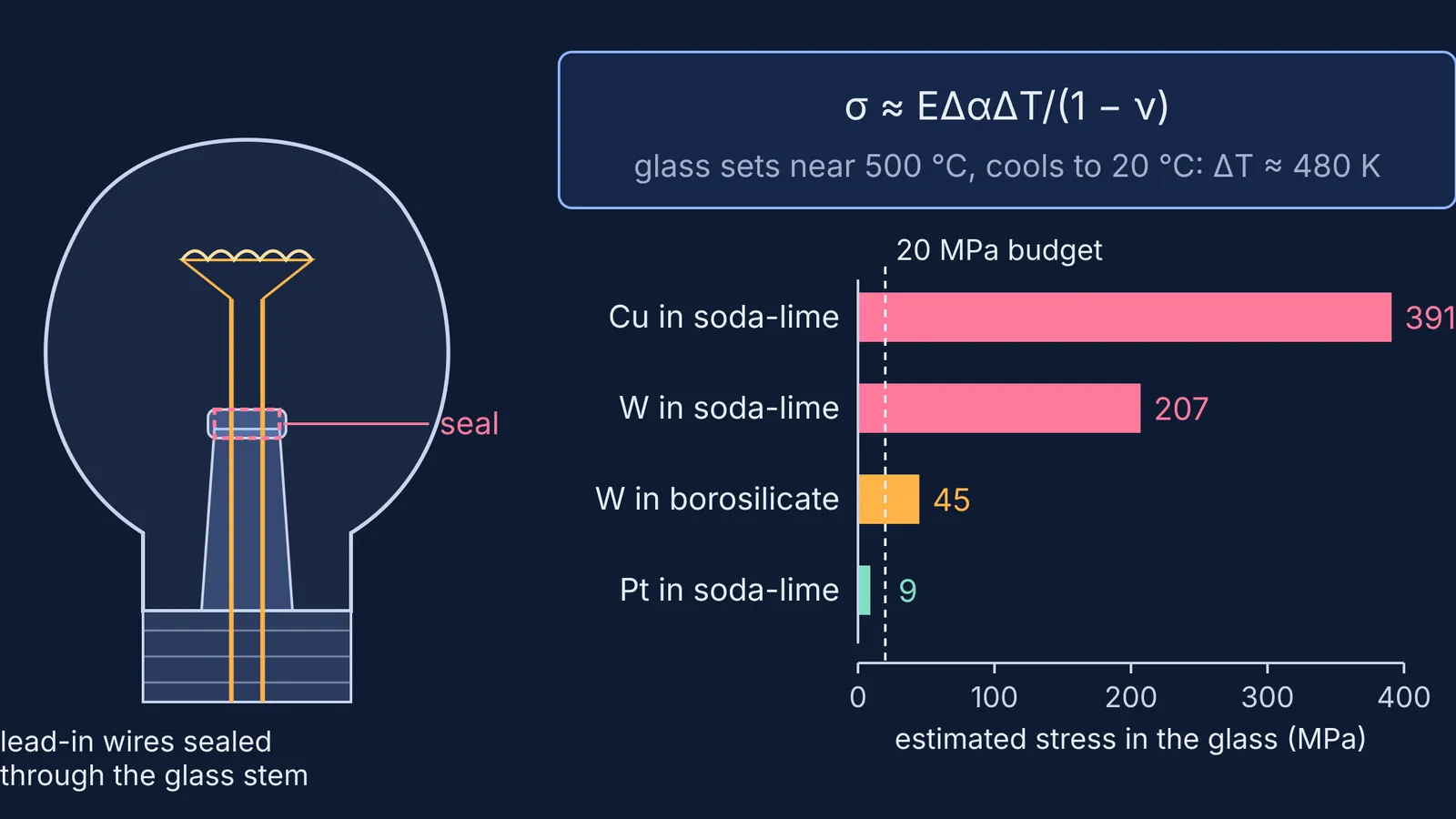
Copper in soda-lime glass. Δα = 17.8 − 9.1 = 8.7 × 10⁻⁶ /K. σ ≈ 73 × 10⁹ × 8.7 × 10⁻⁶ × 480 / 0.78 = 391 MPa.
Platinum in soda-lime glass. Δα = 9.3 − 9.1 = 0.2 × 10⁻⁶ /K. σ ≈ 73 × 10⁹ × 0.2 × 10⁻⁶ × 480 / 0.78 = 9 MPa. More than forty times smaller.
Tungsten in soda-lime glass. Δα = 4.5 − 9.1 = −4.6 × 10⁻⁶ /K, so the glass shrinks more than the wire. The size is about 207 MPa. The sign is opposite, but a mismatch either way puts some part of the glass in tension.
Tungsten in borosilicate glass. Δα = 4.5 − 3.3 = 1.2 × 10⁻⁶ /K. σ ≈ 63 × 10⁹ × 1.2 × 10⁻⁶ × 480 / 0.80 = 45 MPa. Much better, still not small.
How close must the match be? Rearrange: Δα = σ(1 − ν)/(EΔT). For an illustrative stress budget of 20 MPa in soda-lime glass, Δα must be below 20 × 10⁶ × 0.78 / (73 × 10⁹ × 480) = 0.45 × 10⁻⁶ /K, about half a part per million per kelvin.
How low is "safe"? SCHOTT points out that the strength of glass is set by microscopic surface flaws, not by the material alone, and that the calculation for DURAN pressure tubing uses a permissible stress of just 7 N/mm², which is 7 MPa (from the German edition of SCHOTT's DURAN tubing brochure). Against that, 391 MPa is hopeless and even 45 MPa is risky.
Why did early light bulbs use platinum wires?
Step 2 is the answer. Platinum's expansion is close to that of soft soda-lime glass, and it does not oxidise in the flame. The catch was price. A lamp history page on a 1910s General Electric lamp records that Colin Fink's Dumet wire, a copper-plated core of 45% nickel-iron, displaced the costly platinum wires from 1913 (Lamptech).
The idea behind Dumet is to build a wire whose overall expansion matches the glass. The nickel-iron core expands less than copper; the thin copper skin bonds well to glass through its oxide. Patent and supplier descriptions differ on details, so treat the exact composition as approximate.
How are seals matched in modern devices?
The same rule decides every pairing.
Tungsten goes into special low-expansion "tungsten-sealing" glasses, as in the tungsten electrodes of flash lamps (SCHOTT sealing glasses).
Kovar alloy and molybdenum are paired with glasses such as SCHOTT 8250, a borosilicate with α = 5.0 × 10⁻⁶ /K made for sealing to them (8250 data sheet).
Graded seals join two badly matched materials through a chain of glasses, each with an expansion between its neighbours, so no single joint carries the full Δα.
Compression seals do the opposite on purpose. SCHOTT describes them as using glass and metal with very different expansion, so that an outer metal housing shrinks firmly onto the glass (SCHOTT). Because glass is far stronger in compression, the squeeze makes the seal stronger.
Why a single thick glass cracks when only one side heats up is a related story, with no metal involved, in why a thick glass cracks when hot water is poured in.
To practise thermal stress numericals like these, the Fermi Problem Library has a step-by-step solver that explains the reasoning.
Quick checklist
A seal locks glass and metal together when the glass sets, around 500 °C for soda-lime glass.
Stress on cooling: σ ≈ EΔαΔT/(1 − ν). Only the difference Δα matters.
Copper in soda-lime glass: about 390 MPa. Platinum: about 9 MPa.
A 20 MPa budget needs Δα below about 0.45 × 10⁻⁶ /K.
Glass fails in tension and is 10 to 20 times stronger in compression.
Platinum lead-ins gave way to Dumet wire from 1913.