

On this page
Ever poured boiling water into a thick glass tumbler to make tea or coffee, only to hear a sharp *crack*? It feels backwards. Surely a heavy, thick glass should be much stronger than a delicate, thin one? But when it comes to sudden temperature changes, thickness is exactly what destroys the glass.
The culprit is a physical phenomenon called thermal shock. It is a classic problem in thermodynamics and materials science, and understanding it explains why laboratory beakers can sit on an open flame while your favourite kitchen glass shatters in the sink.
Why does a glass crack when hot water is poured in?
When you pour boiling water into a glass, the inner surface in direct contact with the water heats up instantly. Like almost all materials, glass expands as its temperature rises.
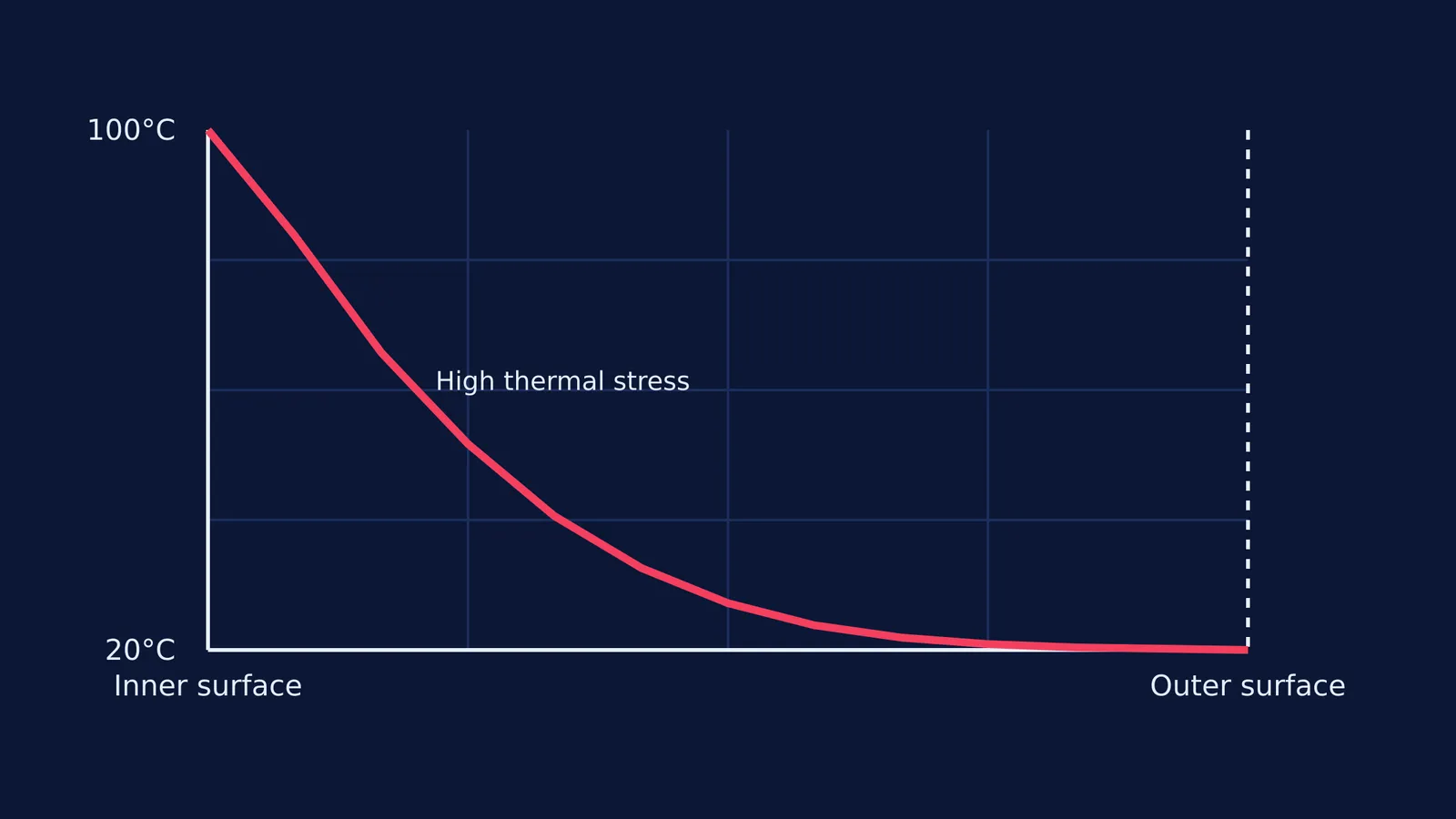
However, glass is also an excellent thermal insulator—meaning it is a very poor conductor of heat. Because heat travels slowly through the material, the outer surface of the glass remains at room temperature for several seconds after the water is poured.
This creates a physical conflict. The hot inner layer is expanding and pushing outwards, while the cold outer layer is rigid and refusing to yield. This differential expansion puts the inner layer under compression and the outer layer under intense tension. Since glass is a brittle material that is much weaker under tension than compression, the outer layer simply pulls apart. It snaps to relieve the mechanical stress, creating the crack you hear.
The failure always starts at the colder surface because that is where the tensile stress concentrates. A microscopic scratch on the outside of the glass can act as a stress multiplier, making the material tear apart even faster when the hot water hits the inside.
Why do thick glasses crack more easily than thin ones?
If a glass is very thin, the heat conducts through the thin wall to the outside air almost immediately. Because the heat does not have far to travel, both the inner and outer walls heat up and expand at roughly the same time. The expansion remains uniform across the glass, which keeps the internal stress low.
In a thick glass, the temperature gradient between the boiling inside and the cold outside is much steeper and lasts significantly longer. The inside reaches maximum expansion long before the outside has even begun to warm up. This sustained, extreme temperature difference is what creates the massive forces required to fracture the material. As the thickness of the glass increases, the temperature difference between the inner and outer walls scales up, making failure almost guaranteed for ordinary glass suddenly filled with boiling water.
Visualising how a temperature curve creeps through a solid over time can be difficult from static graphs. If you want to see the gradient steepen and flatten out dynamically, you can run the heat equation models in the Fermi Simulation Lab to watch how different materials react.
This same slow crawl of heat conduction through a material is what dictates the time for ice to form on a pond in winter.
Why does borosilicate glass not crack?
Not all glass shatters under boiling water. Laboratory flasks and high-quality kitchen bakeware (often known by trade names like Pyrex or Borosil) are made of borosilicate glass, which is immune to this everyday thermal shock.
The secret lies in a property called the coefficient of thermal expansion, which measures how much a material's volume grows per degree of heating. Standard window and tumbler glass is made of soda-lime glass, which accounts for about 90% of manufactured glass (Wikipedia). It has a relatively high expansion coefficient, making it highly susceptible to thermal stress. (Thermal expansion is a widespread effect, also responsible for a pendulum clock losing time in summer.)
Borosilicate glass, on the other hand, contains boron trioxide. This addition alters the molecular structure of the glass. According to its material properties, borosilicate glass has a coefficient of thermal expansion of roughly 3 × 10⁻⁶ K⁻¹ at 20 °C (Wikipedia). This is about a third of the expansion rate of ordinary soda-lime glass.
Because borosilicate glass barely expands when heated, the "push" from the hot inner layer is much weaker. The resulting tension is too low to overcome the structural strength of the outer layer, allowing the glass to survive a sudden trip from the freezer to the oven without breaking.


