On this page
On some dry coastal mountains, people string up a flat mesh net facing the wind and collect water that drips off it into a gutter. The water comes from fog blowing through the net. Why the net catches some drops and lets others slip past comes down to two ideas from your fluids chapter: Stokes's law and inertia.
Why can't fog drops just fall into a bucket?
Fog drops are tiny. Their diameters typically range from about 1 µm to a few tens of µm, according to a review of fog collection projects by Klemm and co-authors in the journal Ambio (Klemm et al., 2012).
A drop this small reaches its terminal speed almost at once, and Stokes's law gives that speed:
v_t = 2r²ρg/9η
Here r is the drop radius, ρ the density of water and η the viscosity of air. Why viscosity wins so completely for tiny drops is covered in George Stokes and why tiny drops fall so slowly, and the same formula applied to blood cells is in ESR and Stokes' law.
Take a 10 µm drop (r = 5 µm), ρ = 1000 kg/m³, η = 1.8 × 10⁻⁵ Pa s, g = 9.8 m/s²:
v_t = 2 × (5 × 10⁻⁶)² × 1000 × 9.8 / (9 × 1.8 × 10⁻⁵) = 3.0 × 10⁻³ m/s
That is 3 mm/s, so falling 1 m takes over five minutes. A 2 µm drop settles at only 0.12 mm/s. You cannot wait for fog to fall; you let the wind carry it into something.
How much water does fog carry through a net?
Liquid water content is the mass of liquid water per cubic metre of fog. Multiply it by wind speed to get the water crossing each square metre of net per second.
Worked example: one night of fog
The numbers here are illustrative round values, not data from a named site.
Water flux. Take a liquid water content of 0.3 g/m³ and a wind of 4 m/s. Each second, 4 m³ of fog passes through each square metre of net, carrying 0.3 × 4 = 1.2 g of water.
Collection efficiency. Only a fraction of that water ends up in the gutter. Conventional woven plastic meshes may extract only about 2% of the water in a mild fog, while finer meshes could extract 10% or more, according to the MIT team behind a 2013 Langmuir study (MIT News on Park et al.; Park et al., 2013). Take 10%.
Collection rate. 1.2 × 0.10 = 0.12 g of water per square metre per second.
Eight hours of fog. 8 h is 28 800 s. 0.12 × 28 800 = 3456 g, about 3.5 L per square metre.
A full-size net. Klemm and co-authors describe large fog collectors whose mesh is in most cases 4 m high and 10 m wide, so 40 m². That net would collect 40 × 3.5 = about 140 L in the night.
Sensitivity. At 2% efficiency the same fog gives only 0.7 L/m².
How does this compare with real projects? The same review reports that yearly averages of 3 to 10 litres per square metre of mesh per day are typical of operational projects, and about 6 L/m² per day over 14 years at one site in Chile (Klemm et al., 2012). The illustrative figure sits in that range.
Why does a mesh catch 10 µm drops but not 2 µm drops?
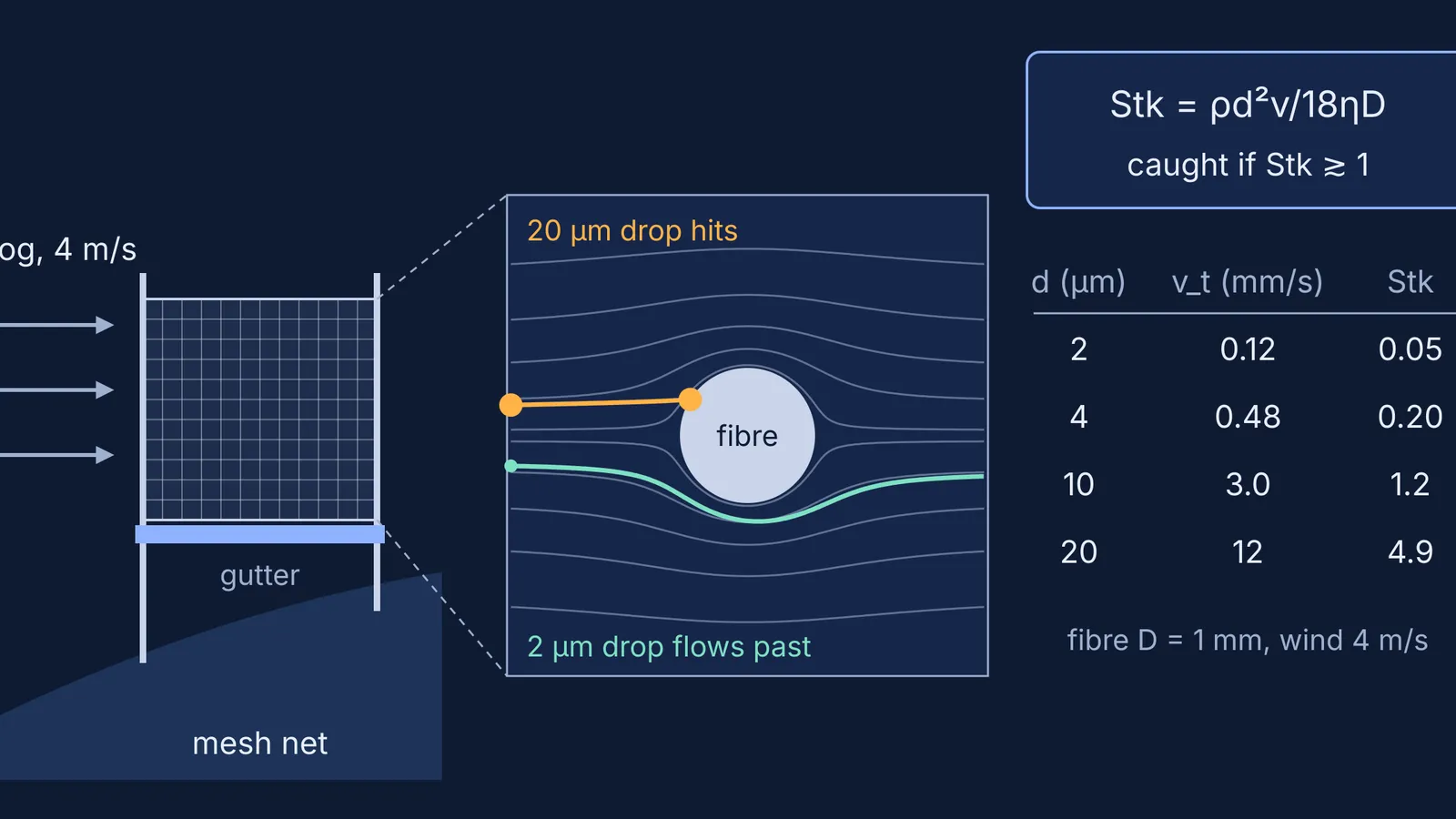
Air bends round each mesh fibre. A drop in that air either turns with it or carries straight on and hits. That depends on how long the drop takes to adjust its velocity to the air, compared with how long the air takes to flow round the fibre. The ratio is the Stokes number:
Stk = ρd²v/18ηD
Here d is the drop diameter, v the wind speed and D the fibre diameter. ρd²/18η is the drop's relaxation time, how long drag takes to match its speed to the air's. D/v is how long the air takes to pass the fibre.
Stk much greater than 1: the drop is too sluggish to turn and hits the fibre.
Stk much less than 1: the drop follows the air and misses.
Take v = 4 m/s and a fibre of D = 1 mm.
20 µm drop: Stk = 1000 × (20 × 10⁻⁶)² × 4 / (18 × 1.8 × 10⁻⁵ × 10⁻³) = 4.9. Hits.
10 µm drop: Stk = 1.2. Mostly hits.
4 µm drop: Stk = 0.20. Mostly misses.
2 µm drop: Stk = 0.05. Misses.
The cut-off is gradual, not sharp. In a simple model (ideal flow round a cylinder, Stokes drag on the drop) we computed the fraction of drops in the fibre's path that hit it: about 84% at 20 µm, 63% at 10 µm, 13% at 4 µm, and essentially none at 2 µm. Some books define Stk with radius instead of diameter, which changes the factor of 18 and moves the "about 1" threshold, so always check which version a question uses.
Because Stk goes as 1/D, thinner fibres catch smaller drops. With D = 0.3 mm, a 10 µm drop has Stk = 4.1 instead of 1.2. This is why mesh design matters so much in the Park et al. work: thinner fibres catch more drops, but fibres packed too closely block the wind, so air flows round the whole net instead of through it.
Why not use a solid wall instead of a mesh?
A solid wall would stop the air, so the air and its drops would turn and flow round the wall's edges. A mesh lets most of the air through and puts each fibre directly in the path of nearby drops. MIT's report on the Park et al. study makes this point: fog drops tend to be deflected around solid surfaces, so permeable meshes work much better. The Raschel mesh used in many projects shades only about 35% of the area per layer, according to Klemm and co-authors.
Caught drops must also merge and drain into the gutter before the wind blows them off.
Where does fog harvesting work, and where doesn't it?
It needs fog that is both frequent and windy. Klemm and co-authors describe the favourable setting as arid or semi-arid regions where fresh water is scarce and fog occurs often, especially near-coast mountains where moist ocean air is pushed uphill.
Is the water safe to drink? The same review found fog water will in most cases be safe to drink, but some coastal sites showed raised levels of some ions and metals, and it advises checking water quality before use wherever contamination is possible. How fog forms in the first place, and why it blankets north India in winter, is a separate story in why dense fog covers north India on winter mornings.
To see how a drop's inertia decides whether it follows the air, look up Stokes's law and viscosity in the Concept Library.
Quick checklist
Fog drops are 1 µm to a few tens of µm; a 10 µm drop settles at only 3 mm/s.
Water flux = liquid water content × wind speed; multiply by area, time and efficiency.
Stk = ρd²v/18ηD: big drops (Stk above about 1) hit fibres, small ones follow the air.
Thinner fibres raise Stk and catch smaller drops.
Real mesh efficiencies are a few percent to about 10%.