On this page
A honeybee's eye is not one lens but a dome of about five thousand tiny ones. Each tiny lens, or facet, sits on top of a tube called an ommatidium that looks in one direction and reports one patch of brightness and colour. The bee's picture of the world is built from these patches, like a photo made of very few pixels. So why doesn't evolution simply pack in more, smaller facets? Because each facet is also an aperture, and a small aperture blurs light by diffraction. The size that balances the two effects comes from one line of algebra, and it predicts real bee eyes surprisingly well.
How does a compound eye form an image?
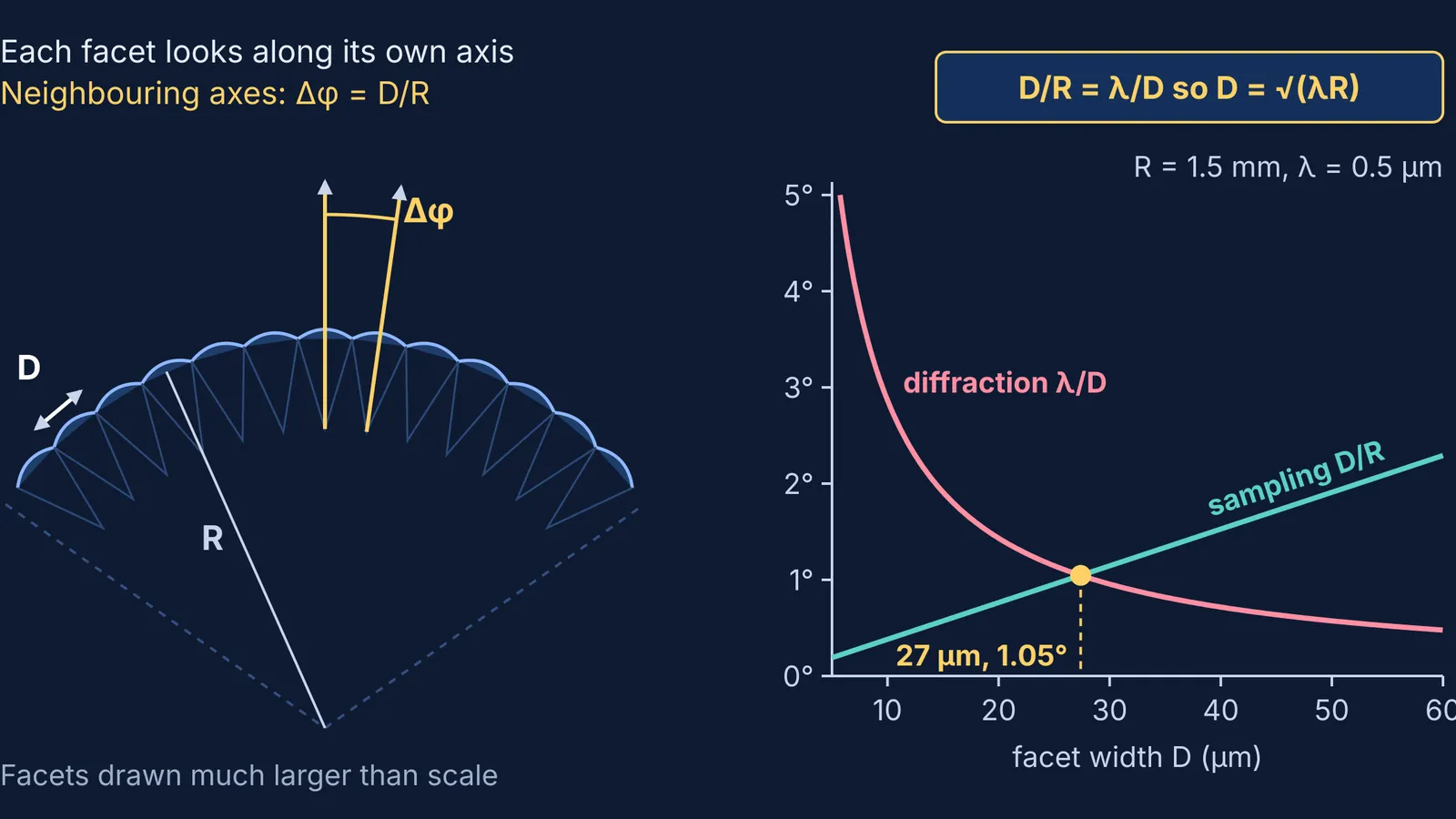
Picture the eye as part of a sphere of radius R, covered with facets of width D. Each facet points straight out from the centre, so two neighbouring facets point in directions that differ by an angle
Δφ = D/R (in radians)
This is the interommatidial angle. It is the eye's sampling interval: the bee gets one reading per Δφ of sky, and it cannot see detail finer than that, in the same way that a screen cannot show detail finer than one pixel.
If this were the only effect, smaller facets would always be better: halve D and you halve Δφ, and you get four times as many facets on the same dome.
Why does a smaller facet blur more?
Each facet is a circular lens of diameter D, and light passing through any aperture spreads out. You already know the result from the resolving power of microscopes and telescopes: the smallest angle a circular aperture can resolve is about 1.22λ/D. For this estimate we drop the 1.22 and call the facet's blur angle λ/D.
So the two effects pull in opposite directions:
Sampling angle D/R gets smaller as D shrinks.
Diffraction blur λ/D gets larger as D shrinks.
Making facets tinier than the blur is wasteful, because neighbouring facets would just report the same smeared patch. Making them larger than needed wastes resolution, because each facet's own image is sharper than the spacing can use.
What facet size gives the sharpest compound eye?
The optimal facet is the one where the two angles are equal:
D/R = λ/D, so D² = λR, which gives D = √(λR)
and the matching angle is Δφ = √(λ/R). This argument was set out by Horace Barlow in a 1952 paper on the size of ommatidia in apposition eyes, where he compared it with measured eyes of many bees and wasps.
Notice the square root. To make the angle ten times finer, R has to grow a hundred times. That is the real weakness of compound eyes: resolution improves only as the square root of eye size.
Worked example: a bee-sized eye
Take green light, λ = 0.5 µm, and a model eye of radius R = 1.5 mm = 1500 µm.
Optimal facet. D = √(0.5 µm × 1500 µm) = √750 µm = 27.4 µm, about 27 µm.
Sampling angle. Δφ = D/R = 27.4/1500 = 0.0183 rad = 1.05°.
Check the blur. λ/D = 0.5/27.4 = 0.0183 rad, the same 1.05°, as it should be.
Smaller and larger heads. For R = 0.5 mm (fruit-fly sized): D = √(0.5 × 500) = 15.8 µm and Δφ = 1.8°. For R = 5 mm: D = 50 µm and Δφ = 0.57°.
Units check. D comes out as √(µm × µm) = µm, and D/R is a pure number, an angle in radians. Multiply by 57.3 for degrees.
How close is this to a real bee? A study of five honeybee species measured worker honeybee (Apis mellifera) facets at about 25 µm across, with about 5,400 facets per eye (Streinzer and colleagues, PLoS ONE, 2013). For a 25 µm facet, λ/D = 0.5/25 = 0.020 rad, about 1.1°. Interommatidial angles reported for the bee's sharpest, forward-looking zone are about 0.9° vertically and 2.1° horizontally, around 1.7° on average (Rigosi and colleagues, Scientific Reports, 2017). So the sampling angle and the diffraction blur of a real bee facet are both close to 1° to 2°, as the simple model predicts.
What does a flower look like to a bee?
Take the model's 1.05° and a flower 1 m away. The smallest separation the bee can tell apart is about 1000 mm × tan 1.05° = 18 mm. With the measured average of about 1.7°, it is about 30 mm. So from a metre away, the spots and stripes on a petal merge into a coloured blob, and the bee has to fly in close to see the pattern.
Your own eye resolves about 1 arcminute, the figure behind how many pixels your eye can see on a screen. That is roughly 60 times finer than 1°.
How big would a compound eye need to be to see like you?
Set Δφ = 1 arcminute = 2.91 × 10⁻⁴ rad and keep λ = 0.5 µm.
Diffraction sets the facet: D = λ/Δφ = 0.5 µm / 2.91 × 10⁻⁴ = 1.72 mm.
Sampling sets the radius: R = D/Δφ = 1.72 mm / 2.91 × 10⁻⁴ = 5.9 m.
An eye of radius 5.9 m is about 12 m across. On this simple model, which assumes the same sharpness all over the eye, a compound eye that matched yours would be bigger than a house. Your camera-type eye avoids this because one large lens (the pupil is a few mm wide) serves all the receptors at once. The same balance between aperture blur and pixel spacing appears in cameras, as shown for the diffraction-limited aperture of a camera.
If you want to see how an aperture's diffraction pattern spreads as it narrows, try it in the Simulation Lab, which has interactive simulations for ideas that are easier to see than read.
Is a bee's vision simply worse than ours?
Only for fine spatial detail. Real compound eyes are not uniform: bees have sharper zones looking forward and coarser ones elsewhere, and facets are often a little larger than the diffraction optimum because a bigger facet also collects more light. Insects can also follow much faster flicker than we can, and many see ultraviolet and the polarisation of skylight. The √(λR) rule is a first estimate of the sharpness limit, not a full description of insect vision.
Quick checklist
Facet spacing sets the sampling angle: Δφ = D/R.
Each facet's diffraction blur is about λ/D (1.22λ/D for the Rayleigh limit).
Equal angles give the optimal facet D = √(λR) and Δφ = √(λ/R).
R = 1.5 mm and λ = 0.5 µm give about 27 µm and 1.05°; real honeybee facets are about 25 µm.
Resolution improves only as √R, so a compound eye as sharp as yours would be about 12 m across.
Work in radians, then convert to degrees.