

On this page
Drive onto a set of rumble strips and the car starts to drum. Drive faster and the drumming rises in pitch. The reason is one line of physics: each tyre hits a bar once every s/v seconds, where s is the spacing between bars and v is the car's speed, so the frequency of the thumps is f = v/s. This post works through that formula with real strip spacings, explains why the "hum" is really a train of pulses, and shows how musical roads use the same rule in reverse.
What are rumble strips on Indian roads?
Rumble strips are raised bars laid across the road at regular intervals, before toll plazas, junctions, curves and narrow bridges. They warn a driver through sound and vibration, without the jolt of a speed breaker.
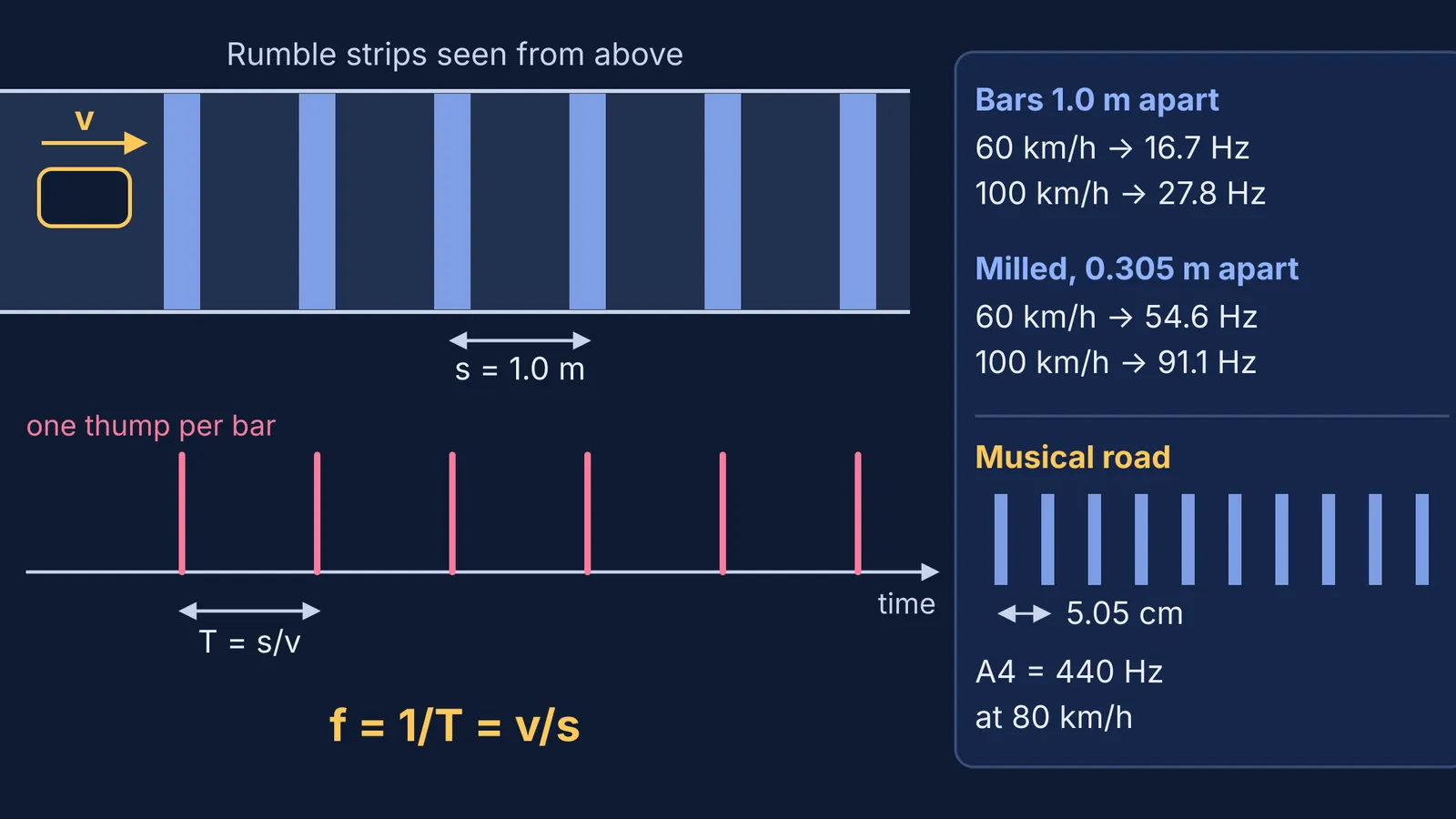
The Indian Roads Congress guideline IRC:99-2018, Guidelines for Traffic Calming Measures in Urban and Rural Areas describes them as raised sections 20 to 30 mm high and 200 to 300 mm wide, spaced about one metre centre to centre, with roughly 6 bars at one location. The same document describes thermoplastic transverse bar markings in sets of 6, with gaps of 600 mm or 1000 mm between bars. So s = 1.0 m is a fair round value for a highway rumble strip in India.
A second design is common on highway shoulders abroad. These are grooves milled into the road surface. The US Federal Highway Administration's description of longitudinal rumble strips gives a spacing of 12 inches (0.305 m) centre to centre. We use both spacings below.
Why is the rumble frequency equal to speed divided by spacing?
Think of one tyre rolling at a steady speed v over bars a distance s apart.
The time to travel from one bar to the next is T = s/v.
Every T seconds the tyre gets one sharp knock from a bar.
A repeating event with period T has frequency f = 1/T = v/s.
This looks exactly like the wave equation v = fλ, which you can revise in how v = fλ works for sound. The spacing plays the part of the wavelength and the car's speed plays the part of the wave speed. Be careful: v here is the speed of the car, not the speed of sound in air (about 343 m/s). The sound that reaches your ears then travels through the air at its own speed, but its frequency is fixed by how often the tyre hits a bar.
The formula has no wheel radius in it. Wheel size decides how many revolutions the wheel makes, a separate idea covered in distance covered by a wheel in revolutions; the bar rate depends only on v.
Worked example: how fast are the thumps at highway speed?
A car drives at 72 km/h over an IRC-style set of 6 bars, 1.0 m apart.
Convert the speed. 72 km/h ÷ 3.6 = 20 m/s.
Time between bars. T = s/v = 1.0/20 = 0.05 s.
Frequency. f = v/s = 20/1.0 = 20 Hz.
Length of the burst. Six bars mean five gaps, so one wheel's drumming lasts 5 × 0.05 = 0.25 s.
Check the units. (m/s)/m = 1/s = Hz.
Now repeat for other speeds:
1.0 m spacing: 60 km/h (16.7 m/s) gives 16.7 Hz, and 100 km/h (27.8 m/s) gives 27.8 Hz.
0.305 m spacing: 60 km/h gives 54.6 Hz, and 100 km/h gives 91.1 Hz.
Because f is proportional to v, halving your speed halves the frequency. On the 0.305 m grooves, braking from 80 km/h to 40 km/h drops the note from 72.9 Hz to 36.4 Hz, exactly one octave. A driver hears the deceleration as a falling pitch.
Why do strips 1 m apart thump instead of hum?
Two pieces of physics stop a 1 m strip from sounding like a clean musical note.
First, the fundamental is very low. At 1.0 m spacing you need 72 km/h just to reach 20 Hz, which is roughly the lower limit of human hearing. Below that you feel the bars through the seat and steering more than you hear them. Much of what you do hear is in the harmonics, described next. The closely spaced 0.305 m grooves put the fundamental at 50 to 90 Hz at highway speeds, which is a clearly audible low hum.
Second, a pitch needs many cycles. A set of 6 bars gives only five intervals, a burst of 0.25 s at 72 km/h. A short burst has a spread of frequencies of roughly 1/(burst length), about 4 Hz here, so the "note" is blurred. Long runs of milled grooves give hundreds of cycles and a much cleaner tone.
Is the rumble a pure tone?
No. Each impact is a short, sharp knock, not a smooth sine wave. A repeating train of short pulses contains the fundamental f plus strong harmonics at 2f, 3f, 4f and so on. That is why rumble strips sound like a buzz or a drone rather than a tuning fork.
There is one more twist. Each car has front and back wheels, and the back wheel hits the same bar a wheelbase L later. The delay is L/v. For an illustrative wheelbase of 2.5 m at 20 m/s, the delay is 0.125 s, which is 2.5 bar periods. Shifted by half a period, the two wheels' pulses at the fundamental are out of step and partly weaken each other, while those at 2f are back in step. So the mix of harmonics you hear depends on L/s, and it changes from car to car. The car body also responds more strongly at some frequencies than others, which is the forced vibration and resonance idea in forced vibration vs resonance.
How does a musical road play a tune?
A musical road runs the same rule backwards. Choose the note and the design speed, then solve for the spacing: s = v/f.
To play A4 (440 Hz) at 80 km/h (22.2 m/s), the grooves must be 22.2/440 = 0.0505 m, or 5.05 cm, apart. One octave lower, A3 (220 Hz), needs twice the spacing, 10.1 cm. Each note is a short patch of grooves at its own spacing, and the tune only plays in tune at the design speed. Drive 10% faster and every note is 10% sharp, although the intervals between notes, and so the tune, stay the same.
A real example is the road in Lancaster, California, cut to play the "William Tell Overture" for cars at 55 mph; the first version was paved over after neighbours complained about the noise, as NBC News reported.
If you want to see how a periodic driving force builds up a response, the Simulation Lab has interactive simulations of forced oscillations and waves.
Quick checklist
Thump frequency: f = v/s, with v the car's speed in m/s and s the bar spacing in m.
IRC:99-2018 rumble strips: about 1 m centre to centre, about 6 bars per set.
At 1 m spacing you need 72 km/h to reach 20 Hz, so you mostly feel the bars.
Closely spaced grooves (0.305 m) give an audible hum of about 55 to 90 Hz at 60 to 100 km/h.
Pulses are not sine waves: expect strong harmonics at 2f, 3f and higher.
Musical roads: s = v/f, so 440 Hz at 80 km/h needs grooves 5.05 cm apart.


