

On this page
Wheel problems turn up in school mensuration and again in rotation for JEE Main. They all rest on one fact.
How far does a wheel move in one revolution?
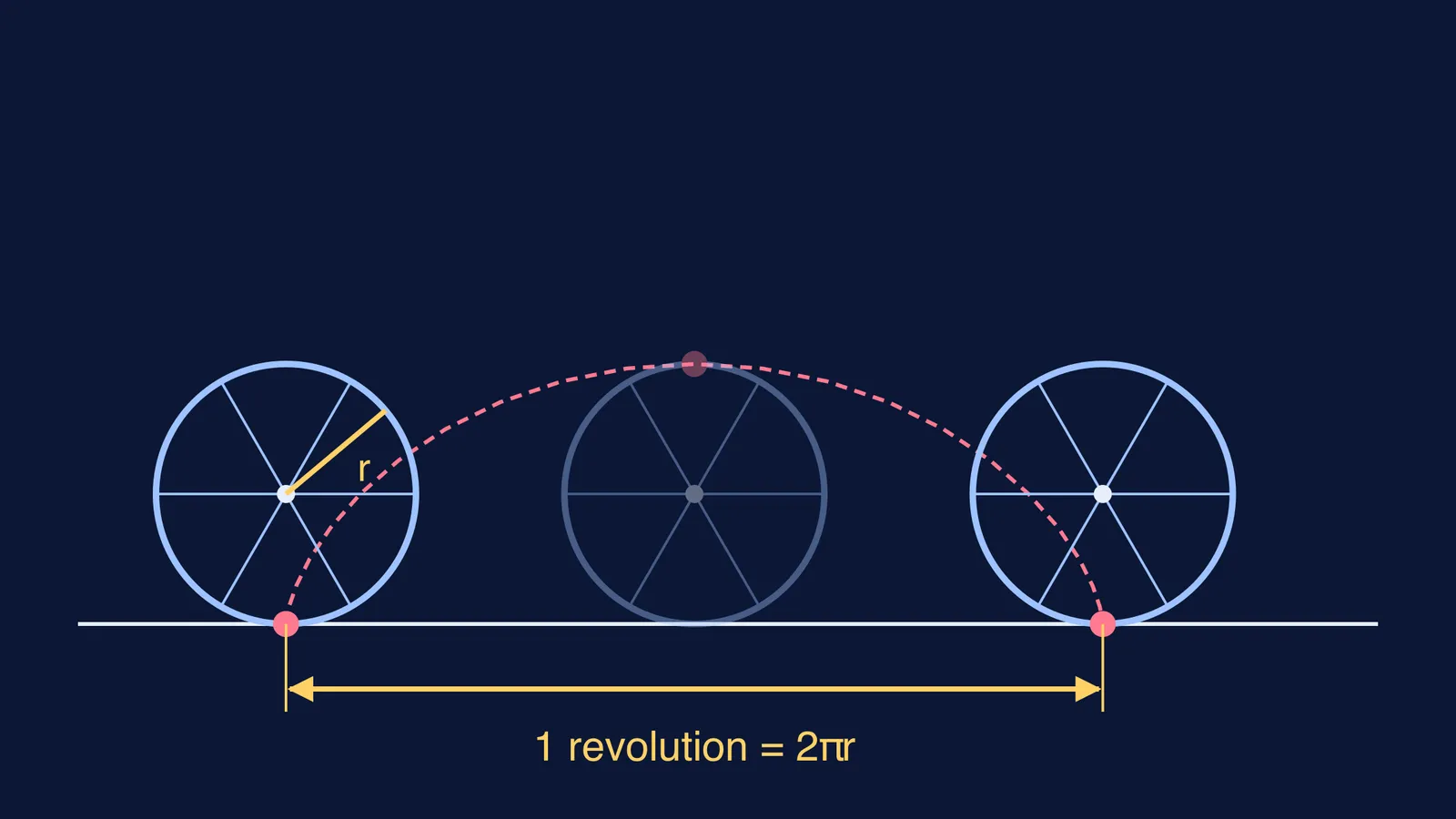
When a wheel rolls without slipping, the distance its centre moves equals its radius times the angle it has turned, d = rθ, as derived in OpenStax University Physics, Volume 1, section 11.1. One full turn is 2π radians, because there are 2π radians in 360° (OpenStax, section 10.1). So one revolution moves the wheel forward by 2πr, which is exactly its circumference.
Picture painting the tyre and rolling it once along the floor: the painted stripe is as long as the rim. Every number in these problems is the circumference, the number of turns, or the time those turns take.
The two formulas you need:
Distance = number of revolutions × 2πr (or × πd if you are given the diameter)
Number of revolutions = distance ÷ 2πr
How many revolutions does a wheel make on a journey?
This uses the same rolling relation from OpenStax section 11.1. Worked example 1: a bicycle wheel has a diameter of 70 cm. How many revolutions does it make on an 11 km ride to school? Use π = 22/7.
Circumference = πd = (22/7) × 70 = 220 cm = 2.2 m.
Put the journey in the same unit: 11 km = 11,000 m.
Revolutions = 11,000 ÷ 2.2 = 5,000.
The wheel makes 5,000 revolutions. Fix the circumference first, put both lengths in metres, then divide.
How do you convert rpm to km/h for a wheel?
rpm means revolutions per minute. The SI conversion tables in NIST Special Publication 811, Appendix B.9 list 1 rpm as 0.1047198 rad/s (that is, 2π ÷ 60) and 1 km/h as 0.2777778 m/s. For a rolling wheel you combine the turn count with the circumference:
Distance per minute = rpm × circumference
Speed in km/h = rpm × circumference in metres × 60 ÷ 1,000 = rpm × C × 0.06
Worked example 2: the same 70 cm wheel turns at 300 rpm. How fast is the cyclist going?
Distance per minute = 300 × 2.2 m = 660 m.
Distance per hour = 660 × 60 = 39,600 m.
Speed = 39.6 km/h.
Check with the shortcut: 300 × 2.2 × 0.06 = 39.6. If the question wants metres per second instead, our guide on how to convert km per hour to m per second explains the factor of 5/18.
How do you find revolutions from a car's speed?
Run the same steps backwards, using the units from NIST Appendix B.9. Worked example 3: a car's wheels are 80 cm in diameter and it travels at 66 km/h. How many revolutions does each wheel make in 10 minutes? Use π = 22/7.
Circumference = (22/7) × 80 = 1,760/7 cm, about 251.4 cm.
Speed = 66 km/h = 66,000 m ÷ 60 min = 1,100 m per minute = 110,000 cm per minute.
Distance in 10 minutes = 1,100,000 cm.
Revolutions = 1,100,000 ÷ (1,760/7) = 1,100,000 × 7 ÷ 1,760 = 4,375.
Each wheel turns 4,375 times, or 437.5 rpm. Keeping π as 22/7 until the last line gives an exact whole number.
Which mistakes cost marks in wheel problems?
Each check below follows from the rolling relation d = rθ in OpenStax section 11.1. Run it before you write the final answer:
Radius or diameter? 2πr and πd give the same circumference; 2πd gives double.
One unit throughout: the wheel is usually in centimetres and the road in kilometres. Convert before you divide.
Minutes or hours? rpm is per minute and km/h is per hour, so a factor of 60 sits between them.
Complete revolutions: round down, so 4,999.6 turns means 4,999.
Two wheels, one road: a front and a rear wheel of different sizes cover the same distance, so the smaller one turns more times. Distance is equal; revolutions are not.
Sanity check: a 2 m circumference means 500 turns per kilometre. If your answer is near 5 or 50,000, a unit slipped.
Part of a turn works the same way, with arc length rθ; practise it in area of sector and arc length formulas. For how a vehicle displays distance and speed, see the difference between an odometer and a speedometer.
Where can you practise more wheel and rotation problems?
If you get the method right but keep losing marks on units, the Fermi Problem Library has worked problems with a step-by-step solver that explains the reasoning rather than printing an answer, so you can see where your working went off track. If radians and angular speed still feel shaky, the Fermi Concept Library gives each concept its own lesson.
Try it now: change the 70 cm wheel to 56 cm, and predict whether the 11 km ride takes more or fewer turns before you calculate.


