

On this page
If you sit in the front seat of a car or bus, you will see a cluster of dials and numbers on the dashboard. In the NCERT Class 7 Science syllabus, these instruments are introduced as the easiest way to understand the difference between how fast you are going right now and how far you have travelled overall. If you need help visualising these concepts for exam numericals, the Fermi Concept Library can walk you through the relationships between speed, distance, and time.
What is the difference between an odometer and a speedometer?
The main difference lies in what they measure and the units they use.
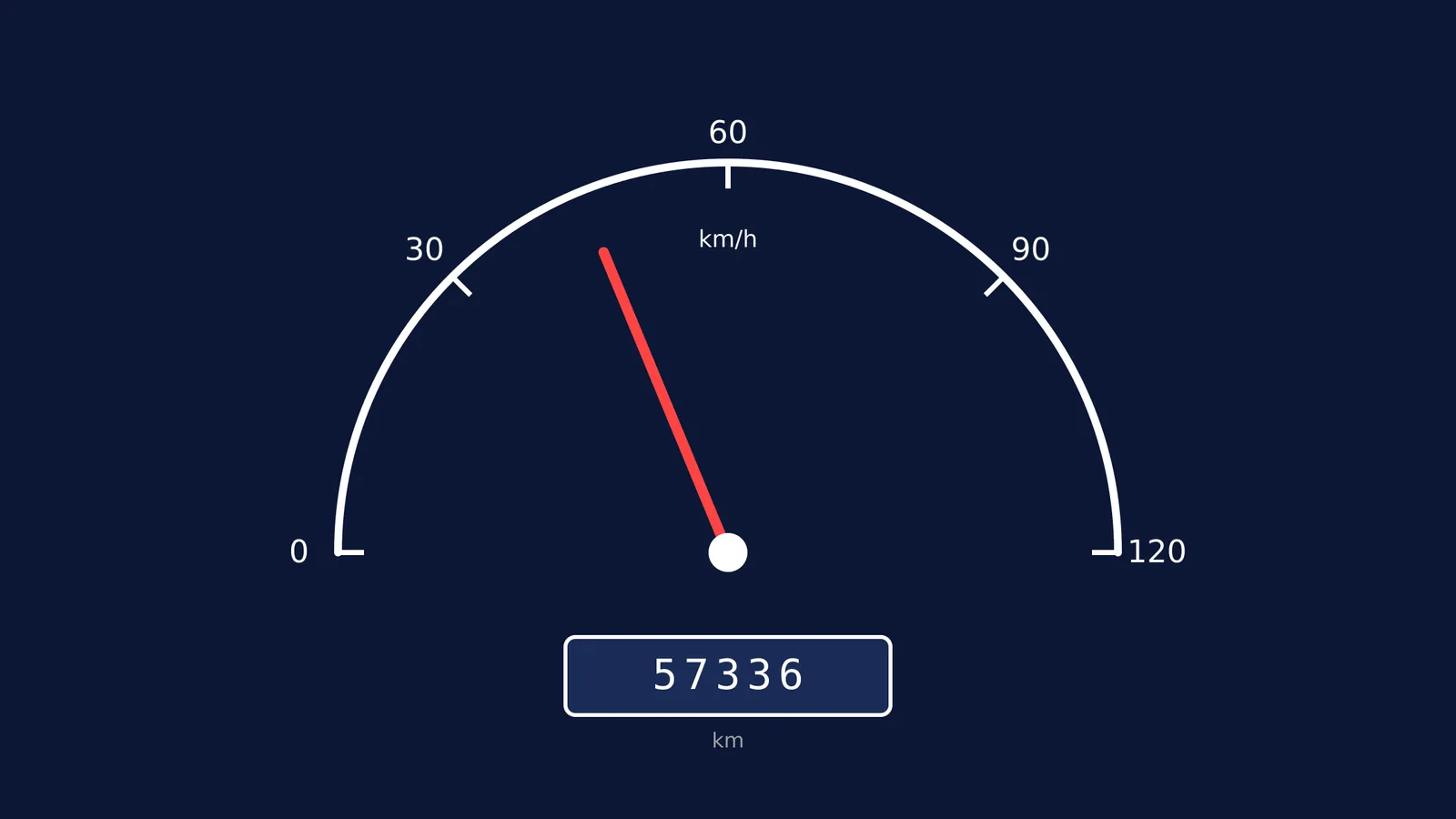
A speedometer is an instrument that measures the instantaneous speed of a vehicle. Instantaneous speed is exactly how fast the car is moving at that specific moment. If the driver presses the accelerator or hits the brakes, the speedometer needle will instantly swing up or down. As the NCERT textbook explains, a speedometer records this speed directly in kilometres per hour (km/h).
An odometer, by contrast, is an instrument that measures the total distance travelled by a vehicle. It keeps a running tally of every rotation the wheels make, adding up the distance covered over the entire lifetime of the vehicle (or since a "trip" meter was last reset). It usually displays this value in kilometres (km).
Historically, both instruments were often driven by the same mechanical cable connected to the vehicle's transmission. In a mechanical setup, a spinning magnet creates a magnetic drag that pulls the speedometer needle up the dial, while a series of geared wheels acts like a clock to increment the odometer. In modern electronic systems, a computer reads electrical pulses from a sensor to calculate speed for the speedometer, while simultaneously tallying those same pulses to increment the digital odometer.
What does an odometer measure in everyday terms?
An odometer measures a physical quantity—the total length of the path the vehicle has travelled.
If you are going on a road trip, your car will not travel at the same speed the entire way. You might reach 90 km/h on an empty highway, but you will slow down to 20 km/h for a toll booth and stop completely at a red light. The speedometer shows you all of these real-time changes. It tells you what is happening at that exact second.
The odometer ignores how fast you were going and only records the result of that motion. If the distance between two cities is 200 km, the odometer will increase by exactly 200 km by the time you arrive, regardless of whether it took three hours of fast driving or five hours in heavy traffic.
Because the odometer records the start and end distance of any journey, it is the perfect tool for calculating your average speed over a long trip.
How do you calculate average speed from odometer readings?
Your speedometer reading constantly fluctuates, so you cannot use it to find out how long a journey took overall. Instead, you calculate the average speed using the total distance and the total time.
Average speed is the total distance covered divided by the total time taken to cover that distance.
Here is a typical Class 7 problem: suppose you note the odometer of a car reads 57,321 km at 08:30 AM. At 08:50 AM, the odometer reading has changed to 57,336 km. What was the average speed?
Find the total distance: Subtract the initial odometer reading from the final reading.
57,336 km − 57,321 km = 15 km
Find the total time: Count the minutes between the start and end times.
From 08:30 AM to 08:50 AM is 20 minutes.
Convert units: Since speed is usually measured in km/h, convert the 20 minutes into hours by dividing by 60.
20 / 60 = 1/3 hour
Apply the formula: Divide the distance by the time.
15 km / (1/3 h) = 15 × 3 = 45 km/h
Even though the speedometer might have shown 60 km/h at times and 0 km/h at traffic lights, the overall average speed for the trip was 45 km/h. If you are struggling with calculations like this, including pendulums and speed in Class 7, breaking the problem down into its distance and time components is always the safest first step.


