

On this page
In physics and mathematics, equations expect speed in standard SI units (metres and seconds). But in daily life, speedometers show kilometres per hour. To plug a speed into an equation like v = u + at, you usually need to change it first.
Why is the fraction 5/18?
To figure out how many metres an object travels every second, you have to break down both the distance and the time.
1 kilometre is equal to 1000 metres. One hour contains 60 minutes, and each minute has 60 seconds, meaning one hour is exactly 3600 seconds.
Therefore, a speed of 1 km/h means moving 1000 metres every 3600 seconds. As a fraction, this is: 1000 m / 3600 s
When you divide the top and the bottom numbers by 200 to simplify the fraction, you get 5/18.
How to convert km/h to m/s?
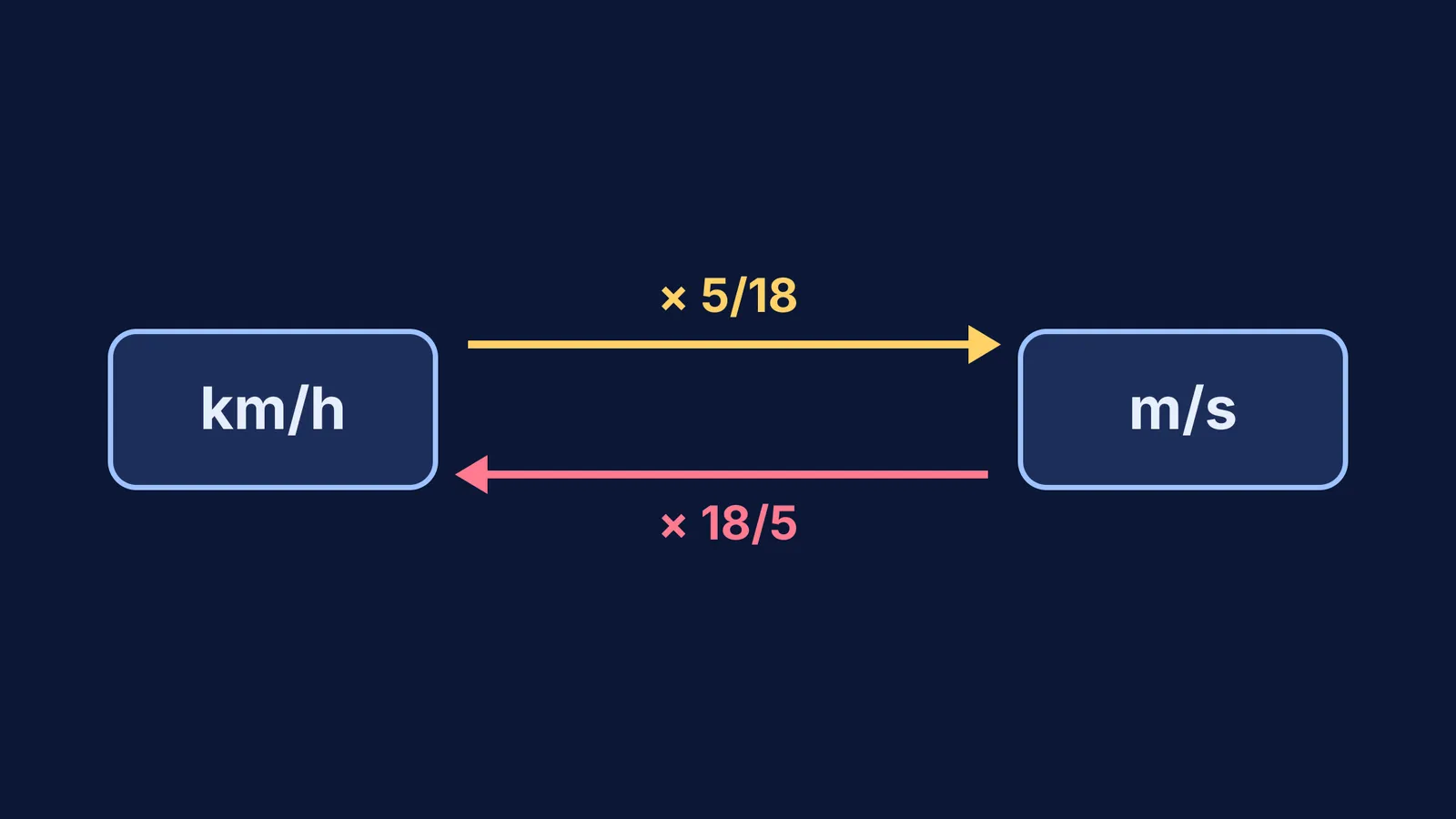
To change kilometres per hour to metres per second, you multiply the speed by 5/18.
Take a bus on a four-lane Indian highway. According to the Ministry of Road Transport and Highways, the maximum speed limit for buses on these roads is 90 km/h. If a bus is moving at this limit, what is its speed in m/s?
90 × 5/18 = 5 × 5 = 25 m/s
Or consider the animal kingdom. The cheetah is the fastest land animal, with a maximum recorded speed of 114 km/h.
114 × 5/18 = 31.67 m/s
How to convert m/s to km/h?
To go the other way, from metres per second back to kilometres per hour, you flip the fraction and multiply by 18/5.
Let's look at the fastest human. During his 100-metre world record race in 2009, Usain Bolt reached a top speed of 12.42 m/s. To understand what that means in everyday terms, convert it to km/h:
12.42 × 18/5 = 44.71 km/h
(If you round 12.42 to three decimal places from the original split times, it comes out to exactly 44.72 km/h).
What are the common speed conversions?
In many textbook problems, examiners intentionally use speeds that are multiples of 18 to make the maths easier without a calculator. Memorising these common pairs will save you valuable time during a physics or mathematics test.
Here are the common pairs:
18 km/h is exactly 5 m/s
36 km/h is exactly 10 m/s
54 km/h is exactly 15 m/s
72 km/h is exactly 20 m/s
90 km/h is exactly 25 m/s
108 km/h is exactly 30 m/s
If you see one of these numbers, you instantly know the equivalent speed. You do not even need to write down the multiplication step. For example, a train accelerating from 36 km/h to 72 km/h is simply changing its speed from 10 m/s to 20 m/s.
How does this apply to solving physics problems?
Let us walk through a typical exam scenario where forgetting to convert units would lead to the wrong answer.
Imagine a question states that a motorcycle travels at 54 km/h and then hits the brakes, coming to a complete stop in 3 seconds. The question asks for the motorcycle's acceleration.
The initial velocity is given in kilometres per hour, but the time is given in seconds. If you try to use the formula v = u + at without converting the units first, your calculation will be completely incorrect. You cannot mix hours and seconds in the same equation.
First, convert the initial velocity (u) into metres per second: 54 × 5/18 = 3 × 5 = 15 m/s.
Now you have all the variables in matching units:
Initial velocity (u) = 15 m/s
Final velocity (v) = 0 m/s (because the motorcycle stops)
Time (t) = 3 seconds
Now plug these into the kinematics equation: 0 = 15 + a × 3 −15 = 3a a = −5 m/s²
The acceleration is −5 m/s². The negative sign means the motorcycle is slowing down. Skipping the conversion step would give −18 m/s², which is physically incorrect.
How to remember which one to use?
It is easy to mix up 5/18 and 18/5 when you are rushing through an exam paper.
Because 5/18 is less than 1, multiplying by it makes your number smaller (km/h to m/s). Because 18/5 is greater than 1, it makes your number bigger (m/s to km/h).
A great habit is to look at your answer and ask if it makes physical sense. If you plug the wrong fraction into your working, you will get a car moving at 300 m/s (which is faster than an aeroplane) or a sprinter moving at 3 km/h (which is walking pace). If you get stuck on this in the Fermi Problem Library, the step-by-step solver explains the reasoning rather than printing an answer, checking your understanding of whether the speed fits the real world as it goes.
For more practice on applying speed and distance formulas, you might want to try solving quadratic word problems in Class 10 or look at how to find the distance in the nth second using kinematics equations.