

On this page
Closing one eye makes simple tasks like pouring water, threading a needle, or catching a ball noticeably harder. Reaching for an object that felt automatic with both eyes open suddenly requires cautious adjustment.
The NCERT Class 10 Science textbook notes that one eye provides a horizontal field of view of about 150°, while two eyes expand it to approximately 180°. Yet a wider view is only part of the advantage. Two forward-facing eyes provide stereopsis: the visual cortex computing three-dimensional depth by fusing two separate, overlapping perspectives.
Why do we need two eyes to judge depth?
Adult human pupils are separated horizontally by an average interpupillary distance of approximately 6.3 cm, according to the American Academy of Ophthalmology's EyeWiki. Because our eyes occupy distinct positions, each eye views objects from a slightly different horizontal angle. Hold a mug at arm's length and alternate closing each eye: each retina captures a slightly different flat image.
In 1838, Charles Wheatstone demonstrated in the Philosophical Transactions of the Royal Society of London that this difference is the primary basis of three-dimensional vision. Using his reflecting stereoscope—which presented slightly different drawings separately to each eye—Wheatstone proved that the brain fuses optical discrepancies into an immediate perception of solid depth. Just as ray refraction clarifies optical defects of the human eye, horizontal disparity explains our depth perception.
How does the brain calculate depth from retinal disparity?
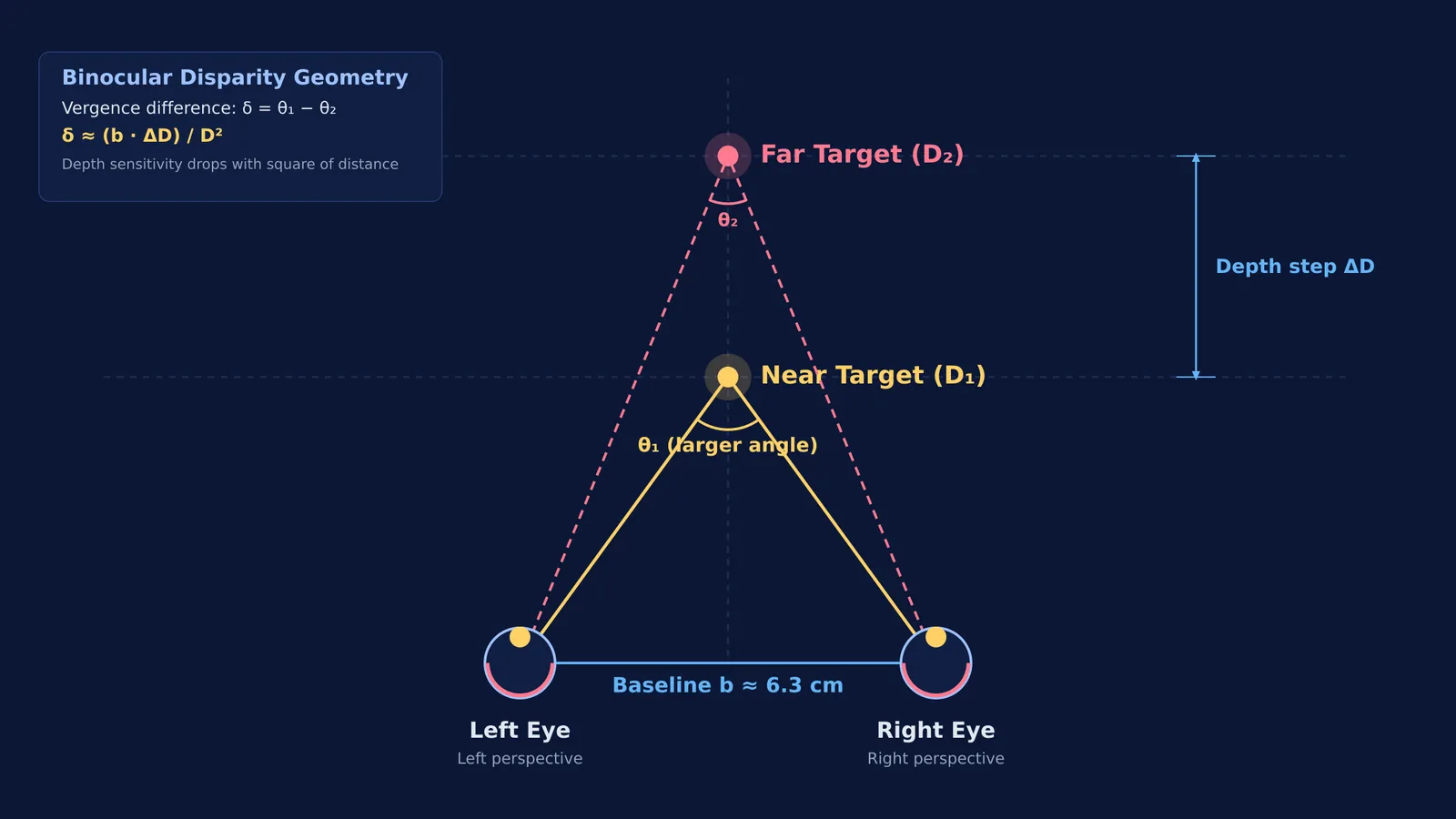
When fixating on an object, its image lands on corresponding retinal points in the fovea centralis. Points nearer or farther cast light onto non-corresponding retinal positions. This spatial shift between the two retinal projections is binocular disparity.
In the primary visual cortex, binocular neurons decode this disparity. A 1970 study in Nature by David H. Hubel and Torsten N. Wiesel proved that cortical cells respond selectively to specific retinal disparities, firing when an image shift matches a physical depth offset.
Depth sensitivity, or stereoacuity, is measured in arcseconds (1/3600 of a degree). Clinical data on EyeWiki show that healthy human eyes detect disparities as fine as 20 to 40 arcseconds.
Disparity follows an inverse-square geometry:
δ ≈ (b × ΔD) / D²
where b is interpupillary distance (~0.063 m), D is viewing distance, and ΔD is depth separation between targets.
For a 2 cm depth separation (ΔD = 0.02 m):
At arm's length (D = 0.5 m):
δ ≈ (0.063 × 0.02) / 0.5² = 0.00126 / 0.25 = 0.00504 radians ≈ 1,040 arcseconds.
Across a room (D = 5.0 m):
δ ≈ (0.063 × 0.02) / 5.0² = 0.00126 / 25 = 0.0000504 radians ≈ 10.4 arcseconds.
Because disparity scales as 1/D², moving ten times farther reduces the signal by a factor of 100. At 5 metres, a 2 cm offset falls to ~10 arcseconds—below the stereoacuity threshold. As explored in how different brain regions process sensory input, stereopsis is specialized for precision tasks in nearby space.
What does the finger test reveal about your vision?
You can demonstrate binocular disparity with two simple desk tests:
Parallax Shift: Align your upright index finger at arm's length with a distant vertical window frame. Alternate closing each eye. Your finger appears to jump sideways because each eye views it from a vantage point 6.3 cm apart.
Tip-to-Tip Alignment: Hold both index fingers horizontally about 30 cm apart at chest height and bring them together tip-to-tip. With both eyes open, you succeed easily. Close one eye and try again: most people miss by 1 to 3 cm.
Why do we miss with one eye? In a 2006 study in Experimental Brain Research, Dean R. Melmoth and Simon Grant showed that binocular disparity guides the terminal deceleration and grip phase of reaching. Without stereo feedback, subjects moved more cautiously and opened their grip wider.
For students exploring optics where geometry is easier to see than to read, interactive models in the Fermi Simulation Lab show how light rays, focal distances, and angles behave.
Why can you still judge distance with one eye closed?
Why do we still perceive depth with one eye closed? The brain uses monocular cues: relative size, linear perspective, occlusion, and motion parallax when moving your head. Straight ray trajectories forming these projections were historically documented in Ibn al-Haytham's pioneering experiments on optics.
This trade-off shaped animal evolution. Prey like rabbits have lateral eyes providing the widest possible field of view approaching 360° to spot predators, according to the NCERT Class 10 Science syllabus. Predators and primates have forward-facing eyes, trading panoramic coverage for overlapping binocular vision to hunt and grasp tools.
When studying sensory biology or optics, the Fermi Concept Library covers every concept in physics and biology, each with its own lesson and place in the map.


