

On this page
If you take off your 3D glasses during a film, the screen turns into a blurry, overlapping mess. You are watching two complete movies playing at the exact same time. The trick of a 3D cinema is not in the screen itself, but in how the projector and your glasses work together to hack your brain's natural depth perception. Answering the question 'how do 3D glasses work in a cinema?' means diving into the biology of your eyes and the physics of light.
What is binocular disparity?
Human depth perception relies on the physical gap between our eyes. A 2012 population study of 1,500 people found that the average adult interpupillary distance—the gap between the pupils—is 62.1 mm (Fesharaki et al., 2012).
Because your eyes sit roughly 62 mm apart, they each see the world from a slightly different angle. Hold a finger in front of your face and alternate closing your left and right eyes: the finger will appear to jump back and forth against the background. Your brain automatically merges these two distinct images into a single picture, calculating depth based on the differences. This mechanism is called binocular disparity, and it is the absolute foundation of how we see the world in three dimensions. For more on how the eye focuses and forms images, you can read about The human eye and its defects: myopia, hypermetropia and lenses.
How do 3D glasses work in a cinema?
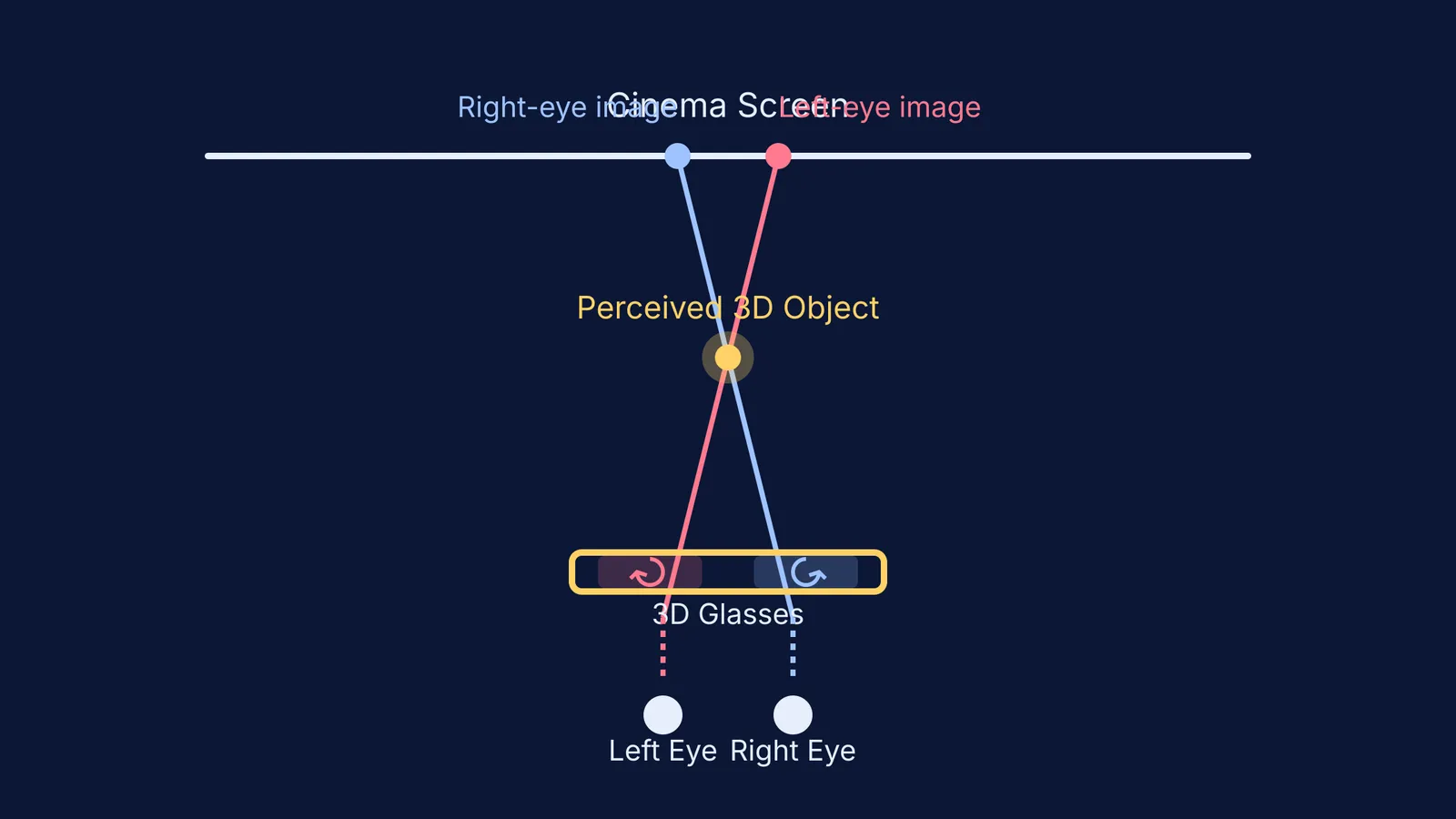
To create a 3D effect on a completely flat screen, filmmakers shoot the movie using two camera lenses spaced about as far apart as human eyes. In the cinema, the projector throws both the left-eye and right-eye perspectives onto the screen simultaneously.
The job of the 3D glasses is to act as a strict optical bouncer. The left lens must let in only the left-eye image, and the right lens must let in only the right-eye image. If the glasses do their job correctly, your brain receives two different perspectives and, following its natural programming, constructs a vivid 3D image.
The physics of polarisation
Modern cinemas separate the two projected images using polarised light. Light is an electromagnetic wave that normally vibrates in all directions. A linear polarising filter acts like a microscopic picket fence, only allowing light waves that vibrate in a specific direction (for example, perfectly vertical) to pass through. You can read the history of this invention in our story on Edwin Land and the sheet polariser for light.
Older 3D systems, such as early IMAX, used linear polarisation. The projector displayed the left image with vertically polarised light, and the right image with horizontally polarised light. The glasses had matching vertical and horizontal filters.
There was one major flaw: if you tilted your head, the "picket fences" in your glasses no longer lined up with the light bouncing off the screen. The filters would fail, the images would bleed into each other, and you would see a disorienting double image known as ghosting.
Why modern cinemas use circular polarisation
To solve the head-tilt problem, most modern cinemas (such as those using RealD 3D technology) use circular polarisation. Instead of restricting the light wave to a flat plane, a special optical component called a quarter-wave plate delays one part of the wave just enough so that the electric field vector rotates as it travels. The light travels through space in a helical shape.
The projector sends the left-eye image twisting in a clockwise direction, and the right-eye image twisting in a counter-clockwise direction.
The lenses in your cinema glasses are carefully layered to decode this. The front layer is another quarter-wave plate, often made of a stretched polymer, that catches the spinning light and introduces a second phase shift. This "untwists" the incoming circular light, converting it perfectly back into a straight, linear wave.
The back layer is a standard linear polariser. If the incoming twist was meant for your right eye, it converts into a wave that passes cleanly through the back layer. If it was the left-eye image, it converts into a wave oriented at 90 degrees to the filter, and is completely blocked. Because the light is constantly spinning as it travels from the screen, it does not matter if your head is tilted. The glasses will always catch the twist and convert it correctly.
If you find it difficult to visualise how electric and magnetic fields can be delayed and rotated to create circular polarisation, you can build and manipulate the waves yourself in the Fermi Simulation Lab. Seeing the vectors rotate in real time makes the mathematics of wave optics immediately obvious.
This mirror trick works because the laws of physics dictate that reflection reverses the "handedness" of circular polarisation. The clockwise light leaving your open right eye bounces off the mirror and becomes counter-clockwise. When this flipped light travels back and tries to re-enter your right lens, the filters read it as the wrong image and permanently block it.


