

On this page
Look at the wires between two electricity poles on a hot May afternoon, and again on a cold January morning. In summer they hang in a deeper curve. The wire has got slightly longer, the poles have not moved, and the extra length has nowhere to go but down.
Why do electric wires sag more in summer?
Metal wires expand when they get hotter. For a wire of length L, the increase in length is ΔL = αLΔT, where α is the coefficient of linear expansion and ΔT is the rise in temperature (HyperPhysics: thermal expansion). The most common transmission conductor is aluminium conductor steel reinforced, or ACSR (overhead power line, Wikipedia). Aluminium has α of about 24 × 10⁻⁶ per °C (HyperPhysics expansion table).
Current heats the wire too. The official report on the 2003 North American blackout puts it plainly: “Higher flow on a transmission line causes the line to heat up, and the hot line sags lower because the hot conductor metal expands” (U.S.-Canada Power System Outage Task Force, Chapter 5). The same chapter notes that on a summer day, conductor temperatures can rise from 60°C on mornings with average wind to 100°C with hot air and low wind. Summer stacks the causes: hot air, still air that cools the wire less, and air conditioners drawing more current.
The report shows why it matters: on 14 August 2003, three 345 kV lines in Ohio tripped after touching trees that had grown too tall, on an afternoon when light winds let the lines sag further. If you ever see a line hanging low enough to reach, keep away and report it to your electricity distribution company.
How much longer does a wire get on a hot day?
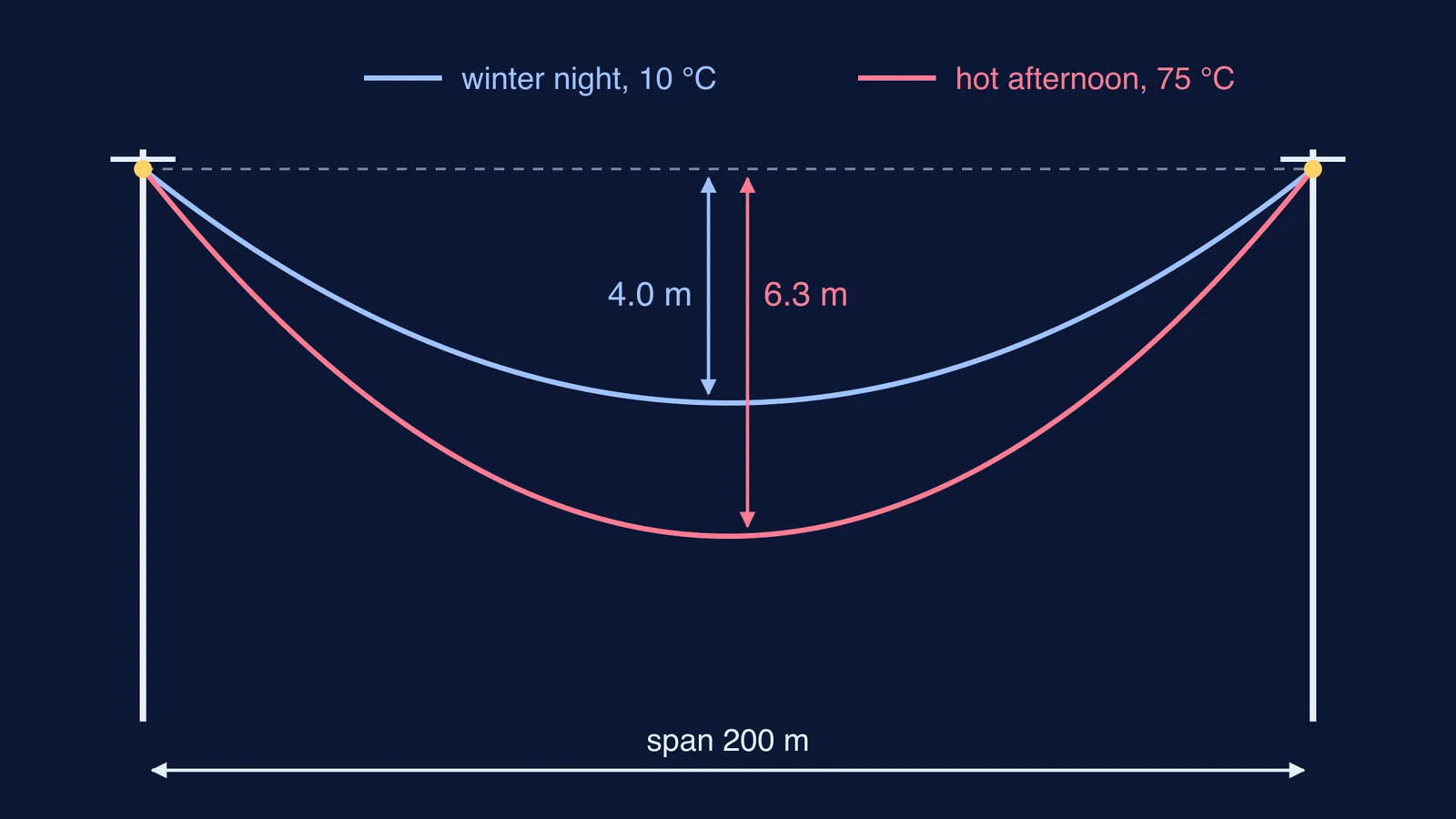
Take a 200 m span (S) of aluminium wire with a 4.0 m sag (D) on a 10°C winter night, and heat it to 75°C, inside the 60–100°C range the blackout report gives for a summer day. Use α = 24 × 10⁻⁶ per °C (HyperPhysics).
Winter length. A shallow hanging wire is very nearly a parabola, and a parabola's length is L ≈ S + 8D²/(3S). So L = 200 + 8 × 16 ÷ 600 ≈ 200.213 m. The wire is only 21 cm longer than the gap it crosses.
Expansion. ΔL = αLΔT = 24 × 10⁻⁶ × 200.213 × 65 ≈ 0.312 m.
New sag. The wire is now 0.526 m longer than the span, so D² = 3S × 0.526 ÷ 8 ≈ 39.4, and D ≈ 6.3 m.
A wire just 31 cm longer hangs 2.3 m lower. Because the poles are fixed, a small change in length becomes a large change in sag. The sag formula D = wS²/(8T), where w is the weight per metre and T the tension (Electrical Easy), then tells you the tension has fallen to about 4.0 ÷ 6.3, or 64%, of its winter value.
Treat 6.3 m as an upper estimate. As tension falls, the wire's elastic stretch shrinks a little, and the steel core of ACSR expands less than aluminium, at about 13 × 10⁻⁶ per °C (HyperPhysics expansion table). Engineers solve tension change and the curve together (McCarthy and Nair, IET Generation, Transmission & Distribution, 2015).
Some ideas are easier to see than to read; the Fermi Simulation Lab has interactive simulations for them.
Why not just pull the wire tight?
Run the example backwards. Suppose a wire were clamped dead straight on a 45°C afternoon and then cooled to 5°C. It cannot shrink, so the clamps stretch it, and the stress is Young's modulus × αΔT. For aluminium, Young's modulus is about 70 × 10⁹ N/m² and the ultimate strength about 110 × 10⁶ N/m² (HyperPhysics elastic properties).
So the stress from cooling alone is 70 × 10⁹ × 24 × 10⁻⁶ × 40 ≈ 67 × 10⁶ N/m², over 60% of the breaking strength, before weight or wind. A drop of about 65°C would reach the breaking stress. Sag is the slack that prevents this. In winter the wire shortens, the curve flattens and tension rises, but the slack is chosen to keep it within safe limits.
How do you answer this in a board or JEE exam?
A “why” question rewards a clear chain:
Name the effect: thermal expansion of solids, ΔL = αLΔT.
Say what is fixed: the poles do not move, so the extra length goes into the curve.
Give both heat sources: hot air and current, worse in still air.
Give the winter side: the wire shortens and tension rises, so slack is left to stop it snapping.
For a numerical, find the length from L ≈ S + 8D²/(3S), expand it, then solve for the new sag.
For more, read how to find the coefficient of linear expansion by experiment, why a tight clothesline has huge tension with small sag and why electricity is transmitted at high voltage.
For practice, the Fermi Problem Library has worked problems with a step-by-step solver that explains the reasoning rather than printing an answer.


