

On this page
A metal rod that grows by less than a millimetre is the whole difficulty of this experiment. The formula takes one line; the skill is measuring three quantities of very different sizes and knowing which one controls your error.
What is the coefficient of linear expansion?
For a small temperature change ΔT, the fractional change in a rod's length is proportional to ΔT: Δl/l = α ΔT, where α is the coefficient of linear expansion, a property of the material (NCERT Class 11 Physics, Thermal Properties of Matter).
NCERT's Table 10.1 gives typical average values for 0 °C to 100 °C, in units of 10⁻⁵ K⁻¹: aluminium 2.5, brass 1.8, copper 1.7 and iron 1.2 (NCERT).
The same chapter notes that a kelvin and a degree Celsius are the same size, so a rise of 75 °C is a rise of 75 K, and either unit works for ΔT.
How do you find the coefficient of linear expansion experimentally?
A common lab method passes steam through a metal tube and reads the extension on a dial gauge. The steps below follow the experiment guide for PASCO's TD-8578 thermal expansion apparatus, which uses copper, brass and aluminium tubes.
Measure the rod's length L at room temperature, between the two points that fix it (one clamped end, one end touching the gauge).
Mount the rod so one end is fixed and the other presses on the dial gauge.
Record the room temperature on a thermometer or thermistor touching the rod.
Turn the gauge's outer scale so it reads zero.
Pass steam through the rod or its jacket. Wait until the temperature reading stops changing.
Record the final temperature and the gauge reading ΔL.
Calculate ΔT = T(hot) − T(room), then α = ΔL/(L ΔT).
In that apparatus, each division on the dial gauge is 0.01 mm of expansion, and temperatures are read to within 0.2 °C (PASCO manual). Your school's apparatus may differ, so check the least count of the instruments you actually use.
Worked example: a copper rod heated by steam
Suppose these are your readings from a setup like the PASCO apparatus:
L = 600.0 mm (metre scale, least count 1 mm)
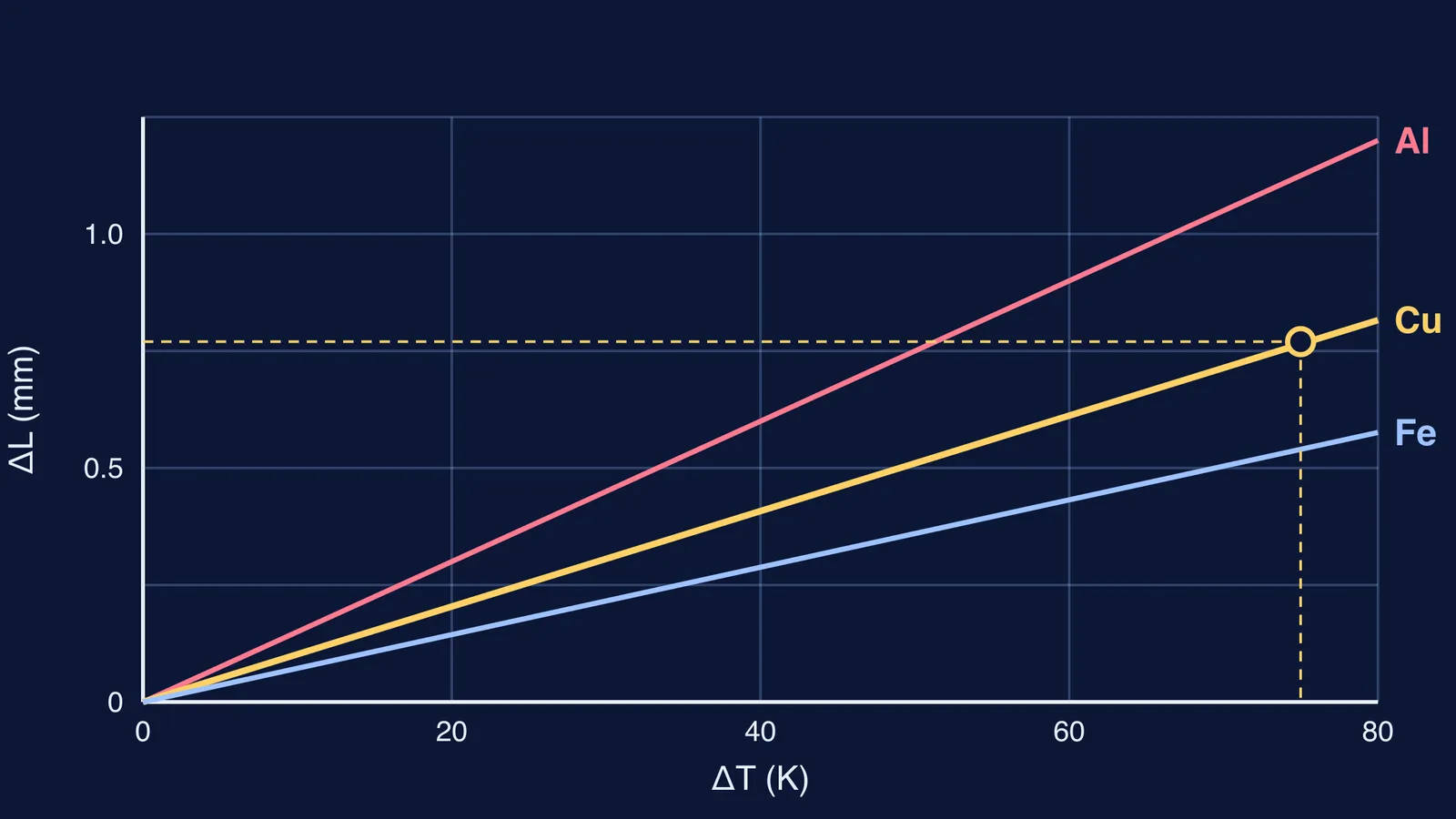
T(room) = 25.0 °C, T(hot) = 100.0 °C (each read to ±0.2 °C), so ΔT = 75.0 K
ΔL = 0.77 mm (dial gauge, 0.01 mm per division)
Then α = 0.77 / (600.0 × 75.0) = 0.77 / 45,000 = 1.71 × 10⁻⁵ K⁻¹.
That sits right on NCERT's copper value of 1.7 × 10⁻⁵ K⁻¹ (NCERT). PASCO's accepted value for copper is the same number written differently: 17 × 10⁻⁶ per °C (PASCO manual).
Which measurement limits your answer?
Because α is a product and quotient, its fractional error is the sum of the fractional errors of ΔL, L and ΔT. For the example above:
ΔL: 0.01 / 0.77 = 1.3%
L: 1 / 600 = 0.17%
ΔT: each temperature is ±0.2 °C (PASCO manual), so ±0.4 on 75, which is 0.53%
Total: about 2.0%, so α = (1.71 ± 0.03) × 10⁻⁵ K⁻¹. If you want to see why errors add like this, our post on why percentage error doubles when a quantity is squared walks through the rule.
The practical lesson: a bigger temperature rise and a longer rod both make ΔL larger, which shrinks the dominant error.
What goes wrong in the lab?
Reading before equilibrium. The rod keeps growing until its temperature settles. Wait for the thermometer to stop moving.
Assuming steam is exactly 100 °C. NCERT defines the steam point as the temperature at which pure water boils under standard pressure. Read the temperature rather than assuming it.
Measuring L hot. Take L at room temperature, before heating.
Forgetting the gauge zero. Set or note the zero before the steam goes on.
Mixing up mm and m. Keep ΔL and L in the same unit and α comes out in K⁻¹.
With a supply of hot water at several temperatures, you can do better than one reading. The PASCO guide suggests passing hot or cold water through the tube for extra data points. Plot ΔL against ΔT: the slope is αL, so α = slope/L. A best-fit line averages out single slips, and our guide to error bars and the uncertainty in a gradient shows how to quote the result. For a related practical with the same habits (waiting for equilibrium, watching heat loss), see specific heat by the method of mixtures.
If an exam question gives you three readings and asks for α with its error, try a few in the Fermi Problem Library. Its step-by-step solver explains the reasoning rather than printing an answer, so you can see where a unit or error term slipped. To revise why solids expand at all, start from thermal expansion in the Fermi Concept Library.


