

On this page
In qualitative inorganic salt analysis, identifying basic radicals follows a systematic separation based on solubility rules. When you reach Group IV in the NCERT Laboratory Manual for Class XII Chemistry, you test for four transition metal cations: cobalt (Co²⁺), nickel (Ni²⁺), manganese (Mn²⁺), and zinc (Zn²⁺). While cobalt and nickel yield black precipitates of CoS and NiS, and manganese produces a buff precipitate of MnS, zinc stands alone. It is the only common cation across Group IV that forms a pure white precipitate of zinc sulphide (ZnS).
Why is zinc sulphide the only white precipitate in Group IV?
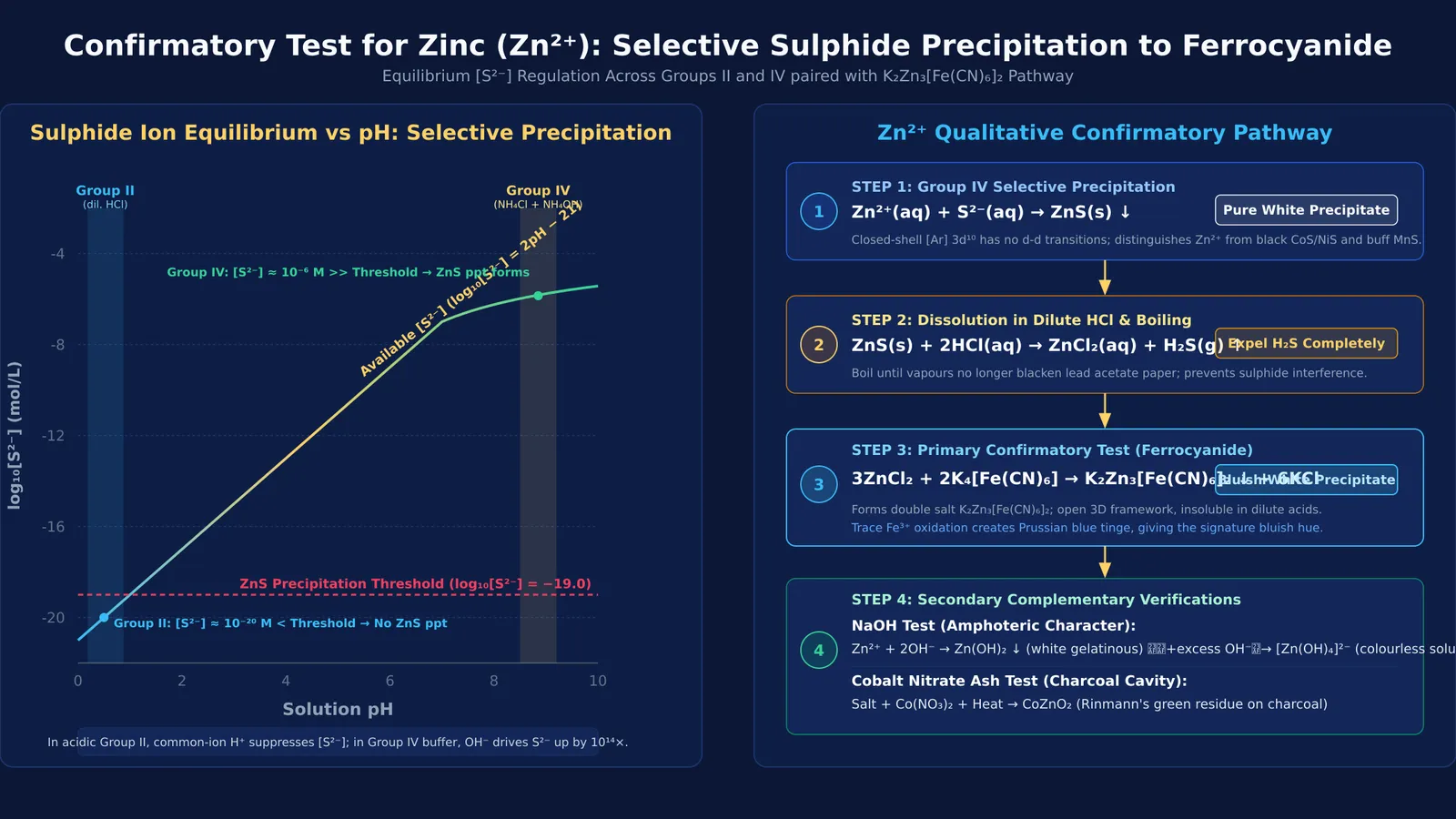
The white colour of zinc sulphide stems from zinc's closed-shell electron configuration. With an atomic number of 30, the dipositive zinc ion (Zn²⁺) has the electronic configuration [Ar] 3d¹⁰. Because all five 3d orbitals are completely filled, no electrons can undergo d-d transitions by absorbing visible light. As detailed in our analysis of why zinc, cadmium and mercury are not called transition elements, this filled d-subshell leaves zinc compounds colourless in aqueous solution and white as solids.
In contrast, Co²⁺ (3d⁷), Ni²⁺ (3d⁸), and Mn²⁺ (3d⁵) contain partially filled d-orbitals. Crystal field splitting and charge transfer in their metal sulphides cause strong absorption across visible wavelengths, making CoS and NiS jet black and MnS buff-coloured. According to analytical solubility benchmarks in the NCERT Class XII Chemistry Laboratory Manual, zinc sulphide precipitates once the ionic product exceeds its solubility product constant (Ksp) of approximately 1.1 × 10⁻²¹ at 25 °C.
Why does zinc precipitate in Group IV rather than Group II?
A core question in salt analysis is why zinc does not precipitate alongside copper or lead in Group II. Both groups use hydrogen sulphide (H₂S) gas as the precipitating reagent, but they operate at different pH levels. In our guide to systematic salt analysis, cation separation depends on regulating sulphide ion concentration [S²⁻].
According to the NCERT Laboratory Manual for Class XII Chemistry, Group II cations precipitate in dilute hydrochloric acid (about 0.3 mol/L HCl), establishing an acidic environment near pH 0.5. Hydrogen sulphide dissociates as H₂S ⇌ 2H⁺ + S²⁻, with an overall dissociation constant of about 1.3 × 10⁻²⁰ mol²/L². The common ion effect from strong acid pushes this equilibrium backward, reducing [S²⁻] to roughly 10⁻²¹ mol/L. While copper(II) sulphide has an extremely low Ksp of 6 × 10⁻³⁶ and precipitates immediately, zinc sulphide (Ksp ≈ 1.1 × 10⁻²¹) requires a much higher [S²⁻] to exceed its solubility product.
In Group IV, adding ammonium chloride and ammonium hydroxide creates an alkaline buffer with a pH between 8.5 and 9.2. Hydroxide ions consume H⁺ to form water, shifting the equilibrium forward and raising [S²⁻] to roughly 10⁻⁶ mol/L. As shown in our review of ionic equilibrium and buffer systems, this elevated [S²⁻] ensures the ionic product exceeds the Ksp of ZnS. To explore how buffer equilibria govern selective precipitation, the Fermi Concept Library maps every concept in physics, chemistry, biology, mathematics and computing, each with its own lesson and its place in the map.
How does potassium ferrocyanide confirm the presence of zinc?
After filtering the white zinc sulphide precipitate, you dissolve it in dilute hydrochloric acid: ZnS + 2HCl → ZnCl₂ + H₂S ↑
Adding potassium ferrocyanide (K₄[Fe(CN)₆]) to the boiled solution produces a bluish-white precipitate of potassium zinc ferrocyanide: 3ZnCl₂ + 2K₄[Fe(CN)₆] → K₂Zn₃[Fe(CN)₆]₂ ↓ + 6KCl
In the presence of excess potassium ferrocyanide, the double salt K₂Zn₃[Fe(CN)₆]₂ forms. Classical studies by D. F. Swinehart in *Analytical Chemistry* verified that this reaction proceeds quantitatively with exact stoichiometry. Research by Hongkyung Lee and colleagues in *Chemical Communications* demonstrated that zinc hexacyanoferrate adopts an open three-dimensional framework of [Fe(CN)₆]⁴⁻ octahedra linked to Zn²⁺ tetrahedra. The bluish tint arises from trace iron(III) impurities forming tiny amounts of Prussian blue, giving the white solid its distinctive appearance. This precipitate is insoluble in dilute acids.
What secondary tests confirm zinc in the school laboratory?
To meet the practical requirements of the CBSE Senior Secondary Chemistry Curriculum, verify zinc with two complementary tests:
Sodium hydroxide test: Adding dilute NaOH dropwise gives a white gelatinous precipitate of zinc hydroxide, Zn(OH)₂. Adding excess NaOH dissolves the precipitate to form colourless sodium tetrahydroxozincate(II), Na₂[Zn(OH)₄], demonstrating zinc's amphoteric character.
Cobalt nitrate ash test: Heating the salt with cobalt nitrate on charcoal yields a green residue of Rinmann's green (cobalt zincate, CoZnO₂).
How do you troubleshoot common mistakes during zinc salt analysis?
Follow this checklist during laboratory examinations:
Expel all H₂S: Boil the dissolved ZnS until vapours no longer turn lead acetate paper black.
Balance the buffer: Always add NH₄Cl before NH₄OH to prevent magnesium from precipitating as Mg(OH)₂.
Check ferrocyanide freshness: Oxidised ferricyanide produces a brownish precipitate instead of bluish-white.
Add NaOH dropwise: Immediate excess base dissolves Zn(OH)₂ before you can observe the white precipitate.
When practicing qualitative analysis problems, the Fermi Problem Library provides worked problems with a step-by-step solver that explains the reasoning rather than printing an answer.


