On this page
You switch off the bedroom light and the LED bulb does not quite go dark. It keeps a faint glow, or it gives a dim flash every few seconds all night. In most homes nothing is broken. The wire that runs from the switch to the lamp lies beside a wire that is always live, and the two wires together make a small capacitor. Here is how big that current is, and why an LED driver turns it into a blink.
Why does an LED bulb glow or blink when the switch is off?
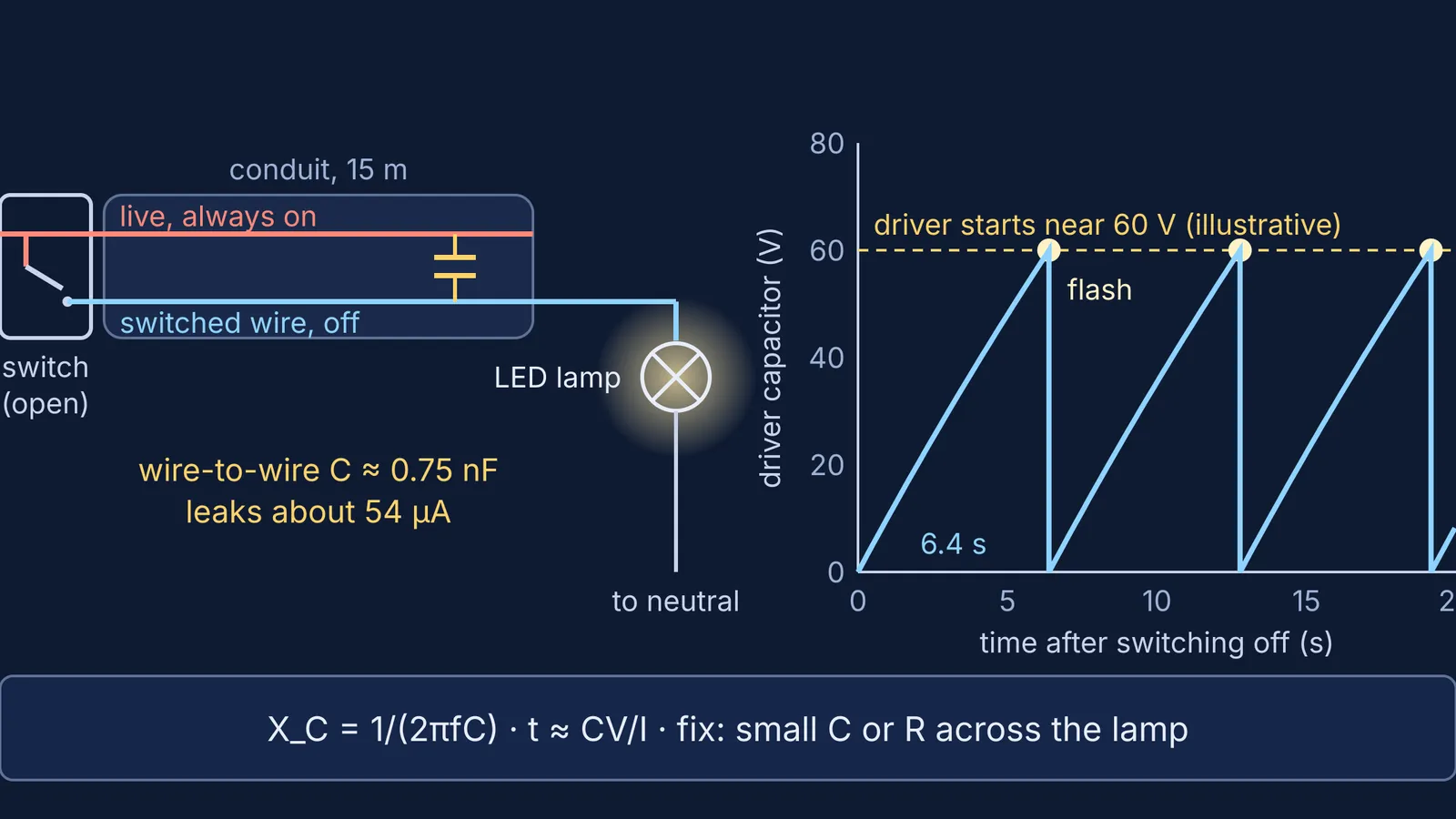
Between the switch and the ceiling, the switched wire usually runs in the same conduit as the live wire that feeds the switch. Two insulated conductors side by side are two plates with a dielectric between them. With the switch open, one plate (the live wire) swings between +325 V and −325 V fifty times a second, and the other plate (the switched wire) is joined to neutral only through the lamp. The charge that flows on and off the switched wire each half cycle has to pass through the lamp.
Lighting makers describe exactly this. Niko's support page on LED lamps that stay lit after switching off says the leakage current "happens when leakage currents are generated via capacitive effects with long cables", and that very low-power lamps can light up from it (Niko FAQ).
How a series capacitor limits a lamp's current is worked out in a bulb in series with a capacitor on AC. The new part here is where the capacitor comes from, and what an LED driver does with a few microamperes.
How much capacitance do two wires in a conduit have?
A cable maker's datasheet for a twisted pair of 1.5 mm² PVC-insulated conductors lists a nominal capacitance of 120 pF/m between conductors (Belden 2P1.5YCY datasheet). Loose single wires in a conduit sit farther apart, so their capacitance is lower.
You can check the order of size yourself. For two long parallel wires of radius a whose centres are d apart, C per metre = πε₀ε_r / cosh⁻¹(d/2a). Take two touching 1.5 mm² wires: a = 0.69 mm, each with 0.7 mm of insulation, so d = 2.78 mm. In air this gives about 21 pF/m, and the PVC between them raises it. Real runs vary a lot, so this post uses 50 pF/m as a round illustrative value, between the air estimate and the datasheet figure. Coaxial and other cable shapes are derived in capacitance of spherical and cylindrical capacitors.
How much current leaks through 15 m of switched wire?
Take a lamp 15 m of wiring from its switch, with the switched wire beside the live wire the whole way. Indian mains is 230 V rms at 50 Hz (NCERT rounds it to 220 V).
Capacitance. C = 15 m × 50 pF/m = 750 pF = 0.75 nF.
Reactance. X_C = 1/(2πfC) = 1/(2π × 50 × 0.75 × 10⁻⁹) = 4.24 × 10⁶ Ω, or 4.24 MΩ.
Current. The lamp's own impedance at this tiny current is small next to 4.24 MΩ, so I ≈ V/X_C = 230/(4.24 × 10⁶) = 5.42 × 10⁻⁵ A, about 54 µA rms.
Rectified current. The driver's bridge rectifier turns this into a direct current averaging 0.90 × 54.2 = 48.8 µA.
Cost. The current is 90° out of phase with the voltage: 230 V × 54 µA = 12.5 mVA of reactive power, which costs essentially nothing.
Check the units: 1/(s⁻¹ × F) = Ω, and V/Ω = A. A 30 m run doubles the current to 108 µA.
Why does the bulb blink every few seconds instead of glowing?
A filament bulb would simply turn 54 µA into heat. At that current the filament stays cold, with a resistance under about 100 Ω, so I²R = (54 × 10⁻⁶)² × 100 = 0.3 µW. Nothing glows.
An LED lamp has a driver. The mains first passes through a rectifier into a storage capacitor, and the switching circuit that runs the LEDs does not start until that capacitor reaches some start-up voltage. Values depend on the design, so take these as illustrative: a 4.7 µF input capacitor and a start-up voltage of 60 V.
Simple estimate. t = CV/I = (4.7 × 10⁻⁶ × 60)/(48.8 × 10⁻⁶) = 5.8 s.
Better estimate. As the storage capacitor charges, less charge gets through the small series capacitor each half cycle. With a peak of 325 V, the average current falls to about 39.8 µA at 60 V, and the charging time becomes 6.4 s.
The flash. Once the driver starts, it dumps the stored energy into the LEDs: ½CV² = ½ × 4.7 × 10⁻⁶ × 60² = 8.5 × 10⁻³ J, about 8.5 mJ. That is a short, dim flash.
Repeat. The driver stops and charging starts again, so the lamp blinks every 6 s or so, all night.
Some lamps with simpler drivers pass the current straight through the LEDs and show a steady faint glow instead. Either way, the cause is the same 54 µA.
Why the switch must sit in the live wire is covered in live, neutral and earth wires and where the switch goes.
How do electricians stop an LED from ghosting?
The fix is a voltage divider: something with an impedance far below 4.24 MΩ across the lamp, so the lamp's voltage stays far below the driver's start-up voltage.
A small capacitor across the lamp. A 100 nF capacitor has X_C = 1/(2π × 50 × 100 × 10⁻⁹) = 31.8 kΩ. Two capacitors in series share voltage in inverse proportion to capacitance, so the lamp sees 230 × 0.75/(0.75 + 100) = 1.7 V rms. When the light is on, this capacitor draws 7.2 mA, but that current is reactive and makes almost no heat.
A resistor across the lamp. A 47 kΩ resistor holds the lamp at about 54 µA × 47 kΩ = 2.5 V when off. But when the light is on, it sits across 230 V and dissipates 230²/47,000 = 1.1 W all the time. That is why the capacitor route is usually preferred.
Manufacturers sell mains-rated parts for this, sometimes called lamp compensators or load capacitors, and Niko's guidance is that they should be fitted by a professional (Niko FAQ). Any change to fittings or wiring is a job for a licensed electrician. Do not open a ceiling rose or a switch yourself.
If capacitive reactance and RC charging still feel like separate topics, the Concept Library has a lesson for each.
Quick checklist
Two wires in one conduit form a capacitor; about 50 pF/m is a round illustrative value, and a tight cable can reach 120 pF/m.
At 50 Hz, 0.75 nF has X_C = 4.24 MΩ and passes about 54 µA from 230 V.
An LED driver stores the charge: t ≈ CV/I gives a flash every 6 s or so.
A filament bulb turns the same current into about 0.3 µW of heat, so it stays dark.
A low impedance across the lamp (100 nF gives 1.7 V) stops it; fitting one is for a licensed electrician.
A glow with the switch in the neutral is a safety fault, not this effect.