

On this page
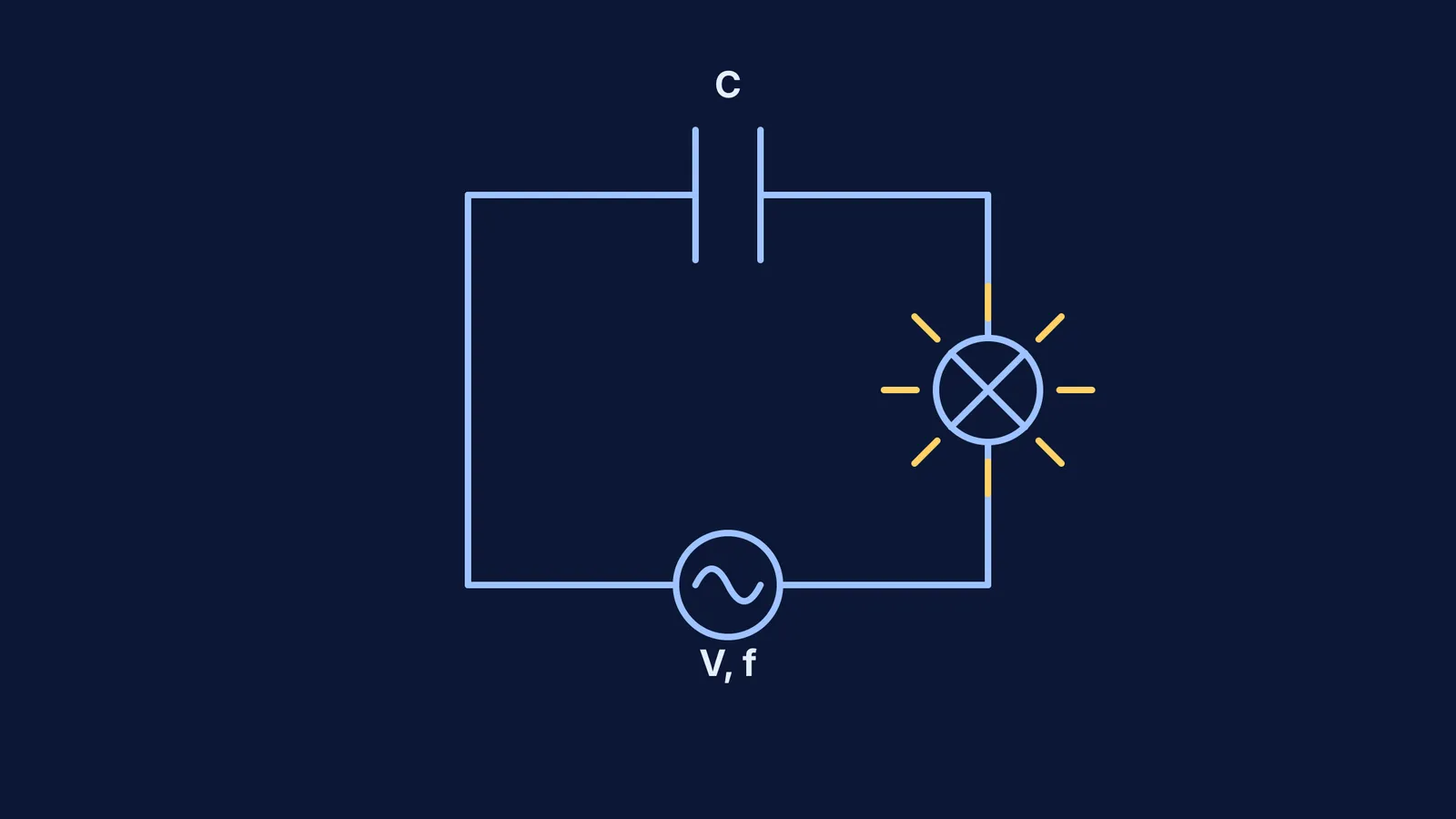
If you connect a light bulb and a capacitor in series to an alternating current (AC) source, you might expect the brightness to stay constant. But if you increase the frequency of the AC source, the bulb actually glows brighter.
This counter-intuitive behaviour is a classic concept in electromagnetism, covered in Chapter 7 of the NCERT Class 12 Physics Part I textbook. It happens because the capacitor's opposition to the current changes with the frequency of the supply.
Here is a step-by-step breakdown of why the brightness increases, what happens when you introduce a dielectric, and how the circuit behaves with a direct current (DC) source.
How Does AC Frequency Affect Capacitive Reactance?
A resistor offers a constant resistance to current, regardless of the frequency. A capacitor, however, offers a frequency-dependent opposition called capacitive reactance (Xc).
The formula for capacitive reactance is: Xc = 1 / (2πfC)
Here, f is the frequency of the AC source and C is the capacitance. Because the frequency f is in the denominator, it has an inverse relationship with the reactance. When the frequency increases, the capacitive reactance decreases. The capacitor offers less opposition to the alternating current at high frequencies.
Why Does the Bulb Glow Brighter?
To find the current flowing through the circuit, you need to calculate the total opposition, or impedance (Z). For a series RC circuit, the impedance combines the bulb's resistance (R) and the capacitive reactance (Xc):
Z = √(R² + Xc²)
When you increase the AC frequency, Xc drops, which means the total impedance Z also decreases.
According to Ohm's law for AC circuits (I = V / Z), a lower impedance allows a higher current I to flow through the circuit. The brightness of the bulb is determined by the electrical power it dissipates, given by I²R. Since the resistance of the bulb stays the same but the current has increased, the power dissipated increases, and the bulb glows brighter.
Worked Example: Doubling the Frequency
Let's test this with numbers to see exactly how much the brightness changes. Suppose a series circuit has a bulb resistance R = 30 Ω and an initial capacitive reactance Xc = 40 Ω at frequency f. The AC source provides V = 100 V.
Find the initial impedance: Z = √(30² + 40²) = √(900 + 1600) = √2500 = 50 Ω.
Find the initial current: I = 100 / 50 = 2 A.
Calculate the initial power (brightness): P = I²R = 2² × 30 = 120 W.
Double the frequency to 2f: Because Xc = 1 / (2πfC), doubling the frequency halves the reactance. The new Xc = 20 Ω.
Find the new impedance: Z = √(30² + 20²) = √(900 + 400) = √1300 ≈ 36 Ω.
Find the new current: I = 100 / 36 ≈ 2.77 A.
Calculate the new power: P = 2.77² × 30 ≈ 230 W.
By simply doubling the frequency, the power dissipated nearly doubles, making the bulb noticeably brighter.
If you struggle to piece together multi-step derivations like this in electromagnetism, the Fermi Concept Library has a lesson for every concept in physics to help you understand reactance, impedance and resonance. Once you have the concepts clear, you can use the Fermi Problem Library to work through AC circuit numericals with a step-by-step solver that explains the reasoning rather than printing an answer.
What Happens if You Add a Dielectric Slab?
Exam questions often introduce a variation: keeping the AC frequency constant but inserting a dielectric slab between the plates of the capacitor.
When you add a dielectric with a constant k (where k > 1), the capacitance increases to k × C.
Looking back at the reactance formula, Xc = 1 / (2πfC), an increase in capacitance C also causes the reactance Xc to decrease. Just like increasing the frequency, this lowers the total impedance of the circuit. The current increases, and the bulb glows more brightly.
What if You Connect a DC Source Instead?
If you replace the AC supply with a direct current (DC) battery, the frequency f becomes zero.
According to the formula Xc = 1 / (2πfC), dividing by zero makes the capacitive reactance theoretically infinite. In practice, when you switch on the DC source, a transient current flows just long enough to charge the capacitor plates. During this brief moment, the bulb might flicker. Once the capacitor is fully charged, it completely blocks the direct current, acting like an open circuit. The steady-state current becomes zero, and the bulb will not glow at all.
If you find it surprising how quickly current stops, or you are curious about how fast electrons actually move, our post on why a bulb glows instantly if drift velocity is so small explains the mechanics of energy transfer in wires.


