On this page
For a few days in early March and again around the start of October, many DTH viewers in India see the picture freeze or break into blocks for a few minutes in the late morning. Nothing is wrong with the set-top box. The Sun has moved directly behind the satellite as seen from your rooftop, and its radio noise is drowning out the weak TV signal. This is a sun outage, and you can predict its dates and time with Class 11 and 12 physics.
What is a sun outage on satellite TV?
Your dish points at one geostationary satellite (why it points south is covered in why DTH dishes in India point towards the south). It does not see a single point. It collects radio waves from a small cone of sky around the satellite, its beam. The Sun is a strong radio source, and when it drifts into that cone its noise adds to the receiver's. The ITU-R Recommendation S.1525, which satellite engineers use to plan for this, says plainly that the Sun does not weaken the signal. It raises the system noise temperature, and if that cuts the carrier-to-noise ratio by more than the link's clear-sky margin, the link drops out. Satellite operator Es'hailSat describes the same thing: a few minutes a day for a few days, near the equinoxes.
Why does it happen only in March and October?
A geostationary satellite sits above the equator, but you are not at Earth's centre. From a city north of the equator you look slightly southward at it, so it appears a few degrees south of the celestial equator. For a city on the satellite's meridian at latitude φ, the satellite's declination is
δ = −tan⁻¹[R sin φ / (r − R cos φ)]
where R ≈ 6,378 km is Earth's radius and r ≈ 42,164 km is the orbit radius. The Sun has the same southern declination twice a year: a little before the March equinox (around 20 March) and a little after the September equinox (around 23 September). Northern India gets its outages earliest in March and latest in October; southern India gets them closer to the equinoxes.
Why is it always around 11 a.m. in India?
Roughly, the Sun is behind the satellite when it stands above the satellite's longitude. Take ISRO's GSAT-15, a Ku-band satellite at 93.5° E. Indian Standard Time is set for 82.5° E, and the Sun moves 15° of longitude an hour, or 4 minutes per degree. So the Sun is above 93.5° E about (93.5 − 82.5) × 4 = 44 minutes before 12:00 IST, at about 11:16.
Parallax shifts this a little for each city, and the Sun runs about 11 minutes slow in early March and 11 minutes fast in early October (the equation of time). Computed for five cities, the outage is centred between about 11:12 and 11:23 a.m. IST in March and 10:52 and 11:02 a.m. in October. The time is set mainly by where the satellite is, not where you are.
How many days and minutes does it last?
Three numbers from the ITU recommendation do the work:
The half-power beam width of a dish is about θ = 70λ/D degrees, where λ is the wavelength and D the dish diameter. (The beam-width idea is worked for a big radio telescope in Grote Reber and the backyard dish that mapped the radio sky; here we only use it.)
Near the equinoxes the Sun's declination changes by about 0.4° a day.
Its hour angle changes by 0.25° a minute (360° in 24 hours).
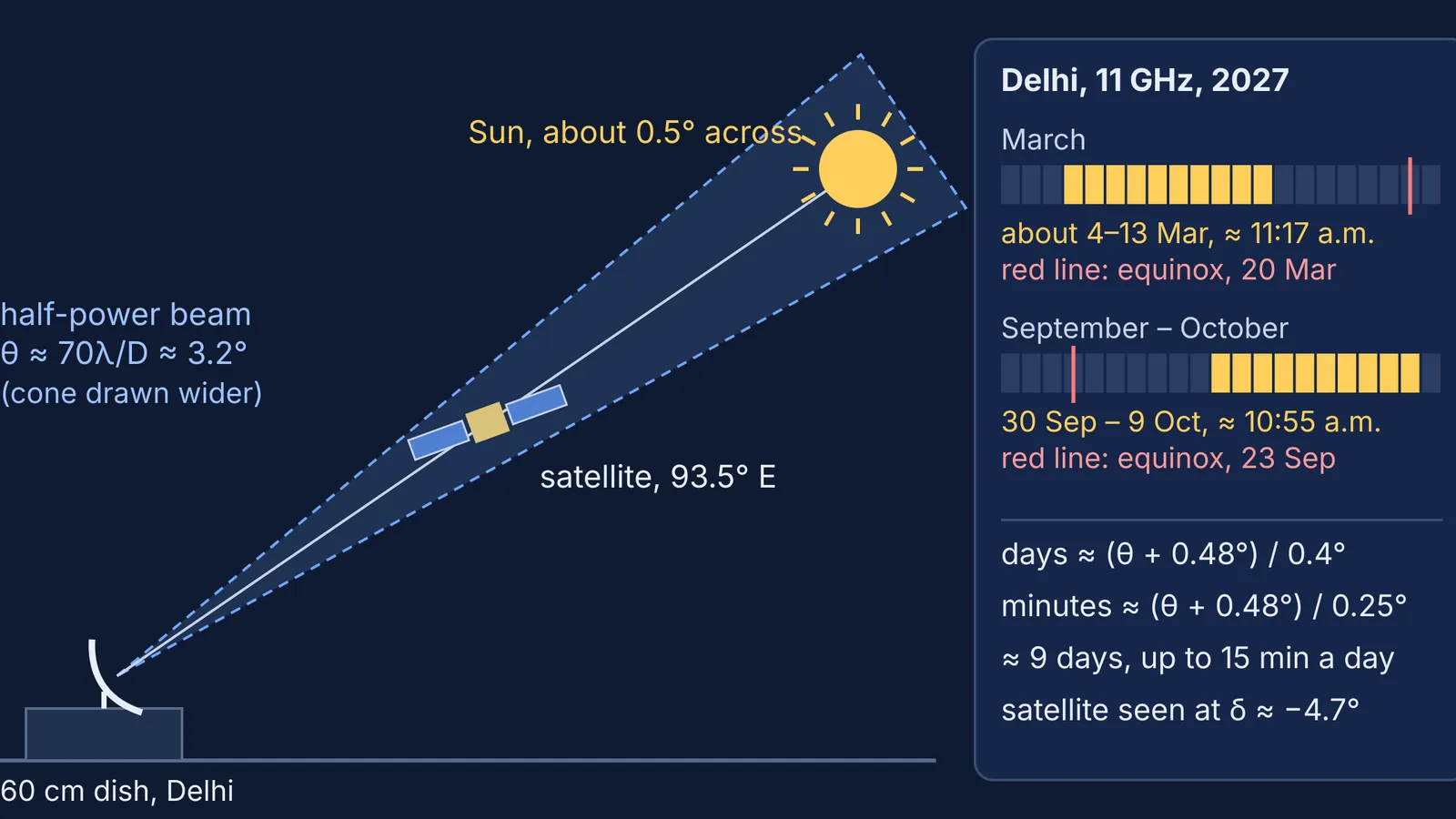
The Sun's disc is about 0.48° across, so it touches the beam on about (θ + 0.48°)/0.4° days, and on the central day it takes about (θ + 0.48°)/0.25° minutes to cross. A small home dish has a wide beam, so it is affected on more days, and for longer, than a big ground-station dish.
Worked example: a 60 cm dish in Delhi
Take a 60 cm dish in Delhi (28.6° N, 77.2° E), pointed at a satellite at 93.5° E, receiving at 11 GHz.
Wavelength: λ = c/f = (3.0 × 10⁸ m/s)/(11 × 10⁹ Hz) = 0.027 m, about 2.7 cm.
Beam width: θ = 70 × 2.73 cm / 60 cm ≈ 3.2°.
Satellite's declination from Delhi: R sin φ = 6,378 × sin 28.6° ≈ 3,054 km and r − R cos φ ≈ 42,164 − 5,598 = 36,566 km, so δ ≈ −tan⁻¹(0.0835) ≈ −4.8°. Allowing for the 16° difference in longitude gives −4.7°.
Central date: the Sun's declination is −4.7° about 4.7/0.4 ≈ 12 days before the March equinox and 12 days after the September one: about 8–9 March and about 5 October.
Number of days: (3.2 + 0.48)/0.4 ≈ 9 days, so about 4–13 March and about 30 September to 9 October.
Longest crossing: (3.2 + 0.48)/0.25 ≈ 15 minutes, on the central day, at about 11:17 a.m. IST in March and about 10:55 a.m. in October.
Other cities, same satellite (central dates for 2027; they shift by about a day between years):
Mumbai: δ ≈ −3.3°, about 12–13 March and 1–2 October.
Kolkata: δ ≈ −3.9°, about 11 March and 3 October.
Chennai: δ ≈ −2.3°, about 15 March and 29 September.
Thiruvananthapuram: δ ≈ −1.5°, about 17 March and 27 September.
How much noise does the Sun add?
The ITU recommendation models the quiet Sun's brightness temperature as T ≈ 120,000 × 0.5 × f⁻⁰·⁷⁵ kelvin, with f in GHz. At 11 GHz that is about 9,900 K. Near sunspot maximum it can be several times brighter.
The Sun's disc fills only part of a 3.2° beam. Taking an assumed aperture efficiency of 0.65, the beam's solid angle is λ²/(0.65 × πD²/4) ≈ 4.0 × 10⁻³ sr and the Sun's disc is about 6.7 × 10⁻⁵ sr, a fraction of 1.7%. So the dish picks up at most about 0.017 × 9,900 ≈ 165 K extra. Against a receiving system at 150 K, the noise rises by a factor (150 + 165)/150 ≈ 2.1, a drop of about 3.2 dB in the signal-to-noise ratio. The ITU's own detailed curve for a 0.6 m dish at 11 GHz shows a smaller peak, about 100 K and about 2 dB. A link with a thin margin, or one already weakened by cloud, freezes; one with more margin survives. The uplink station has its own outage days too, so a channel can also break up on other dates.
Is it safe to look at the dish during an outage?
No. Never look at the Sun, or at its bright reflection in the dish, directly. A dish is a curved mirror, and on these days it faces almost straight at the Sun. Watch the TV, not the sky, and wait a quarter of an hour. To see how a curved reflector gathers a beam, the Fermi Simulation Lab has interactive simulations of ideas that are easier to see than to read.
Quick checklist
Sun outage = the Sun behind the satellite, adding noise, not blocking the signal.
Dates: when the Sun's declination equals the satellite's, about −1.5° to −4.7° from India.
Time: when the Sun is near the satellite's longitude, about 11 a.m. IST for 93.5° E.
Days ≈ (θ + 0.48°)/0.4°; minutes ≈ (θ + 0.48°)/0.25°; θ ≈ 70λ/D.
Never look at the Sun or its reflection in the dish.