

On this page
Why did Grote Reber build the first radio telescope dish?
In 1932, physicist Karl Jansky at Bell Telephone Laboratories discovered that faint hiss static arriving at his 20.5-megahertz directional antenna repeated every 23 hours and 56 minutes, matching the sidereal day and originating from the Milky Way, as documented in Nature in 1933. Yet professional observatories ignored the discovery because optical astronomers were focused entirely on visible starlight.
Grote Reber, an amateur radio operator (W9GFZ) and engineer in Chicago, realized that astronomy was neglecting an entire spectrum of radiation. When academic observatories declined to pursue radio observations, Reber resolved to construct his own instrument. According to the Green Bank Observatory archives, he chose a parabolic reflector because a concave dish reflects all wavelengths to a single focal point without chromatic distortion, providing the flexibility to test different receiver frequencies.
Our post on Karl Jansky and the radio hiss that came from the Milky Way covers the initial discovery of cosmic static. For students mapping how electromagnetic radiation spans across wavelengths, the Fermi Concept Library organizes every concept in physics, chemistry, biology, mathematics and computing, each with its own lesson and its place in the map.
How did Reber build a 9.6-metre parabolic dish in his backyard?
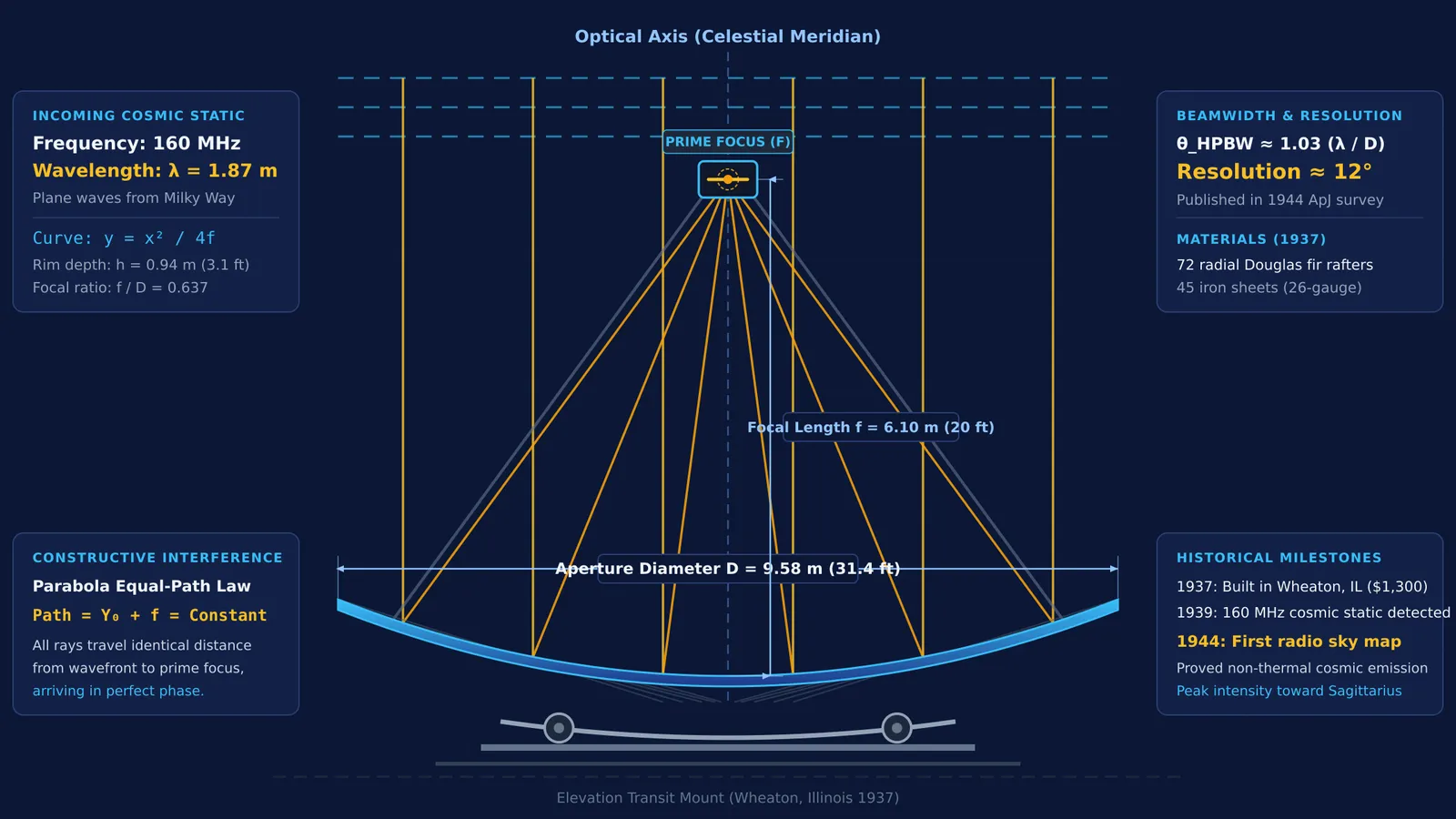
Working in his mother's backyard in Wheaton, Illinois, Reber spent $1,300 of his own earnings—roughly a year's wages—to construct the telescope in 1937, as recorded in his retrospective paper in the Proceedings of the IRE in 1958 and documented by the Green Bank Observatory.
The telescope featured an ingenious mechanical design:
A parabolic reflector spanning 31.4 feet (9.58 metres) with a focal length of 20 feet (6.10 metres).
A radial framework of 72 Douglas fir rafters supporting 45 pieces of 26-gauge galvanized iron sheet metal.
A central tower supporting the dipole feed antenna and receiver 20 feet above the dish vertex.
A transit mount built from Ford Model T axles, allowing tilt along the meridian while Earth's rotation swept the sky east to west.
As detailed in observatory records, Reber first tested receivers at 3,300 megahertz (a 9-centimetre wavelength) and 900 megahertz (33 centimetres) without detecting cosmic signals. In 1938, he built a receiver tuned to 160 megahertz (1.87 metres), finally registering clear, repeatable galactic static in the spring of 1939.
For students exploring how curved surfaces focus incoming parallel waves, the Fermi Simulation Lab provides interactive simulations for the ideas that are easier to see than to read.
How did Reber prove cosmic static was non-thermal?
Between 1938 and 1943, Reber mapped the sky along the celestial meridian. In his 1944 paper in The Astrophysical Journal, building on his preliminary 1940 cosmic static report, Reber published the first radio contour maps of the heavens. His maps confirmed that cosmic radio emission peaked toward Sagittarius and revealed intense discrete sources in Cygnus and Cassiopeia.
Crucially, Reber's data contradicted the reigning belief that cosmic radio noise was black-body thermal radiation. Under Planck's radiation law and the Rayleigh-Jeans approximation, thermal emission intensity scales with the square of frequency (proportional to ν²), predicting stronger signals at shorter wavelengths. Reber's successful detection at 160 megahertz after total silence at 3,300 megahertz proved that cosmic radio power grew stronger at lower frequencies.
In the 1950s, astrophysicists recognized this as synchrotron radiation, emitted by relativistic electrons accelerating through magnetic fields. Decades later, major installations like India's Giant Metrewave Radio Telescope, discussed in our article on Govind Swarup and the GMRT, used metrewave dishes to study these non-thermal sources in detail.
How do you calculate the beamwidth of a parabolic dish?
The angular resolution of a circular parabolic reflector depends on wavelength (λ) and dish diameter (D), governed by wave diffraction:
θ ≈ k × (λ / D) radians
For the first diffraction minimum (the Rayleigh criterion), k ≈ 1.22 radians, while the half-power beamwidth (the angle between points where power drops by half) uses k ≈ 1.03 radians for a circular aperture.
Using specifications from the Green Bank Observatory and Reber's paper in The Astrophysical Journal, we can calculate the beamwidth of Reber's dish at 160 megahertz:
Wavelength: At frequency ν = 1.6 × 10⁸ hertz and c ≈ 3.0 × 10⁸ metres per second, λ = c / ν = 1.875 metres.
Diameter: The aperture diameter D is 9.58 metres (31.4 feet).
Half-power beamwidth in radians: θ_HPBW ≈ 1.03 × (1.875 / 9.58) ≈ 0.201 radians.
Half-power beamwidth in degrees: θ_HPBW ≈ 0.201 × (180 / π) ≈ 11.5 degrees (approximately 12 degrees).
As confirmed in Reber's 1944 paper, his observed beamwidth was approximately 12 degrees—broad enough that cosmic sources registered as extended contours rather than point stars, yet sharp enough to trace the galactic plane and isolate Cygnus A. By contrast, a 0.1-metre optical lens observing light at 550 nanometres yields an angular resolution of 1.4 arcseconds (0.00038 degrees)—roughly 31,000 times sharper. This fundamental diffraction constraint drove the development of radio interferometry.
Our guide on electromagnetic waves and their spectrum examines wave properties across the spectrum. For students practicing problems on diffraction limits and wave optics, the Fermi Problem Library offers worked problems with a step-by-step solver that explains the reasoning rather than printing an answer.


