

On this page
To prove 1/2, 1/4, 1/8, … converges, you name the limit, 0, and show the terms get close to it. A Cauchy sequence asks instead whether the terms get close to each other. That lets you test convergence when you cannot write the limit down, and it shows what the real numbers have that fractions lack.
What is a Cauchy sequence, in one sentence?
A sequence x1, x2, x3, … of real numbers is a Cauchy sequence if for every ε > 0 there is a positive integer N such that |xm − xn| < ε for all m, n > N (Wikipedia: Cauchy sequence).
Read it as a game. Someone names a tolerance ε, as small as they like: 0.1, 0.001, 10⁻⁹. You reply with a position N after which every pair of terms sits within ε of each other. If you can always reply, the sequence is Cauchy. No limit appears in the definition.
The name honours Augustin-Louis Cauchy (1789–1857), whose 1821 Cours d'analyse set out to develop calculus as rigorously as possible (MacTutor biography of Cauchy).
Why that series diverges is in our post on when 1/nᵖ converges and the comparison test.
How do you prove 1/n is a Cauchy sequence?
This standard first proof follows Jiří Lebl's open textbook Basic Analysis, section 2.4.
Target. You want |1/m − 1/n| < ε.
Bound it. By the triangle inequality, |1/m − 1/n| ≤ 1/m + 1/n. So it is enough to make each piece smaller than ε/2.
Solve for N. 1/n < ε/2 whenever n > 2/ε. So pick N to be any whole number bigger than 2/ε.
Write the proof. Let ε > 0. Choose an integer N > 2/ε. For m, n > N we have 1/m < 1/N < ε/2 and 1/n < ε/2, so |1/m − 1/n| ≤ 1/m + 1/n < ε.
Test it. With ε = 0.01 you need N > 200, so take N = 201. Every later term lies between 0 and 1/201, which is about 0.005, so any two differ by less than 0.01.
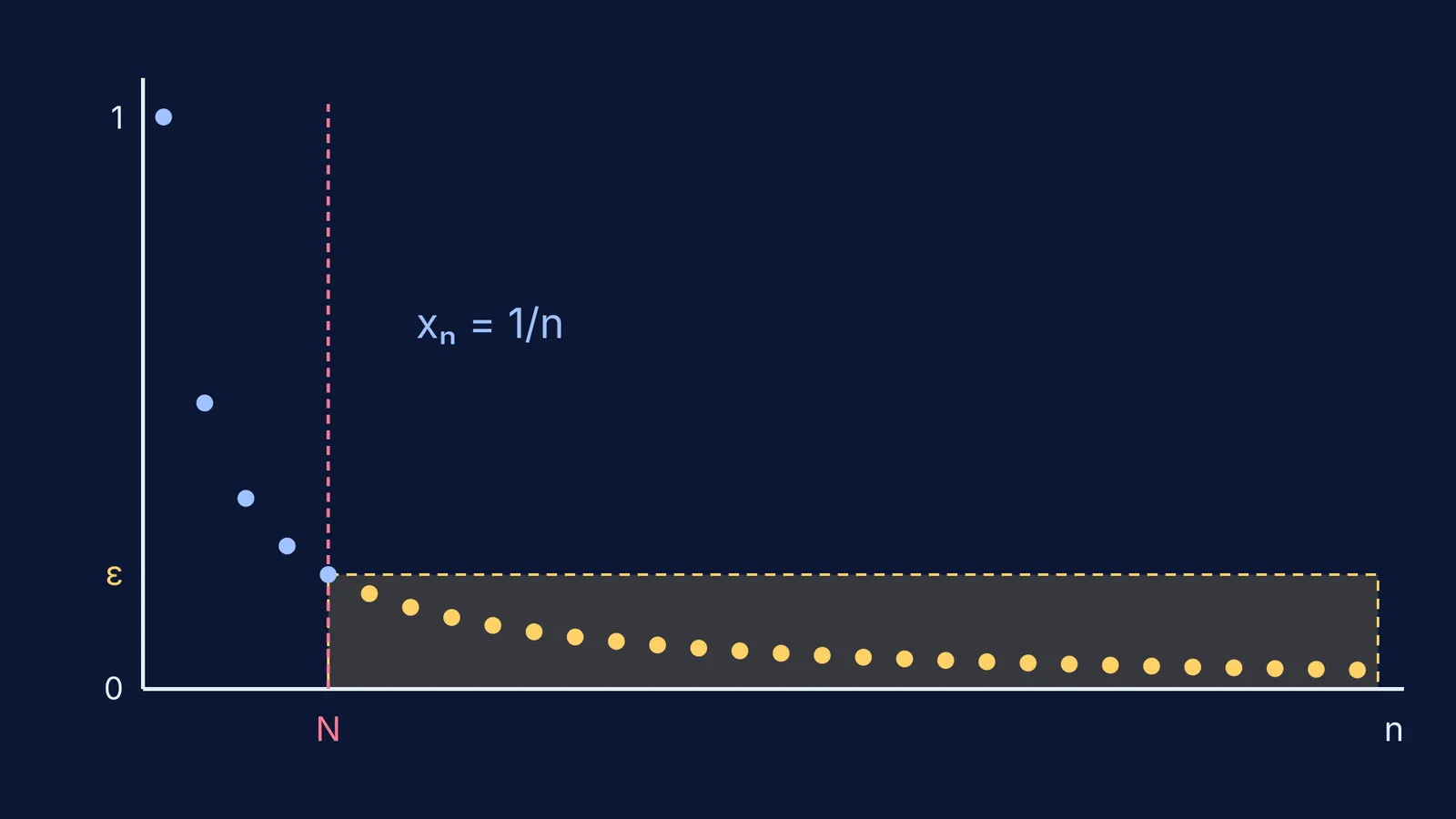
N need not be the smallest that works. With ε = 0.2, N = 5 already works (see the diagram), while the recipe gives N = 11. Both are correct.
Why can a Cauchy sequence of fractions head to √2?
Start at 1 and repeatedly replace x by the average of x and 2/x. You get 1, 3/2, 17/12, 577/408, … and every term is a fraction. The Wikipedia article lists the first terms 1, 3/2, 17/12 and notes that this sequence of rationals converges to the irrational number √2 (Wikipedia: Cauchy sequence).
Check how fast it closes in: (17/12)² = 289/144 ≈ 2.0069, and (577/408)² = 332929/166464 ≈ 2.000006. The terms bunch together, and since the sequence converges in the reals, it is Cauchy. But √2 is not a fraction: with only fractions, there is nothing to converge to.
The decimal truncations 1, 1.4, 1.41, 1.414, … do the same. Each is a fraction, any two terms after the kth agree in their first k decimal places, and the limit is irrational (Wikipedia). As Wolfram MathWorld puts it, Cauchy sequences in the rationals do not necessarily converge, but they do converge in the reals (MathWorld: Cauchy Sequence).
For another number no fraction can reach, see Fourier's short proof that e is irrational; for a recursive sequence whose limit you can find, see why root 2 plus root 2 plus root 2 forever equals 2.
What does completeness of the real numbers mean?
A sequence of real numbers is Cauchy if and only if it converges (Lebl, Basic Analysis, Theorem 2.4.5). Lebl adds that this statement is sometimes used to define the completeness property of the real numbers.
In plain words: the reals are the rationals with the gaps filled, so every sequence that bunches up has a number to bunch up at. Wikipedia puts it in four words: completion turns ℚ into ℝ (Wikipedia: Cauchy sequence).
In practice, when you cannot guess the limit of a series or recursive sequence, showing the terms are eventually within ε of each other proves it converges.
A checklist for your first ε–N proofs
Write the target inequality |xm − xn| < ε before anything else.
Bound the left side by something that depends only on N, using the triangle inequality.
Solve that bound for N in terms of ε.
Write the final proof forwards, starting with "Let ε > 0".
Test your N with one actual number, such as ε = 0.01.
Ask whether you controlled every pair of terms, or only neighbours.
If one step loses you, the Fermi Concept Library gives every concept in mathematics its own lesson and its place in the map, so you can go back to limits or the triangle inequality first. To practise, the Fermi Problem Library has worked problems with a step-by-step solver that explains the reasoning rather than printing an answer.
Try it now: prove that 1/n² is Cauchy using the same five steps.


