

On this page
The number e, about 2.71828, is the base of the natural logarithm (Wolfram MathWorld). Is it a fraction? No, and the proof needs only the series for e and the fact that no whole number lies strictly between 0 and 1.
What does it mean for e to be irrational?
A number is rational if it equals p/q for whole numbers p and q, with q not zero; it is irrational if no such pair exists. Like the Class 10 proof that the square root of 2 is irrational, this proof assumes a fraction and shows the assumption breaks something. Our Class 10 real numbers key terms recap the vocabulary.
Euler wrote the first proof that e is irrational in 1737, using its continued fraction, though the text was published only seven years later (Wikipedia: Proof that e is irrational). The same page calls Joseph Fourier's proof by contradiction the best-known proof, and cites it to a book by Janot de Stainville published in 1815. Charles Hermite went further in 1873 and proved that e is transcendental, meaning it is not the root of any polynomial with integer coefficients (MacTutor History of Mathematics).
Which fact about e does the proof use?
The proof starts from the series e = 1/0! + 1/1! + 1/2! + 1/3! + ..., that is 1 + 1 + 1/2 + 1/6 + 1/24 + ..., which MathWorld notes was first published by Newton in 1669 (Wolfram MathWorld). Two features of it do all the work:
every term is positive;
the terms shrink very fast, because factorials grow faster than any fixed power.
For why such a series converges, see the radius of convergence of a power series.
How do you prove e is irrational, step by step?
This is Fourier's argument as set out on Wikipedia's proof page, written in our own steps.
Assume e = p/q, where p and q are positive whole numbers.
Cut the series after the term 1/q!. Call the part before the cut S and the rest the tail, so e = S + tail.
Multiply by q! and define x = q!(e - S), which is the same as q! times the tail.
x is a whole number: q! times p/q is p times (q-1)!, and for every n up to q, q!/n! is the whole number (n+1)(n+2)...q.
x is greater than 0, because every term of the tail is positive.
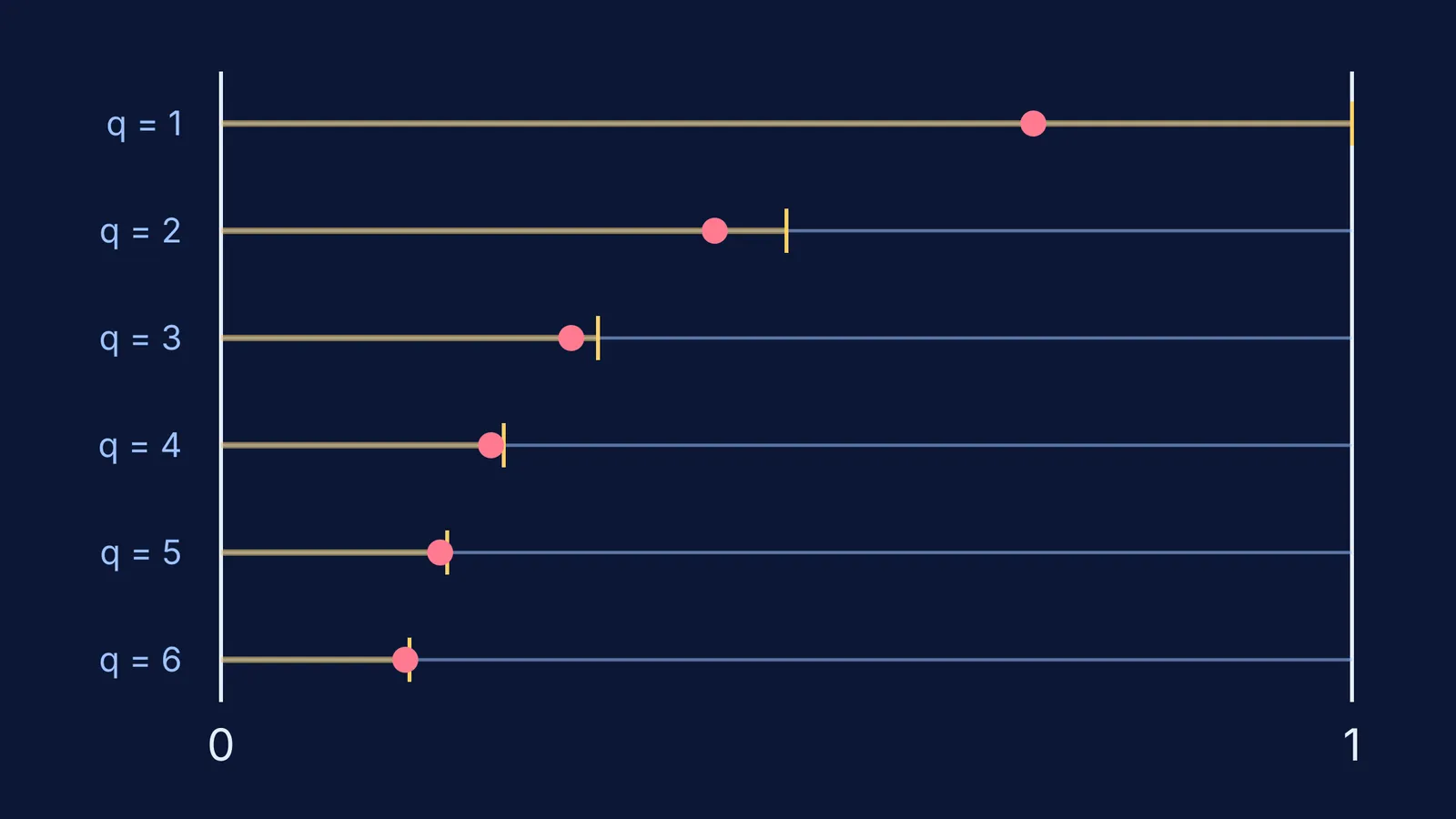
x is less than 1. Written out, x = 1/(q+1) + 1/((q+1)(q+2)) + .... Each term after the first is smaller than the matching term of the geometric series 1/(q+1) + 1/(q+1)^2 + ..., and that series adds up to 1/q. So x is less than 1/q, which is at most 1.
A whole number cannot lie strictly between 0 and 1. The assumption was false, so e is irrational.
Does the proof work for q = 2?
Try the proof on one denominator. If e were p/2, then 2e would be the whole number p, so x = 2(e - 1 - 1 - 1/2) = 2e - 5 would be whole too. But x = 1/3 + 1/12 + 1/60 + ... comes to about 0.437, which is more than 0 and less than 1/2. So no fraction with denominator 2 equals e. The proof runs this check for every q at once.
Where do students get stuck on this proof?
Rewrite the proof from memory, then answer each question below in one sentence.
Why cut the series at 1/q!? It is the last place where multiplying by q! keeps every term before the cut whole, so the leftover is as small as it can be.
Why is q!/n! whole when n is at most q? Because it is the product of the whole numbers from n+1 to q.
Where does 1/q come from? The geometric series with first term 1/(q+1) and ratio 1/(q+1) sums to (1/(q+1)) divided by (1 - 1/(q+1)), which is 1/q.
Why is the inequality strict? From the second term on, each tail term is strictly smaller than its geometric partner.
If a step stalls, the Fermi Problem Library has a step-by-step solver that explains the reasoning rather than printing an answer, so you can see which line you skipped. For factorials and geometric series themselves, try the Fermi Concept Library.
How can you practise proofs like this one?
A proof sticks when you rebuild it, not when you reread it. Try this three-day plan:
Day 1: write the seven steps from memory and mark what you missed.
Day 2: explain the proof aloud to a friend or parent, without notes.
Day 3: prove that 1/e is irrational from the series 1 - 1/1! + 1/2! - 1/3! + .... The tail now alternates in sign, so bound its size instead.
If you enjoy seeing e appear where you least expect it, read how the average number of random numbers needed to pass 1 turns out to be e.


