

On this page
A power series is an infinite polynomial, and the first question about one is: for which x does it add up to a number? The answer is always a centre and a radius. If partial sums feel shaky, first read sequence vs series: terms, notation and partial sums.
What is the radius of convergence of a power series?
A power series centred at a is Σ cₙ(x − a)ⁿ. OpenStax Calculus Volume 2, section 6.1 shows that each one either converges only at x = a (R = 0), converges for every real x (R = ∞), or has a number R > 0 with convergence for |x − a| < R and divergence for |x − a| > R.
That number R is the radius of convergence. The set of x where the series converges is the interval of convergence; at its two ends, where |x − a| = R, the series may converge or diverge (same source).
How do you find R with the ratio test?
The ratio test uses L = lim |aₙ₊₁/aₙ|: the series converges absolutely if L < 1, diverges if L > 1, and the test is inconclusive if L = 1 (Wikipedia: Ratio test). For a power series, apply it to the whole term, x included:
Simplify |aₙ₊₁/aₙ|; one factor of |x − a| remains.
Take the limit as n → ∞ to get k·|x − a|.
Solve k·|x − a| < 1, so R = 1/k.
Equivalently, R = lim |cₙ/cₙ₊₁| when that limit exists (Wikipedia: Radius of convergence). Note that cₙ is on top, the reverse of the ratio test.
Where does the series for 1/(1 − x) converge?
1 + x + x² + x³ + ... is a geometric series with ratio x. OpenStax 6.1 notes that it converges when |x| < 1 and diverges when |x| ≥ 1, and on that interval its sum is 1/(1 − x), the infinite GP sum from the Class 11 sequences and series formulas.
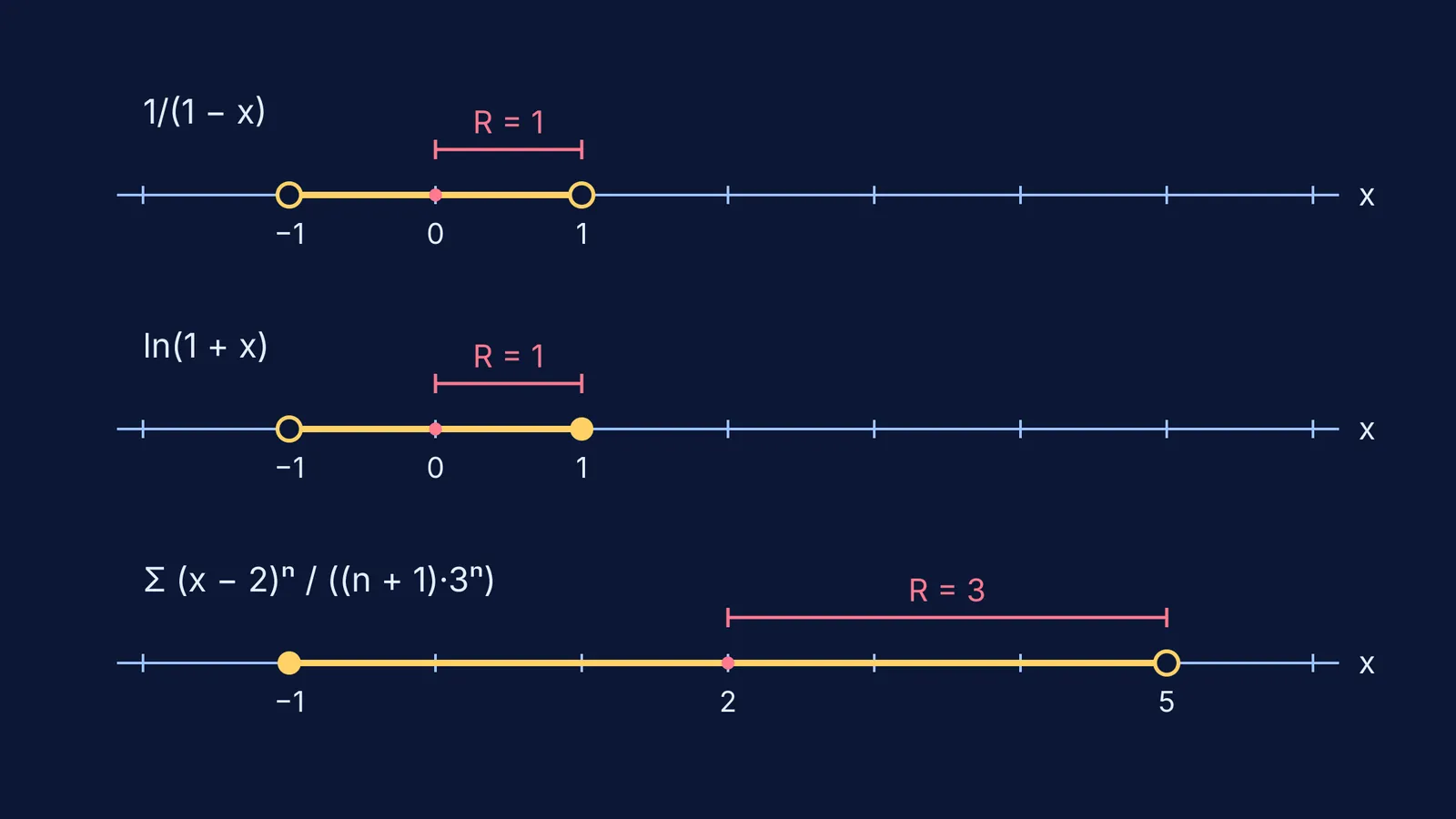
Ratio test: |xⁿ⁺¹/xⁿ| = |x|, so the centre is 0 and R = 1.
At x = 1: 1 + 1 + 1 + ... grows without bound. Diverges.
At x = −1: 1 − 1 + 1 − 1 + ... never settles, because the terms do not shrink to zero. Diverges.
Interval of convergence: (−1, 1), both ends open. For the same sum doing real work, see the probability of winning a game from deuce.
Why does ln(1 + x) include x = 1 but not x = −1?
Replace x by −x to get 1/(1 + x) = 1 − x + x² − ..., then integrate term by term from 0. OpenStax section 6.2 does exactly this and gets ln(1 + x) = x − x²/2 + x³/3 − x⁴/4 + ...
Integrating or differentiating a power series term by term keeps the same radius of convergence but says nothing about the endpoints (OpenStax 6.2). Check the radius with the ratio test anyway: |aₙ₊₁/aₙ| = |x| · n/(n + 1), which tends to |x|, so R = 1.
At x = 1: 1 − 1/2 + 1/3 − ..., the alternating harmonic series, converges.
At x = −1: −(1 + 1/2 + 1/3 + ...), the harmonic series negated, diverges.
So the interval is (−1, 1]: same radius as 1/(1 − x), different interval. The series equals ln(1 + x) for every x with −1 < x ≤ 1, so at x = 1 it adds up to ln 2 (Wikipedia: Mercator series).
A third check: a series not centred at zero
OpenStax Example 6.1, part c takes Σ (x − 2)ⁿ / ((n + 1)3ⁿ). The ratio limit is |x − 2|/3, so the centre is 2 and R = 3. At x = −1 the series becomes the alternating harmonic series and converges; at x = 5 it becomes the harmonic series and diverges. The interval is [−1, 5).
What is a quick checklist for any power series?
Read the centre a off (x − a).
Ratio test on the full term; solve for |x − a| to get R. A limit of 0 for every x means R = ∞ (as for Σ xⁿ/n! in OpenStax Example 6.1).
Substitute each endpoint and name the series: geometric, harmonic, alternating harmonic, p-series.
Test it: nth-term test, alternating series test, or p-series comparison.
Write the interval with the right brackets.
The Fermi Problem Library has worked problems with a step-by-step solver that explains the reasoning rather than printing an answer, so you can see where an endpoint test went wrong. If the ratio test itself is the gap, the Fermi Concept Library gives each mathematics concept its own lesson.
Next: find the interval for ln(1 − x) = −(x + x²/2 + x³/3 + ...). You should get [−1, 1).


