On this page
Deuce looks endless: a game can bounce between deuce and advantage forever. Yet the chance of winning it comes out as one tidy fraction. Here is how to get it, with numbers and two checks.
What does deuce mean in tennis scoring?
Under Rule 5 of the ITF Rules of Tennis 2026, the score is "Deuce" when each player has won three points. The player who wins the next point has "Advantage". If they win the point after that too, they win the game. If they lose it, the score goes back to deuce.
The key sentence for the maths: "A player/team needs to win two consecutive points immediately after “Deuce” to win the “Game”" (ITF Rules of Tennis 2026).
How do you turn deuce into two-point rounds?
Treat the next two points as one round. Player A wins each point with probability p; the opponent wins it with probability q = 1 − p. Points are assumed independent, with p fixed.
One round from deuce has only three outcomes:
A wins both points (WW): probability p². A wins the game.
The opponent wins both (LL): probability q². A loses the game.
The points are split (WL or LW): probability 2pq. The score is back at deuce, and nothing has changed.
A split round wipes the slate clean, so every round starts from the same position.
What is the probability of winning a game from deuce?
A wins in round 1, or splits once then wins, or splits twice then wins, and so on:
P(win) = p² + (2pq)p² + (2pq)²p² + (2pq)³p² + …
This is a geometric series with first term p² and common ratio 2pq. Milan Pahor sets out this series in Winning@Wimbledon in Parabola, the UNSW school mathematics magazine. Since 2pq ≤ 1/2, it converges to a/(1 − r):
P(win) = p²/(1 − 2pq)
Now tidy the bottom. Since p + q = 1, we have 1 = (p + q)² = p² + 2pq + q², so 1 − 2pq = p² + q². That gives the result:
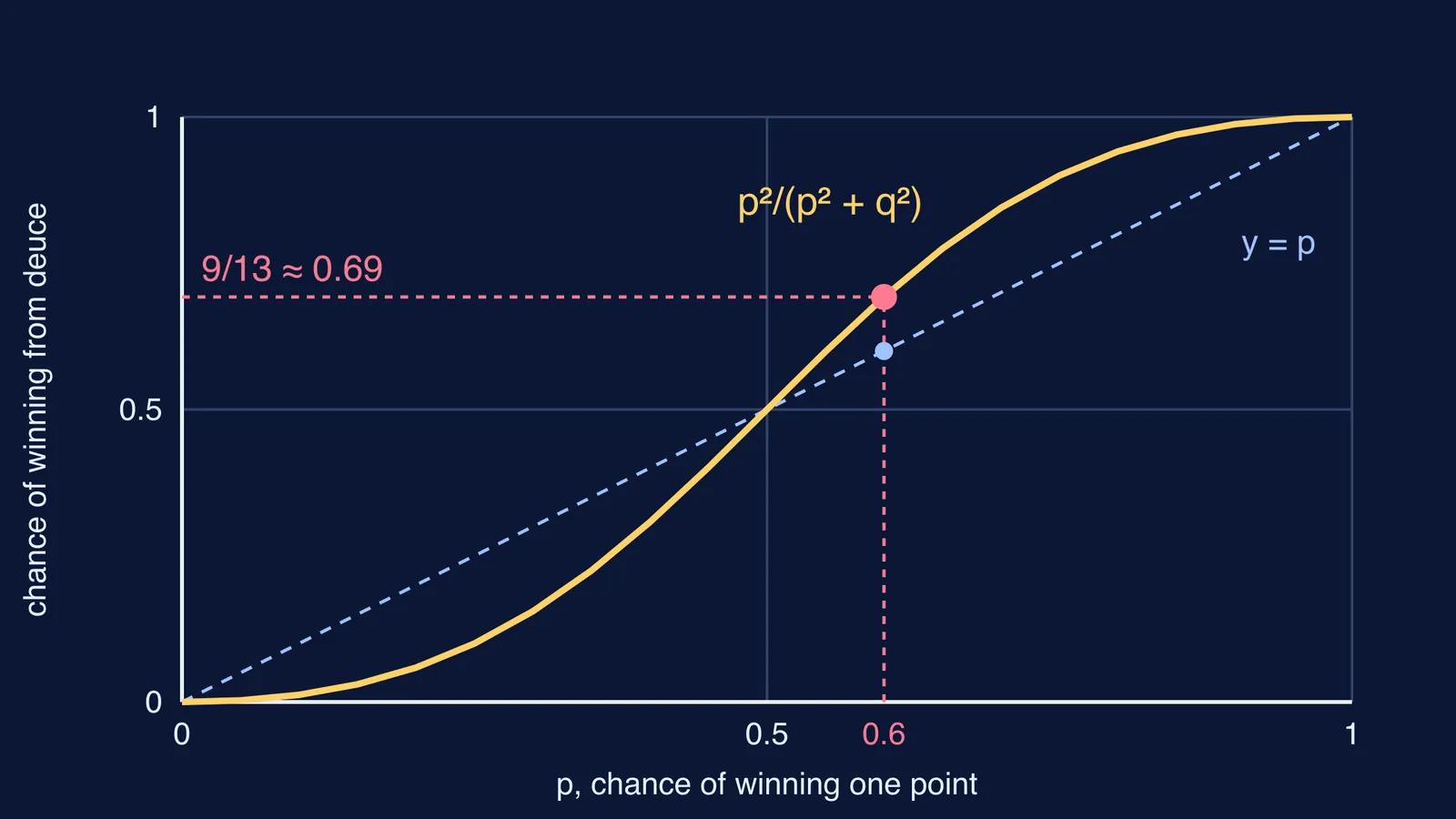
P(win from deuce) = p²/(p² + q²)
If infinite sums feel slippery, our post on why 1/2 + 1/4 + 1/8 + … equals 1 shows what it means for a geometric series to have a finite total.
Worked example: what if you win 60% of points?
Take p = 0.6, so q = 0.4.
Win a round: p² = 0.36.
Lose a round: q² = 0.16.
Split a round: 2pq = 0.48. Check: 0.36 + 0.16 + 0.48 = 1.
Sum the series: 0.36/(1 − 0.48) = 0.36/0.52 = 9/13, about 0.692.
Watch the partial sums climb towards 9/13:
After 1 round: 0.36
After 2 rounds: 0.36 + 0.1728 = 0.5328
After 3 rounds: 0.6157
After 4 rounds: 0.6556
After 5 rounds: 0.6747
A 60% chance per point became a 69% chance from deuce. Deuce stretches small edges. Pahor's article makes the same point at match level: in his model of a five-set Wimbledon men's final, a player with a 55% chance of winning each point has a more than 95% chance of winning the match (Pahor, Parabola).
How can you check the answer without a series?
Check 1: the one-line equation. Let x be A's chance of winning from deuce. From deuce, A either wins the next round outright, or splits it and is back at deuce with the same chance x. So x = p² + 2pq·x. Solving gives x = p²/(1 − 2pq), the same answer. Pahor offers this route for readers who have not met series yet.
Check 2: only the deciding round matters. Split rounds change nothing, so the game is settled by the first round that is not split. That round is either WW or LL, and their chances are in the ratio p² : q² = 0.36 : 0.16 = 9 : 4. So A wins 9 times out of 13. No infinite sum is needed.
Check 3: sanity tests.
At p = 0.5 the formula gives 0.25/0.5 = 1/2, as fairness demands.
The opponent's chance is q²/(p² + q²) = 4/13, and 9/13 + 4/13 = 1, so the game ends with probability 1. It cannot really go on forever.
A checklist for any "win by two" problem
Find the state that repeats (here, deuce).
Group trials into rounds that either end the game or return you to that state.
Write the win, lose and return probabilities, and check that they add to 1.
Sum the geometric series, or write x = win + return·x.
Check with the ratio of win to lose, and test p = 0.5.
To practise the step before deuce, try our walk-through on calculating the probability of winning a best-of-three series. The gambler's ruin simulation uses the same idea of states that repeat.
If you want more problems like this, the Fermi Problem Library has worked problems with a step-by-step solver that explains the reasoning rather than printing an answer.