

On this page
If you are playing a game of skill—whether it is a tennis match, a chess tournament, or a debate—a single game can be decided by luck. A best-of-three series reduces that volatility. The first side to win two games takes the series.
But exactly how much does playing three games help the stronger player? If your chance of winning a single game is p, your probability of winning the series is p²(3 - 2p).
This result comes from listing the ways you can win, adding up their probabilities, and relying on the rule that each game's outcome does not change the odds of the next.
How do you calculate the probability of winning a best-of-three series?
To win a best-of-three series, you need to reach two wins before your opponent does. If we assume each game is an independent event (winning the first does not make you more likely to win the second), the maths follows the binomial distribution, which models the number of successes in a fixed number of trials (MathWorld).
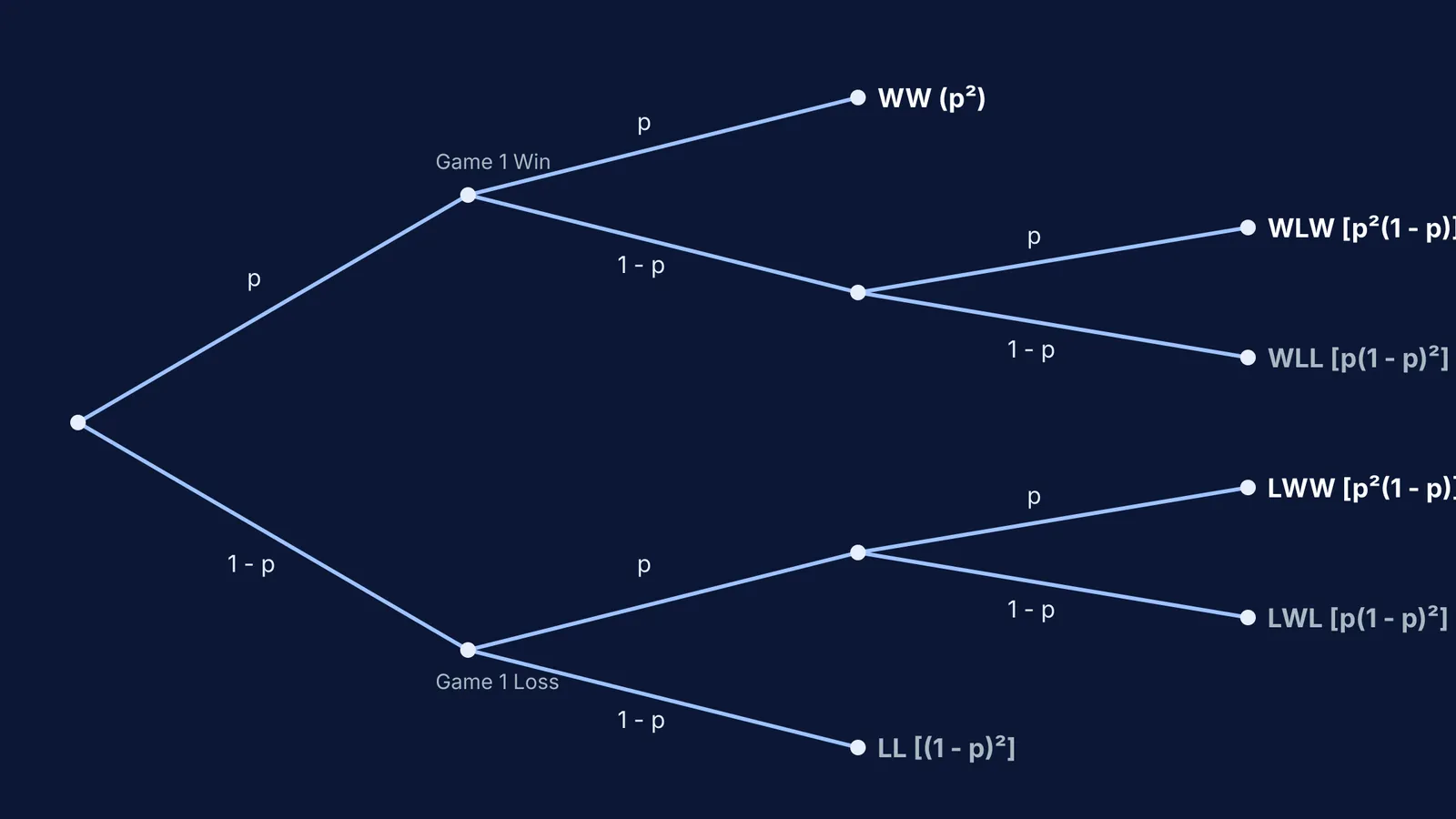
There are three sequences of wins (W) and losses (L) that result in you winning the series:
WW (Win-Win): You win the first two games. The series is over, and the third game is not played. Your probability of this sequence is p × p = p².
WLW (Win-Loss-Win): You win the first game, drop the second, and win the decider. The probability is p × (1 - p) × p = p²(1 - p).
LWW (Loss-Win-Win): You lose the opening game but win the next two. The probability is (1 - p) × p × p = p²(1 - p).
To find your total chance of winning the series, you add these three mutually exclusive outcomes together:
P(Series Win) = p² + p²(1 - p) + p²(1 - p)
P(Series Win) = p² + 2p²(1 - p)
P(Series Win) = 3p² - 2p³
This formula, often written as p²(3 - 2p), tells you exactly how a single-game advantage translates across a short tournament. If you are revising for exams and have concept gaps in independent events, the Fermi Concept Library covers every concept in mathematics, each with its own lesson and its place in the map.
Does a best-of-three series always favour the better player?
Yes, provided the better player's win probability p is greater than 0.5. The mathematics of a series amplifies any existing edge.
Consider a player who has a win probability of 0.6 for a single game. If they play a single sudden-death match, their chance of advancing is 0.6. But if they play a best-of-three series, their chance of winning rises according to the binomial distribution (MathWorld):
P = 3(0.6)² - 2(0.6)³
P = 3(0.36) - 2(0.216)
P = 1.08 - 0.432 = 0.648
By extending the contest to a best-of-three, the favourite increases their overall win probability from 0.6 to 0.648. The more games you play, the harder it is for the underdog to string together enough lucky wins. This is why major finals often use best-of-five or best-of-seven formats.
Where can you practise series probability problems?
Questions about repeated trials and game series are common in competitive exams, as they test whether a student can systematically list outcomes without double-counting.
When you tackle these problems, watch out for the wording. If a question asks for the probability of winning "in exactly three games", it only wants the WLW and LWW scenarios (2p²(1 - p)), not the WW sweep.
To build your intuition for these setups, try solving problems from these related topics:
If you are stuck on a tricky series question and making wrong-method mistakes, the Fermi Problem Library has worked problems with a step-by-step solver that explains the reasoning rather than printing an answer. The AI tutor holds a line of reasoning across a session, notices where you are stuck, and decides whether to explain, ask, or show to help you build the right probability tree.


