

On this page
Can you add infinitely many numbers and still get a finite answer? A square of paper and a pencil settle it in a minute.
How does a square show that 1/2 + 1/4 + 1/8 + … = 1?
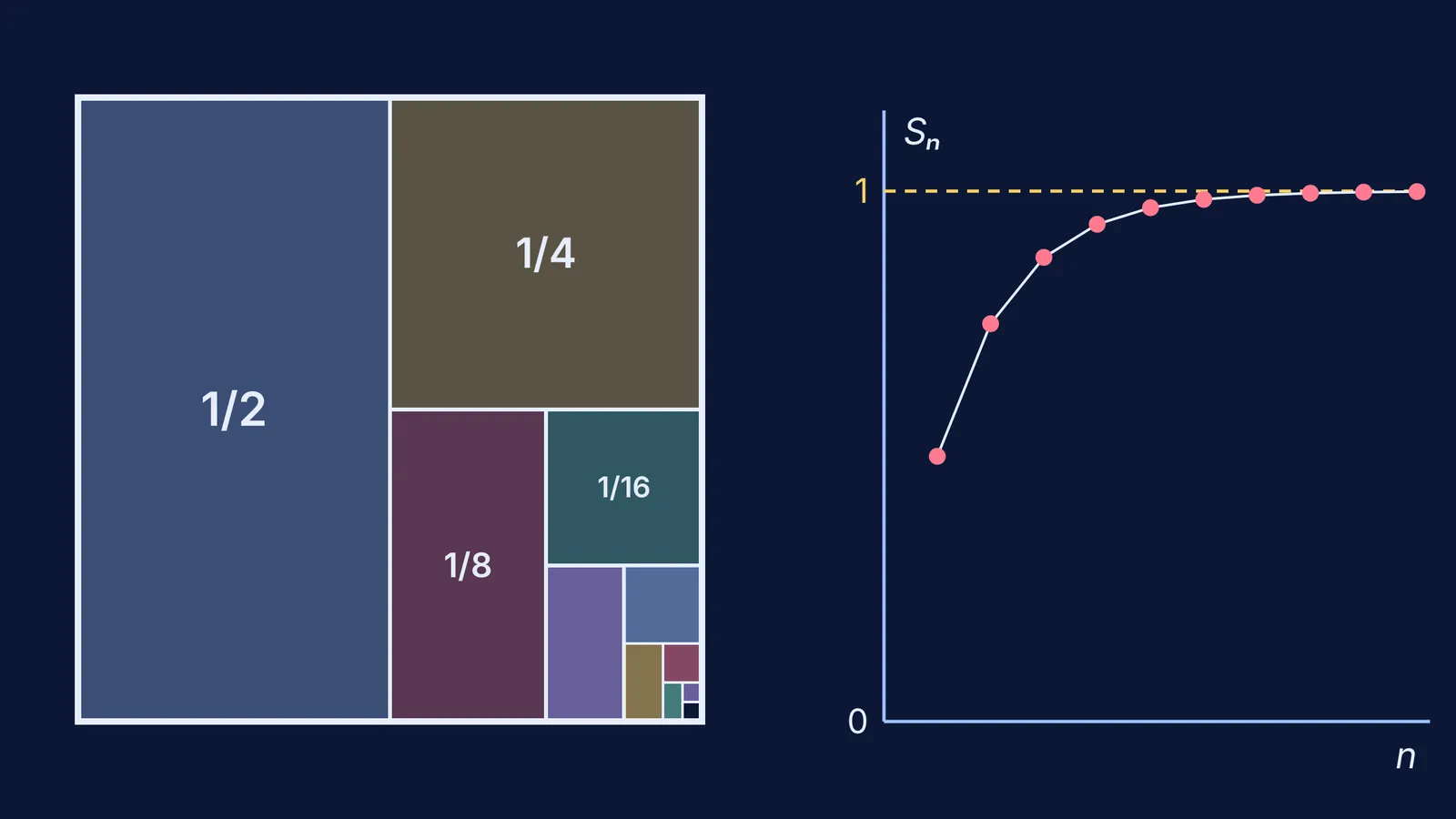
Take a square of area 1 and shade the left half. The white part is a rectangle of area 1/2. Shade half of it, the top quarter. Now 3/4 is shaded and 1/4 is white.
Keep going: shade half of what is left (1/8), then half again (1/16). The white gap halves every time, so after n steps the shaded area is 1 − (1/2)ⁿ.
You never shade outside the square, and the gap gets smaller than any size you name: after 10 steps it is 1/1024 of the square. The only number the shaded area can be heading to is 1.
That is what the sum of an infinite series means. OpenStax Calculus Volume 2 puts it this way: if the sequence of partial sums converges to a real number S, the series converges and S is its sum. You never finish adding; you ask where the running totals are heading. It is the same picture as Zeno's runner, told in our post on Zeno of Elea's paradoxes of motion.
What is the formula for the sum of a geometric series?
A geometric series is a + ar + ar² + ar³ + …, where each term is the previous one multiplied by the same ratio r, as defined in OpenStax Calculus Volume 2, section 5.2.
The same section gives the sum of the first k terms as a(1 − rᵏ)/(1 − r) for r ≠ 1. When |r| < 1, rᵏ shrinks towards 0, just as the white gap closed up, so the infinite sum is a/(1 − r). On the square, a = 1/2 and r = 1/2, giving (1/2)/(1/2) = 1.
Predict first: four series to try
The square lets you guess before you calculate. Cover the answers, predict each sum, then check with a/(1 − r).
1/4 + 1/16 + 1/64 + … Cut the square into quarters, shade one, leave two white, and cut the last quarter into four again. Each round shades one of the three quarters it uses up, so the shaded part tends to 1/3. Formula: (1/4)/(3/4) = 1/3.
1/3 + 1/9 + 1/27 + … Cut the square into three strips: shade one, leave one white, split the third again. Shaded and white grow in step, so each ends up as half. Formula: (1/3)/(2/3) = 1/2.
1 − 1/2 + 1/4 − 1/8 + … Here r = −1/2. The running totals go 1, 0.5, 0.75, 0.625, closing in from both sides. Formula: 1/(1 + 1/2) = 2/3.
0.999… This is 9/10 + 9/100 + …, with r = 1/10, so the sum is exactly 1. Our post on writing recurring decimals as fractions with an infinite GP has more.
If your guess and the formula disagree, redraw the picture before trusting either.
When does an infinite series diverge?
With r = 1, 1 + 1 + 1 + … grows past every number; with r = 2 the terms themselves grow. OpenStax states the rule: if |r| ≥ 1, the geometric series diverges.
r = −1 is the tricky case. The terms never grow, but the running totals flip between two values for ever. The same section works through the series of (−1)ⁿ, whose partial sums go −1, 0, −1, 0, …, and concludes that it diverges.
A common trap: shrinking terms are not enough. The harmonic series 1 + 1/2 + 1/3 + … has terms falling towards 0, yet OpenStax notes that it diverges, though very slowly. A geometric series converges because each term shrinks by a fixed factor smaller than 1.
How do you practise this so it sticks?
A plan for one evening:
Draw the halving square by hand and label each piece.
Draw the r = 1/4 version and explain aloud why the shaded part tends to 1/3.
Write five series of your own, predict each sum or write "diverges", then check.
For exam practice, our guide to deriving sums in sequences and series for JEE carries the same derivation into harder problems.
If you like learning from pictures like this one, the Fermi Simulation Lab has interactive simulations for ideas that are easier to see than to read. If you are stuck on which terms form the GP, the Fermi Problem Library has worked problems with a step-by-step solver that explains the reasoning rather than printing an answer.
Grab a sheet of paper and shade the first five pieces now. You will remember the picture long after the formula fades.


