

On this page
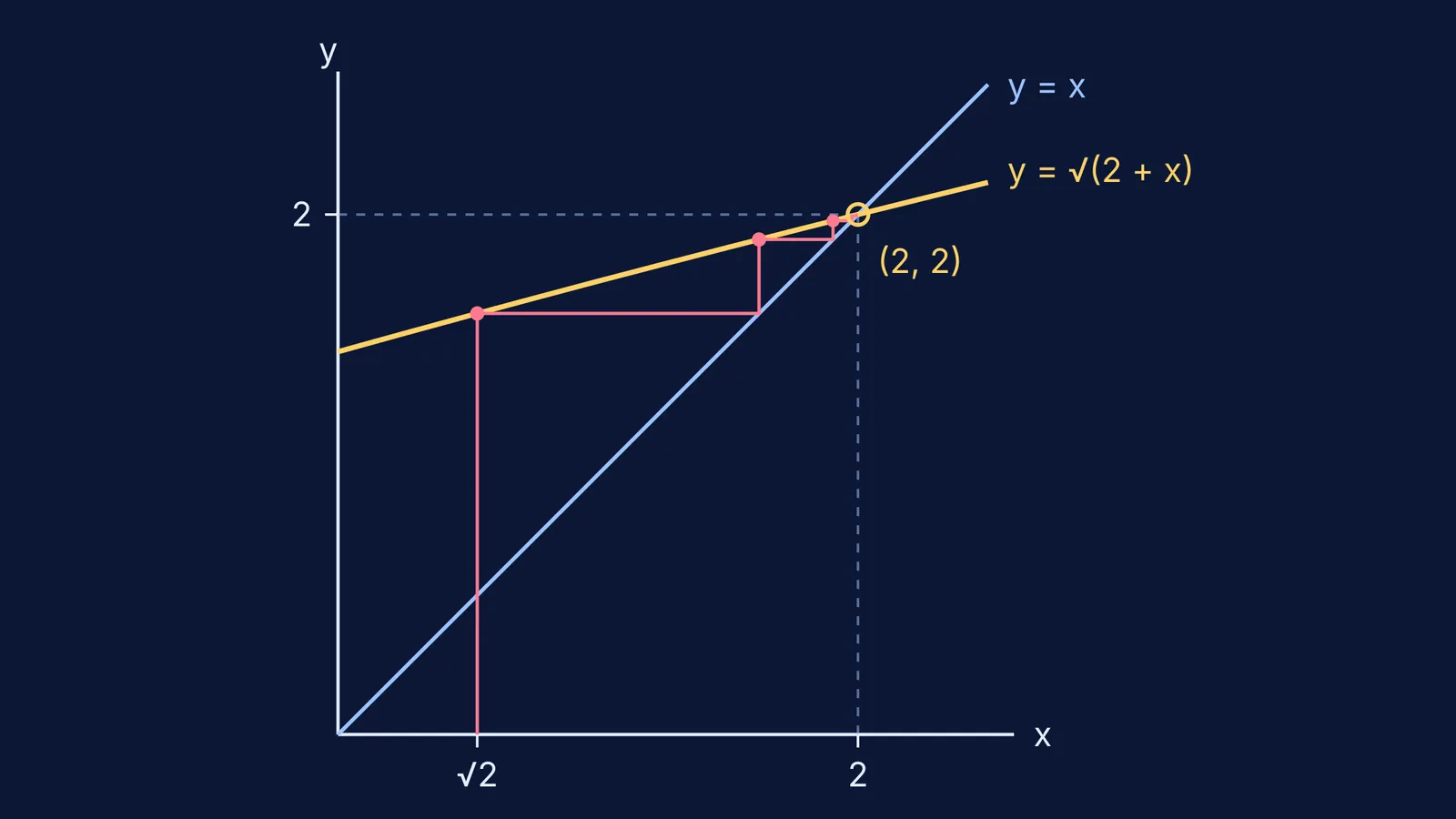
Type √2 into a calculator, add 2, take the square root, and repeat. You get 1.41421, 1.84776, 1.96157, 1.99037, 1.99759. The numbers creep towards 2 and never pass it. Here is the proof you can write in an exam: show the terms stay below 2, show they rise, then find the limit.
What is the value of √(2 + √(2 + √(2 + …)))?
It is 2. The Wikipedia article on nested radicals gets there by setting x = √(2 + x), which gives x = 2, and throws out the other root, x = −1, because the square root sign means the positive root.
The catch is that "call the whole thing x" assumes the infinite expression has a value at all. To make that honest, define the sequence a₁ = √2 and aₙ₊₁ = √(2 + aₙ), so that a₂ = √(2 + √2), a₃ = √(2 + √(2 + √2)), and so on. "Forever" means the limit of aₙ as n grows, and we have to show that limit exists before we solve for it.
How do you prove the sequence converges?
The tool is the monotone convergence theorem: a non-decreasing sequence of real numbers that is bounded above converges to its smallest upper bound, its supremum (monotone convergence theorem). So we need two facts, each proved by induction.
Step 1: every term is less than 2.
Base case: a₁ = √2 ≈ 1.414, which is less than 2.
Inductive step: suppose aₙ < 2. Then 2 + aₙ < 4, so aₙ₊₁ = √(2 + aₙ) < √4 = 2.
So aₙ < 2 for every n. Every term is also positive, because it is the square root of a positive number.
Step 2: the sequence increases.
We want aₙ₊₁ > aₙ. Both sides are positive, so it is enough to compare squares: aₙ₊₁² − aₙ² = 2 + aₙ − aₙ² = (2 − aₙ)(1 + aₙ).
From Step 1, 2 − aₙ is positive, and 1 + aₙ is positive because aₙ is. The product is positive, so aₙ₊₁ > aₙ for every n. Prove the bound first; it hands you the monotonicity.
Step 3: solve for the limit.
Increasing and bounded above by 2, the sequence converges to some limit L, and since every term is at least a₁ = √2, L ≥ √2. Take limits on both sides of aₙ₊₁ = √(2 + aₙ). The square root is continuous, so L = √(2 + L). Squaring gives L² − L − 2 = 0, which factors as (L − 2)(L + 1) = 0. Of L = 2 and L = −1, only 2 is at least √2, so L = 2.
Why does √(2 + √(2 + …)) involve cosines?
This gives you an exact formula for every term. The half-angle identity 2 + 2cos θ = 4cos²(θ/2) means √(2 + 2cos θ) = 2cos(θ/2) for θ between 0 and π. Start from a₁ = √2 = 2cos(π/4) and apply it again and again: aₙ = 2cos(π/2ⁿ⁺¹).
Wolfram MathWorld's page on nested radicals lists the first cases, such as cos(π/8) = ½√(2 + √2). As n grows, the angle π/2ⁿ⁺¹ shrinks to 0 and its cosine climbs to 1, so aₙ climbs to 2: the same answer, reached a second way. The same nested roots, each halved, are the factors of Viète's formula, published in 1593, which writes 2/π as an infinite product.
How do you handle any nested radical or recursive sequence?
Exam questions often change the 2 to 6, 12 or k, or swap the square root for a fraction. The same four moves work:
Compute three or four terms to guess the behaviour and the limit.
Find the candidate limit by solving L = f(L), and keep only the root that fits the sign and size of the terms.
Prove the bound by induction, using that candidate as the bound.
Prove the sequence is monotonic, often by comparing squares or the sign of aₙ₊₁ − aₙ, then quote the monotone convergence theorem.
Worked example: for √(6 + √(6 + …)), L = √(6 + L) gives L² − L − 6 = 0, so (L − 3)(L + 2) = 0 and L = 3. In general, as the Wikipedia article on nested radicals shows, √(k + √(k + …)) = (1 + √(1 + 4k))/2 for k > 0. Put k = 1 and you get the golden ratio, which also turns up in our post on continued fractions and the golden ratio.
The diagram at the top is a cobweb plot of this sequence; our post on fixed-point iteration with cos x = x shows how to read one, and the Leibniz test for alternating series is another place to prove convergence before trusting a value.
If the induction step is where you get stuck, the Fermi Problem Library has a step-by-step solver that explains the reasoning, so you see why each line follows. For the ideas underneath, such as limits and the supremum, the Fermi Concept Library covers every concept in mathematics.
Try it now: show that √(12 + √(12 + …)) = 4, writing out all three steps.


