

On this page
Put solar panels in rows on a roof or a field and each row casts a shadow on the ground behind it. Place the next row too close and, on winter mornings, the front row shades the bottom of the one behind. Place it too far and you waste land. The right gap comes from one piece of geometry you already know: shadow length = height ÷ tan(Sun's elevation).
Why do solar panel rows need a gap at all?
In India, fixed panels face south and are tilted up towards the Sun. The top edge of each row stands some height h above the ground, so it throws a shadow northwards. If that shadow reaches the next row, part of that row goes dark. As what shading does to a panel's bypass diodes explains, even a strip of shade along one edge can cut a panel's output by more than its share of area. So designers choose a row spacing that keeps shadows off the next row for the hours that matter.
When is the shadow between rows the longest?
Shadows are longest when the Sun is lowest. In the northern hemisphere, the noon Sun is lowest on the winter solstice, around 21 December, when the Sun's declination is about −23.44°. At solar noon the Sun's elevation α is:
α = 90° − φ − 23.44°
where φ is your latitude. (The same elevation sets how strongly sunlight heats the ground, which is the story of why the noon Sun feels hottest.)
At other times of day, the elevation comes from the standard solar-position formula:
sin α = sin φ sin δ + cos φ cos δ cos H
Here δ is the declination and H is the hour angle, 15° for every hour away from solar noon. We worked the positions below with the declination from NOAA's solar calculator equations, which are based on Jean Meeus's Astronomical Algorithms (NOAA Global Monitoring Laboratory, solar calculation details). For 21 December 2026 they give δ = −23.44°.
How do you calculate the row spacing for a tilted panel?
Take a panel of slant length ℓ tilted at angle β.
Height of the top edge: h = ℓ sin β.
Footprint on the ground: ℓ cos β.
Shadow behind the top edge, measured north–south: h cos A / tan α, where A is the Sun's azimuth measured from due south.
Row pitch (front edge to front edge): pitch = footprint + shadow.
Only the north–south part of the shadow matters, because the next row runs east–west and is in line behind. At noon A = 0, so the whole shadow points north. In the morning the shadow is longer but slants towards the north-west, so its north–south part is shorter than its full length.
Worked example: a 2 m panel in Delhi
Take a panel 2.0 m long, tilted 25°, at Delhi (latitude about 28.6° N). The numbers are illustrative; the method works for any site.
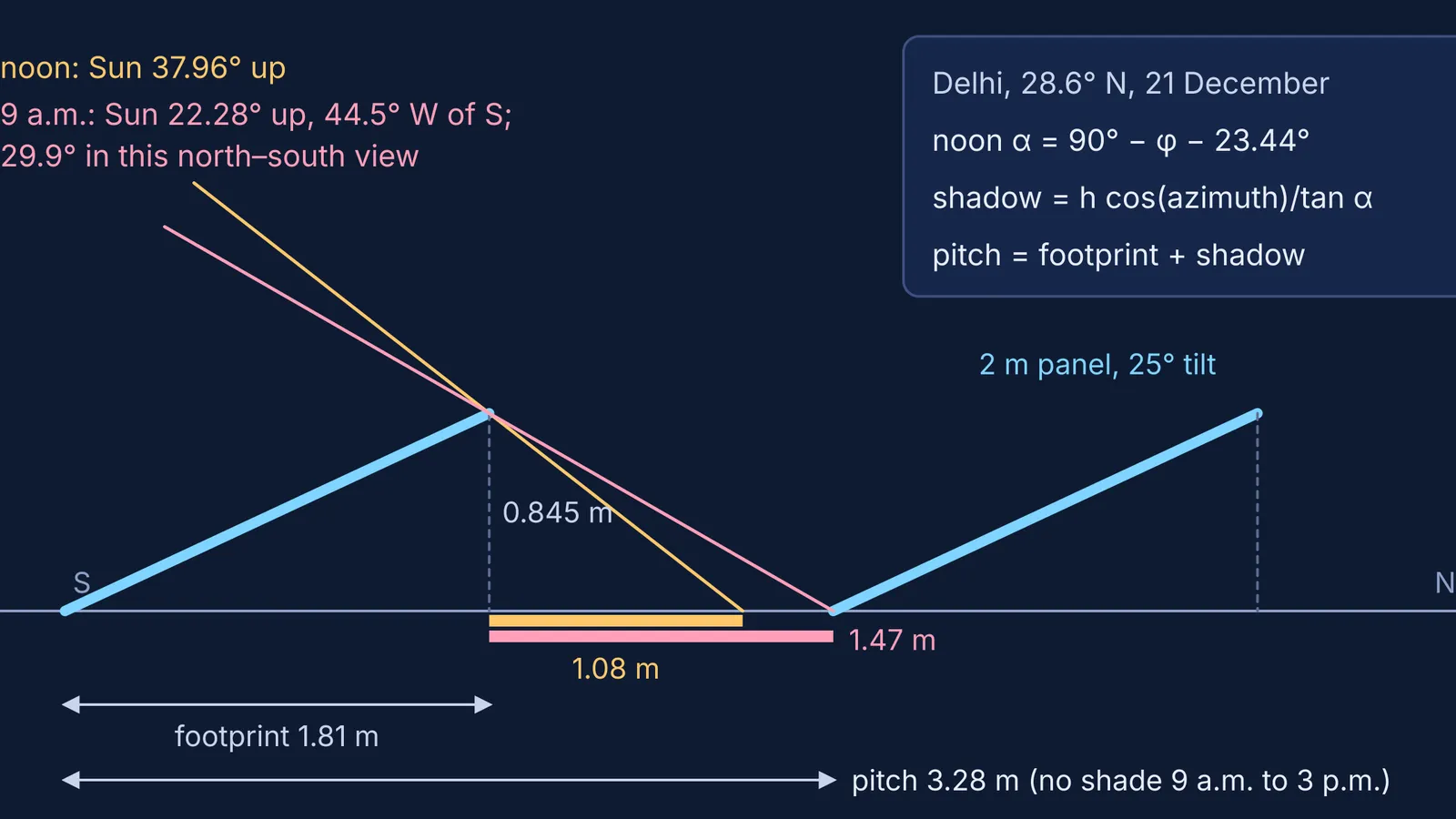
Top edge height. h = 2.0 × sin 25° = 0.845 m.
Footprint. 2.0 × cos 25° = 1.813 m.
Noon on 21 December. α = 90° − 28.6° − 23.44° = 37.96°. Shadow = 0.845 / tan 37.96° = 1.083 m. Pitch = 1.813 + 1.083 = 2.896 m.
9 a.m. solar time (H = −45°). sin α = sin 28.6° sin(−23.44°) + cos 28.6° cos(−23.44°) cos 45° = −0.190 + 0.569 = 0.379, so α = 22.28°. The azimuth works out to 44.5° east of south, mirroring the 44.5° west of south at 3 p.m.
Full shadow at 9 a.m. 0.845 / tan 22.28° = 2.063 m, but slanting.
North–south part. 2.063 × cos 44.5° = 1.471 m.
Pitch for no shade from 9 a.m. to 3 p.m. 1.813 + 1.471 = 3.283 m.
Check the units: h is in metres, tan α is a pure number, so the shadow is in metres. Check the sense: a lower Sun gives a longer shadow and a larger pitch, as it should.
In the side view, the 9 a.m. ray looks as if it comes in at 29.9°, not 22.28°, because tan 29.9° = 0.845/1.471. This "profile angle" is what you would see looking along the rows.
What is ground coverage ratio and why does it fall at higher latitudes?
Ground coverage ratio (GCR) is the panel area divided by the ground area it occupies. For rows of equal panels, that is panel slant length ÷ pitch. NREL's System Advisor Model documentation defines it the same way and uses it to set row spacing: D = panel side length ÷ GCR (NREL SAM, PV land area calculations).
Delhi, no shade at noon only: 2.0 / 2.896 = 0.69.
Delhi, no shade from 9 a.m. to 3 p.m.: 2.0 / 3.283 = 0.61. Panels cover 61% of the ground.
Now move south to Chennai (about 13.1° N) with a 13° tilt. The 9 a.m. Sun on 21 December is 32.80° up at 50.5° from south. The panel's top edge is 0.450 m high, its footprint is 1.949 m, the north–south shadow is 0.444 m, and the pitch is 2.393 m. GCR = 2.0 / 2.393 = 0.84. Nearer the equator, the winter Sun is higher and the panels lie flatter, so rows can sit much closer.
What does this simple sum leave out?
Solar time is not IST. Our 9 a.m. and noon are local solar time. With Delhi at about 77.2° E, east of IST's 82.5° E meridian by 5.3°, and the equation of time near +2 minutes in late December, solar noon in Delhi is close to 12:19 IST.
Refraction. The air lifts the Sun's image slightly. At 22° elevation the correction is only about 0.04°, which changes the shadow by well under a centimetre.
Sloping ground. We assumed flat, level ground. Ground that falls away to the north lengthens shadows; ground that rises to the north shortens them.
The hours are a choice. "No shade from 9 a.m. to 3 p.m. on the shortest day" is just the rule used in this example. A designer may accept some winter-morning shade to fit more panels, or pick a different window.
Tilt is a separate question. How to choose the 25° is covered in finding the solar panel tilt angle with a simulation.
If the solar-position formula feels like magic, the Concept Library builds it up from latitude, declination and hour angle, and the Simulation Lab lets you move the Sun and watch shadows change.
Quick checklist
Shadow = h / tan α; only its north–south part, h cos A / tan α, matters for the next row.
Worst case: the winter solstice, δ ≈ −23.44°.
Noon elevation: α = 90° − φ − 23.44°.
Pitch = panel footprint + north–south shadow.
Delhi, 2 m panel at 25°: pitch 2.90 m for noon, 3.28 m for 9 a.m. to 3 p.m.
GCR = panel length ÷ pitch; about 0.61 in Delhi and 0.84 in Chennai for that rule.
Use solar time, not clock time.


