

On this page
A leaf lands on one cell of a rooftop solar panel. That cell is less than 2% of the panel's area, yet without protection it could cut the panel's output by more than three quarters and start to overheat. A small component in the junction box on the back, the bypass diode, keeps the loss to about a third. It is a direct application of two Class 12 ideas: series circuits carry one current, and a p-n junction conducts in only one direction.
Why does one shaded cell affect the whole panel?
A single silicon cell gives only about half a volt at its working point, which is far too little to be useful. So a panel joins many cells in series to add up their voltages. How one cell turns light into current is covered in how solar panels make electricity from sunlight; here the important part is the series connection.
In a series circuit every element carries the same current. A cell's current is set mainly by the light falling on it. If one cell is shaded so that it can only produce a small current, it acts like a bottleneck: the whole string is held to roughly that current, even though the other cells could deliver much more.
There is a second problem. If the rest of the string is pushing more current than the shaded cell can generate, the other cells drive the shaded cell into reverse bias. Instead of producing power, it absorbs power from its neighbours and turns it into heat. This is called a hot spot. How hot it gets depends on the shaded cell's reverse I–V characteristic and the operating point of the string, so there is no single number for it, but hot spots can damage the cell and the panel's back sheet over time.
What does a bypass diode do?
A bypass diode is connected in parallel with a group of cells, with its polarity opposite to theirs. PVEducation's page on bypass diodes shows the circuit.
Normal operation. The cells in the group are generating, so the end of the group where current leaves is at a higher potential than the end where it enters. The diode sees this as reverse bias and carries almost no current. It is effectively not there.
Shaded operation. When a cell in the group cannot carry the string current, the voltage across the group drops and then reverses. As soon as the diode becomes forward biased by about its forward voltage, it switches on and carries the string current around the whole group.
The reverse voltage on the shaded cell is now capped. It can be no more than the forward voltage of the other cells in its own group plus one diode drop, instead of being set by the whole string.
A common layout for a 60-cell panel is three groups of 20 cells, each group bridged by one bypass diode in the junction box. Many panels today use half-cut cells (120 of them) with a different internal wiring, so check the datasheet of any real panel rather than assuming this layout.
How much power does a bypass diode save?
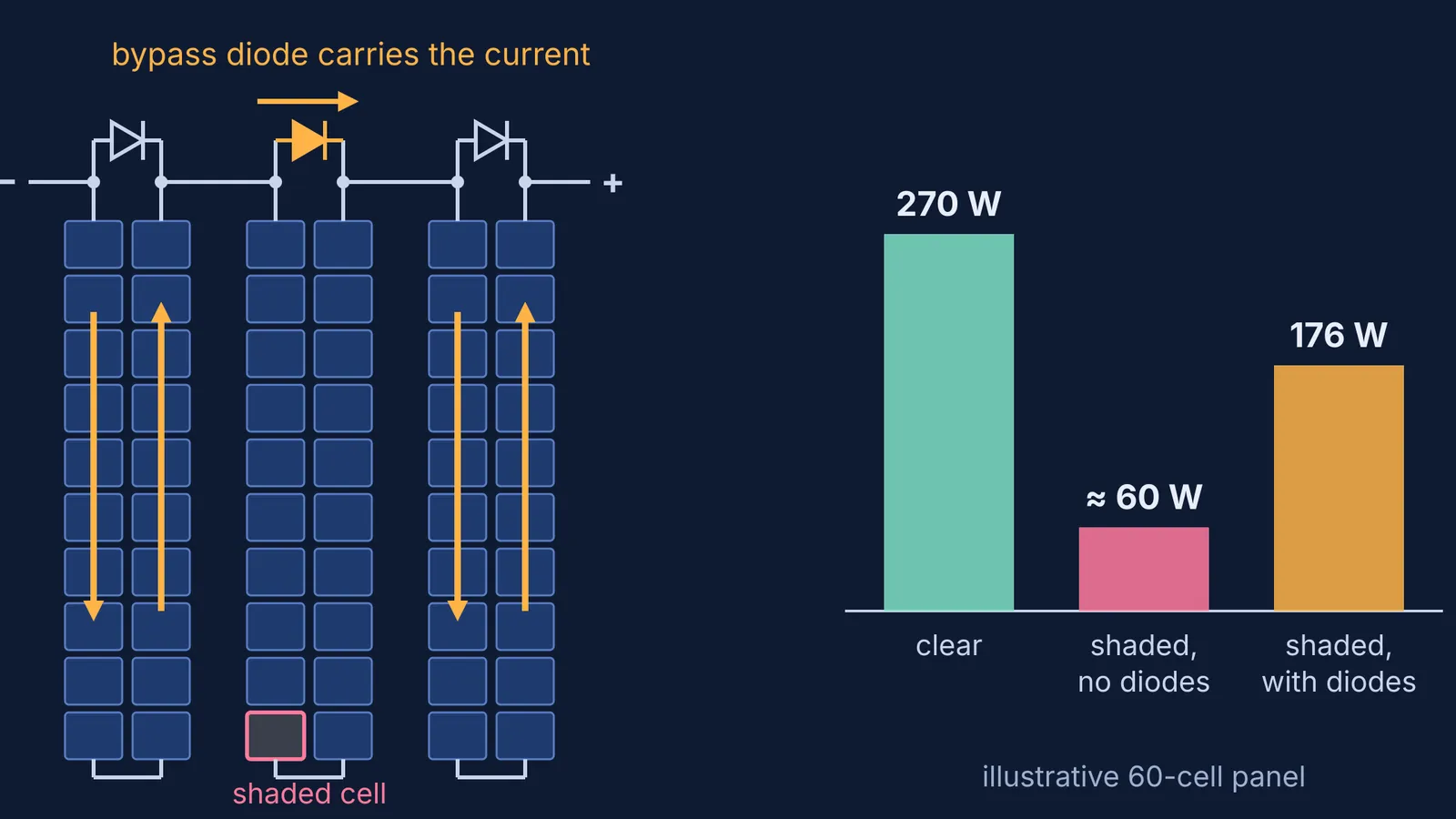
Take an illustrative panel, not a specific product: 60 cells in three groups of 20, each cell giving 0.5 V and 9 A at its maximum power point, and a bypass diode forward voltage of 0.4 V. One cell is shaded so that it can pass only 2 A.
Full sun. Panel voltage = 60 × 0.5 = 30 V. Power = 30 V × 9 A = 270 W.
One cell shaded, no bypass diodes. The string is held to about 2 A. With the other cells still near 0.5 V each, power ≈ 30 V × 2 A = 60 W, about 22% of full power. This is a simplified estimate: at lower current the good cells' voltage rises slightly, and the shaded cell may be pushed into reverse breakdown, so the real figure depends on the cells.
One cell shaded, with bypass diodes. The diode across the shaded group turns on. The other 40 cells carry the full 9 A. Voltage = 40 × 0.5 − 0.4 = 19.6 V. Power = 19.6 V × 9 A = 176 W, about 65% of full power.
Power lost in the diode. P = V × I = 0.4 V × 9 A = 3.6 W.
Check the units: volts times amperes gives watts in each line. Check the sense: shading one-sixtieth of the area costs about a third of the power with diodes, because you lose a whole group of 20 cells, and over three quarters without them.
That 3.6 W in a component the size of a fingertip is why bypass diodes are usually Schottky diodes, which have a lower forward voltage than ordinary silicon p-n diodes, and why the junction box is designed to get rid of heat. The 0.4 V figure here is illustrative; a real diode's forward voltage at 9 A is given in its manufacturer's datasheet.
Why does the inverter matter when a panel is shaded?
With bypass diodes on, the panel's power–voltage curve can have two peaks. In the example, one peak is near the full 30 V with the current limited to about 2 A (about 60 W). The other is near 19.6 V with the full 9 A (176 W). The inverter's maximum power point tracker looks for the operating point that gives the most power. A tracker that settles on the lower peak wastes much of the benefit, which is why some trackers sweep the voltage from time to time. The 60 W and 176 W figures above are a simplified picture of these two peaks.
How is this different from how a single cell behaves?
A single solar cell's I–V curve, with its open-circuit voltage and short-circuit current, is covered in photodiode, LED and solar cell I–V curves for JEE Main. Shading changes what happens when many such cells are joined. Temperature is a separate loss again, covered in why solar panels produce less power on very hot days. Bypass diodes do nothing for heat losses; they only deal with mismatch between cells.
If you want to see how series and parallel connections share current and voltage, the Simulation Lab has interactive simulations for ideas that are easier to see than read.
Quick checklist
Cells in a panel are in series, so they all carry the same current.
One shaded cell limits the string current and can be driven into reverse bias, making a hot spot.
A bypass diode is in parallel with a group of cells and reverse biased in normal operation.
When the group cannot carry the string current, the diode conducts around it.
Illustrative panel: 270 W in full sun, about 60 W shaded without diodes, about 176 W with them.
The diode dissipates V × I, here 3.6 W, so Schottky diodes with a low forward voltage are used.
Bypass diodes and blocking diodes do different jobs.


