On this page
Every car engine is an air pump first. Fuel is easy to add; what limits power is how much air, and so how much oxygen, fits into each cylinder per stroke. A turbocharger's job is to cram in more.
How does a turbocharger work?
A turbocharger is two bladed wheels on one shaft. One sits in the hot exhaust pipe and the other in the air intake. The turbine wheel's blades "convert kinetic energy from the flow of exhaust gases to mechanical energy of a rotating shaft", and a shaft in the centre housing "connects the turbine to the compressor", as Wikipedia's turbocharger article describes. The compressor wheel on the other end pushes intake air into the engine above atmospheric pressure.
That is the clever part: energy in the exhaust that would otherwise leave through the tailpipe is spent on the intake.
According to FuelEconomy.gov, "Turbochargers are compressors that force additional air into the engine's cylinders", and "the additional air and fuel create more power". The same official US page says this lets carmakers "use smaller engines without sacrificing performance", and lists a potential efficiency improvement of up to 8% for turbocharging with engine downsizing.
The idea is old. The 1905 patent by Swiss engineer Alfred Büchi is often considered the birth of the turbocharger (Wikipedia).
What does the ideal gas law have to do with it?
The engine cares about the mass of air in the cylinder, not its volume, because a fixed mass of oxygen can burn a fixed mass of fuel. The cylinder's volume is fixed, so what matters is density.
NASA's Glenn Research Center writes the ideal gas law in an engineer's form, p = ρRT, where p is pressure, ρ is density, R is the gas constant for air and T is absolute temperature in kelvin (NASA Glenn, Equation of State). Rearranged, ρ = p / RT.
So density goes up with pressure and down with temperature. A turbo raises the pressure. The catch is that it raises the temperature too.
Why does compressed air get hot, and what does an intercooler fix?
When you squeeze a gas quickly, the work you do on it turns into heat. You have felt the reverse when a tyre bursts: we explain in why air from a burst tyre feels cold that expanding air cools down.
For fast compression with no time for heat to escape, NASA gives T2/T1 = (p2/p1)^((γ − 1)/γ), and for air at standard conditions γ is 1.4 (NASA Glenn, Isentropic Compression).
An intercooler is a heat exchanger used to cool a gas after compression (Wikipedia, Intercooler). Cooler intake air is denser, and the same article notes it is less likely to suffer from pre-ignition or knocking, where the fuel-air mix ignites at the wrong moment.
Worked example: how much extra air does a turbo give?
Take outside air at 1 bar and 300 K (about 27 °C, a mild Delhi evening). The turbo compresses it to 2 bar absolute, a pressure ratio of 2. Use NASA's p = ρRT and isentropic relation.
Temperature after compression: T2 = 300 × 2^(0.4/1.4) = 300 × 1.219 ≈ 366 K, about 93 °C.
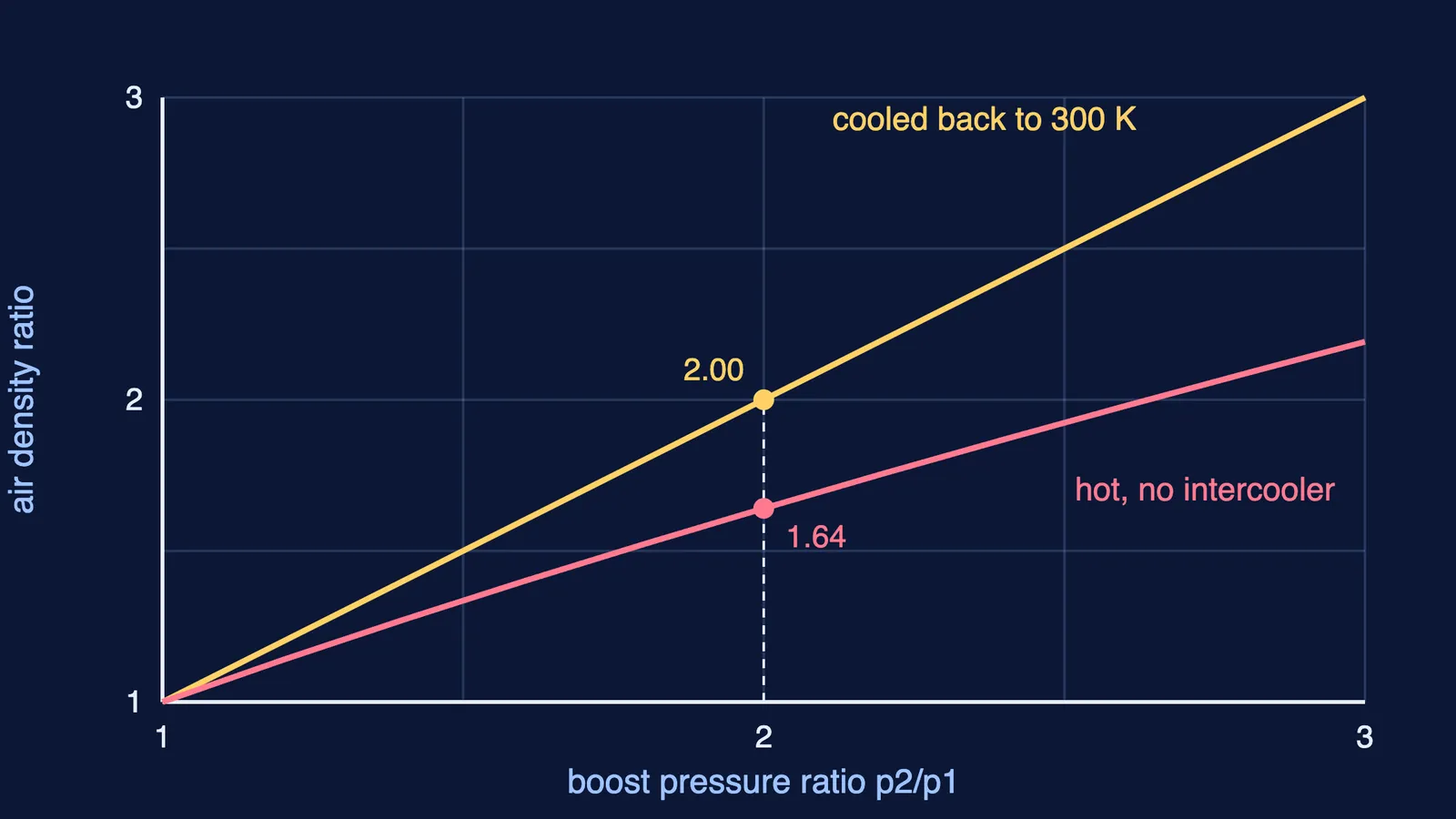
Density ratio without an intercooler: (p2/p1) × (T1/T2) = 2 × 300/366 ≈ 1.64.
Now cool the air in an intercooler to 320 K (47 °C). Density ratio: 2 × 300/320 ≈ 1.88.
Compare: 1.88 / 1.64 ≈ 1.14, so the intercooled engine gets about 14% more air per stroke than the hot one.
Two honest caveats. Real compressors are not perfect, so the air leaves hotter than step 1 says. And an ordinary air-to-air intercooler cannot cool the air below the outside temperature, so the best possible ratio here is 2.00, the yellow line in the chart at the top of this post.
What should you remember for exams?
This is a gas-law question in disguise.
Always use kelvin in pV = nRT and p = ρRT.
"More pressure" does not mean "proportionally more air" unless the temperature is brought back down.
Fast compression is adiabatic: use T p^((1 − γ)/γ) = constant.
Treat an intercooler as a roughly constant-pressure cooling step, so density rises in proportion to the fall in absolute temperature.
The same compression physics decides an engine's efficiency, which we derive in Otto cycle efficiency, worked for r = 8. And the heat a turbo adds is one more load on the cooling system described in why a car engine needs a radiator and coolant.
If the adiabatic step feels slippery, it helps to see pressure, volume and temperature move together. The Fermi Simulation Lab has interactive simulations for ideas that are easier to see than read. And if you want to work through the derivation one line at a time, Fermi's AI tutor holds a line of reasoning across a session and checks your understanding as it goes.