

On this page
If you throw a ball on a flat field, a launch angle of 45° yields the maximum distance. This familiar rule balances the need for time in the air with horizontal speed. But when you move to a hillside, the 45° rule completely fails.
When the ground tilts upwards, the slope rises to meet the projectile, drastically cutting the time of flight. To clear the rising ground and achieve the maximum range, you must launch the object steeper than 45°.
Why 45° fails on a slope
On flat ground, gravity only pulls the projectile downwards toward an unchanging horizontal plane. At an angle of 45°, the momentum is perfectly halved between horizontal distance and vertical height, giving the maximum possible range of u²/g.
When throwing up a hill, the surface "catches" the projectile early. A 45° launch angle does not provide enough vertical clearance to stay airborne. Conversely, throwing *down* a hill gives the projectile more time to fall, meaning a shallower launch angle will carry it further.
What is the formula for projectile range up an inclined plane?
To model this, physicists rotate the coordinate system. By setting the x-axis parallel to the incline and the y-axis perpendicular to it, the mathematics becomes much easier to manage.
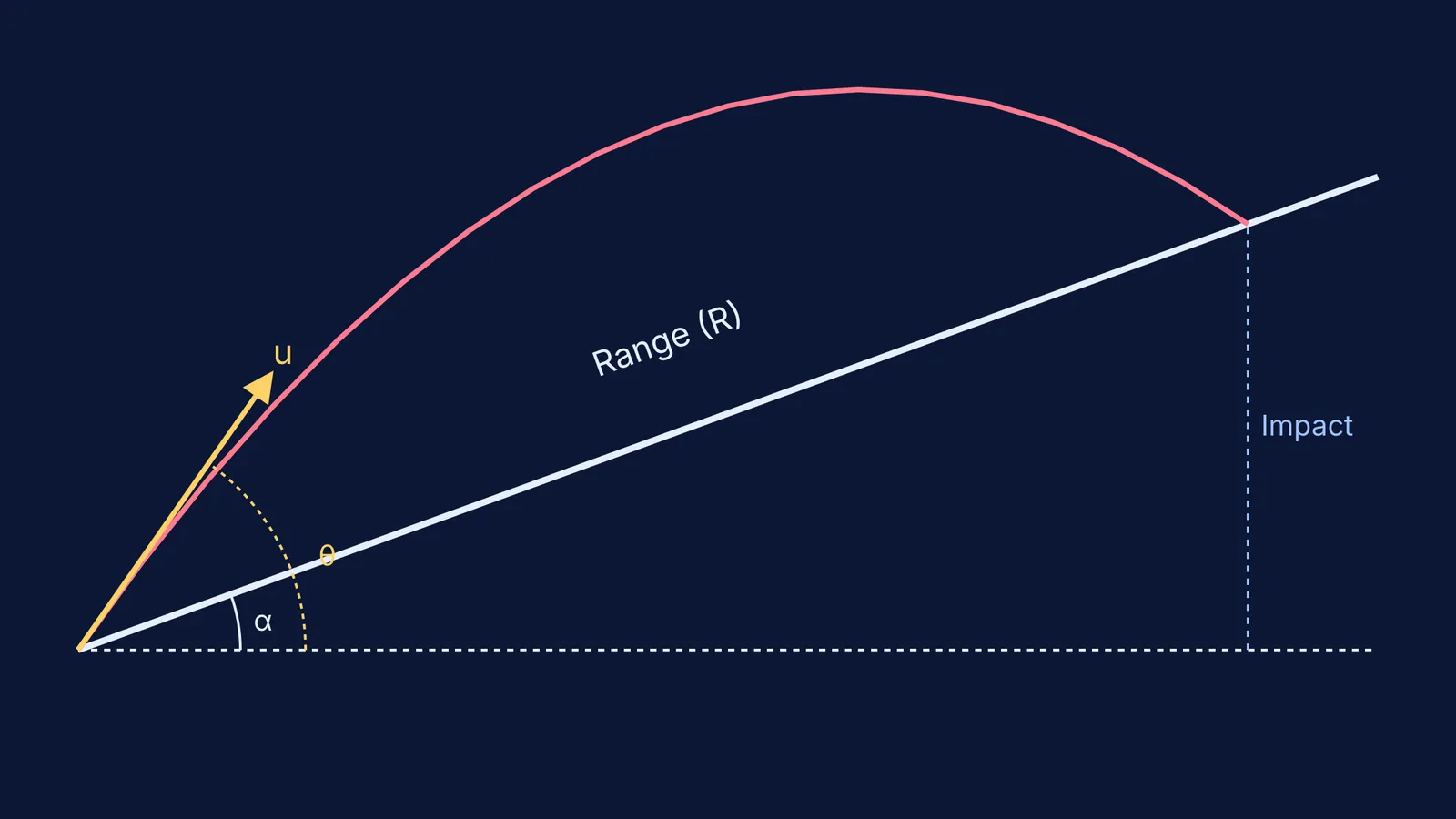
For a slope inclined at an angle α, and a projectile launched at an initial speed u and an angle θ from the horizontal, the range R measured along the slope is:
R = [2u² sin(θ − α) cos θ] / (g cos² α)
When analysing a projectile, getting comfortable with the underlying equations allows you to find unknown variables quickly, much like using the Equation of trajectory of a projectile: finding u and θ from it.
At what angle is the range maximum on an inclined plane?
To extract the maximum range along the incline, you must bisect the angle between the vertical direction (the pull of gravity) and the slope itself.
The optimal launch angle from the horizontal to maximise range up a slope is: θ = 45° + α/2
If you are firing the projectile back *down* the slope, gravity works with you, allowing the object to travel further. In this case, the best launch angle from the horizontal drops to: θ = 45° − α/2
For example, if you are throwing a ball up a 30° hill (α = 30°), your optimal launch angle is 45° + 15° = 60° relative to the horizontal (which is 30° above the surface of the incline). If you are throwing it down the same hill, your best angle is 45° − 15° = 30° from the horizontal.
It is often difficult to picture how altering the launch angle affects the resulting arc. You can interact with these variables in the Fermi Simulation Lab, where you can drag the launch angle to see the range curve respond instantly to your inputs.
A practical framework for incline problems
If you are preparing for exams like the JEE Main or NEET-UG, projectile problems on a slope are standard fare. Follow these steps to keep the variables straight:
Tilt your axes: Always draw your x-axis parallel to the incline and your y-axis perpendicular to it.
Split the acceleration: Gravity now has two components. You have an acceleration of g sin α pulling down the slope, and an acceleration of g cos α pulling the object into the surface.
Check your reference angles: Examiners love to trick students by providing the launch angle relative to the surface of the incline rather than the horizontal plane. Read the question carefully.
Compare with other models: See how shifting your coordinate system helps in other contexts by reviewing a Horizontal projectile from a cliff: time, range and impact speed.
Analyse the path: For more advanced trajectory analysis, consider calculating the Radius of curvature of a projectile's path at the top and launch.
By mastering the rotated coordinate frame, incline problems become just as straightforward as throwing a ball on a flat field.


