

On this page
In 1875, French chemist Paul-Émile Lecoq de Boisbaudran was examining a sample of zinc ore from the Pyrenees mountains. When he placed the ore in his spectroscope, he saw two bright violet lines he had never seen before. He had found a new element.
The discovery of gallium was a triumph for experimental chemistry, but it became even more famous as a victory for theoretical chemistry. Four years earlier, the Russian chemist Dmitri Mendeleev had predicted that this exact element must exist.
How did a spectroscope find a new element?
A spectroscope splits the light emitted by a heated substance into its component colours, much like a prism splits sunlight into a rainbow. Because every element has a unique arrangement of electrons, it emits specific wavelengths of light when heated. These wavelengths appear as sharp, bright lines—a chemical fingerprint.
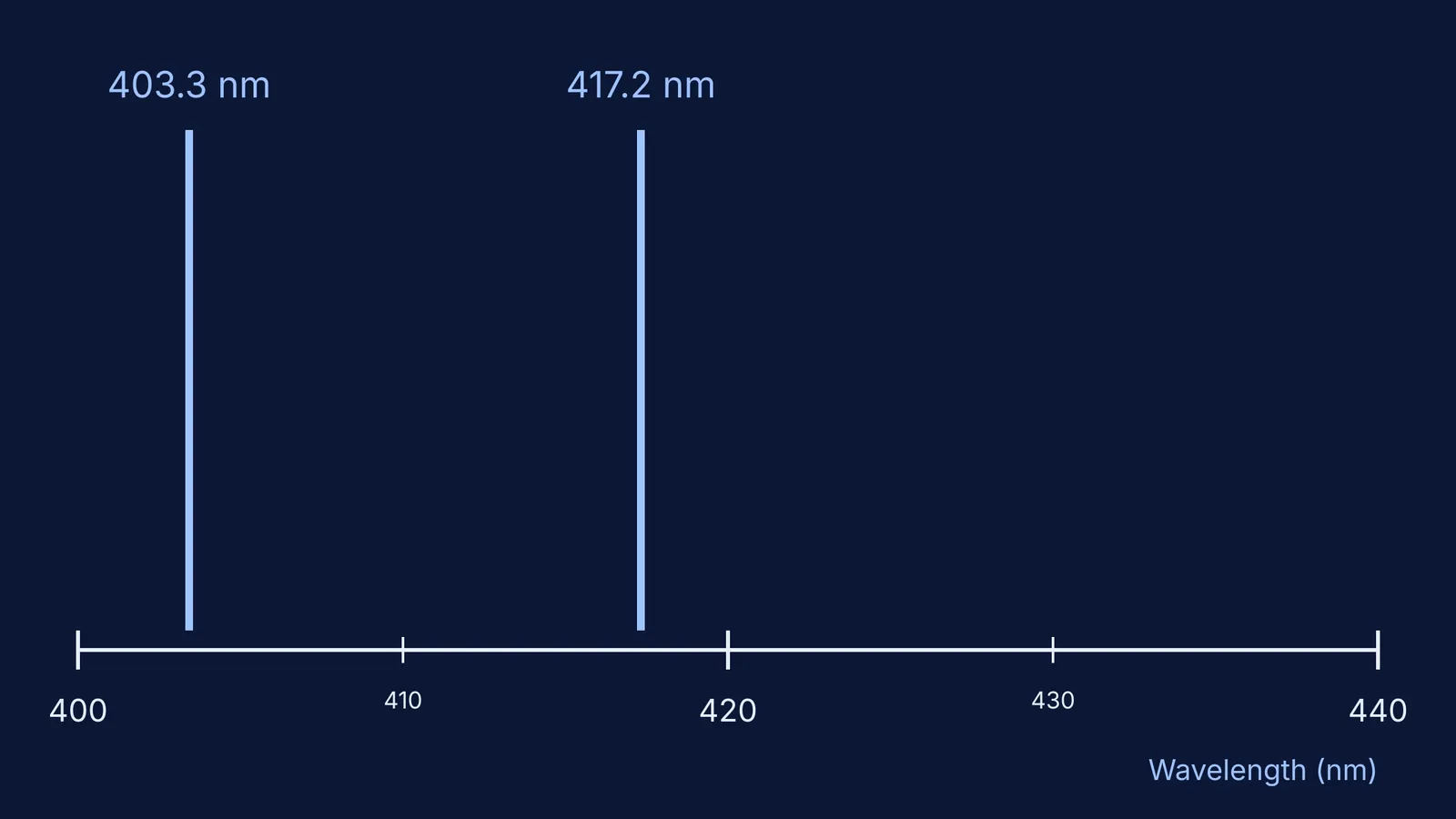
When Lecoq de Boisbaudran heated his zinc blende (sphalerite) ore, he observed two distinct violet lines at wavelengths of 417.2 nm and 403.3 nm (Royal Society of Chemistry). These lines did not match zinc or any other known element. On 27 August 1875, he isolated a tiny sample of the new metal and named it gallium, after *Gallia*, the Latin name for France.
What was Mendeleev's eka-aluminium?
In 1871, Dmitri Mendeleev published a revised version of his periodic table. Unlike other chemists who simply grouped known elements by atomic weight, Mendeleev left empty spaces for elements he believed were missing. He used the Sanskrit prefix *eka-* (meaning "one") to name these placeholders based on the element sitting directly above them in the same column.
One of these gaps sat directly below aluminium. Mendeleev called it "eka-aluminium" and predicted its properties with astonishing detail. He stated it would have an atomic weight of around 68, a low melting point, and a density of 5.9 g/cm³ (Britannica).
When Lecoq de Boisbaudran published his initial report on gallium, Mendeleev read it and immediately wrote to the French Academy of Sciences, claiming that gallium was his missing eka-aluminium.
Who won the density dispute of 1875?
Mendeleev and Lecoq de Boisbaudran agreed on almost everything, except the element's density. Lecoq de Boisbaudran had initially measured the density of his newly isolated gallium and found it to be 4.7 g/cm³ (Linda Hall Library).
Mendeleev, writing from St. Petersburg, insisted the Frenchman was wrong. Without ever having seen a single atom of gallium, Mendeleev argued that the density must be 5.9 g/cm³, because his periodic law demanded it. He suggested that Lecoq de Boisbaudran's sample was contaminated or that his measurement was flawed.
Lecoq de Boisbaudran went back to his laboratory, purified his sample further, and carefully repeated the measurement. He found the true density to be 5.94 g/cm³ (Linda Hall Library). The theorist had corrected the experimentalist.
This moment changed how the scientific community viewed the periodic table. It was no longer just a neat way to organise data; it was a powerful tool that could predict the laws of nature. If you are learning how atomic properties emerge from these rules and get stuck on a difficult question, the Fermi Problem Library has worked problems with a step-by-step solver that explains the reasoning rather than printing an answer.
How can you predict properties using the periodic table?
Mendeleev's method of predicting eka-aluminium relied on interpolating the properties of surrounding elements. When you are studying periodicity, you can use a similar framework to estimate properties:
Locate the element: Find its group (column) and period (row).
Check the group above and below: Elements in the same group share chemical behaviour because they have the same number of valence electrons.
Check the period left and right: Atomic radii decrease from left to right, while electronegativity increases.
Average the neighbours: For a rough estimate of a physical property like density or atomic weight, average the values of the elements directly above, below, left, and right.
Understanding how to read these trends is often harder than memorising them. Fermi's AI tutor teaches rather than answers: it works out what you know and builds a plan for the session, drawing the figure and checking your understanding as it goes.
The predictive power of Mendeleev's table was soon proven twice more. In 1879, Lars Fredrik Nilson discovered scandium, matching Mendeleev's "eka-boron". And in 1886, Clemens Winkler found germanium, which perfectly matched "eka-silicon" (read more about Clemens Winkler and the missing 7% that revealed germanium). Together with gallium, these discoveries cemented the periodic table as the foundation of modern chemistry. You can also explore how atomic volumes were charted by reading about Lothar Meyer and the atomic volume curve of the elements.


