

On this page
Global sea level rose by 0.20 metres between 1901 and 2018, according to the IPCC's 2021 Summary for Policymakers. The same report found the rate climbing: 1.3 mm a year over 1901–1971, 1.9 mm a year over 1971–2006 and 3.7 mm a year over 2006–2018. Two physical processes do almost all of this work, and one popular suspect, melting Arctic sea ice, does almost none.
What causes sea level rise?
The IPCC defines global mean sea-level change as the change in the volume of the ocean divided by the ocean's surface area (IPCC AR6, Chapter 9, Box 9.1). So the sea can rise in only two ways: the same water takes up more room, or more water arrives.
Thermal expansion: warmer water is less dense, so the same mass of seawater occupies more volume. The IPCC calls this thermosteric sea-level change.
Added mass: water stored on land, as glaciers, the Greenland and Antarctic ice sheets, groundwater or lakes, ends up in the ocean.
If density and temperature feel shaky, our explainer on how density changes with temperature walks through the ρ(1 − γΔT) rule from Class 11 physics.
How much is thermal expansion and how much is melting ice?
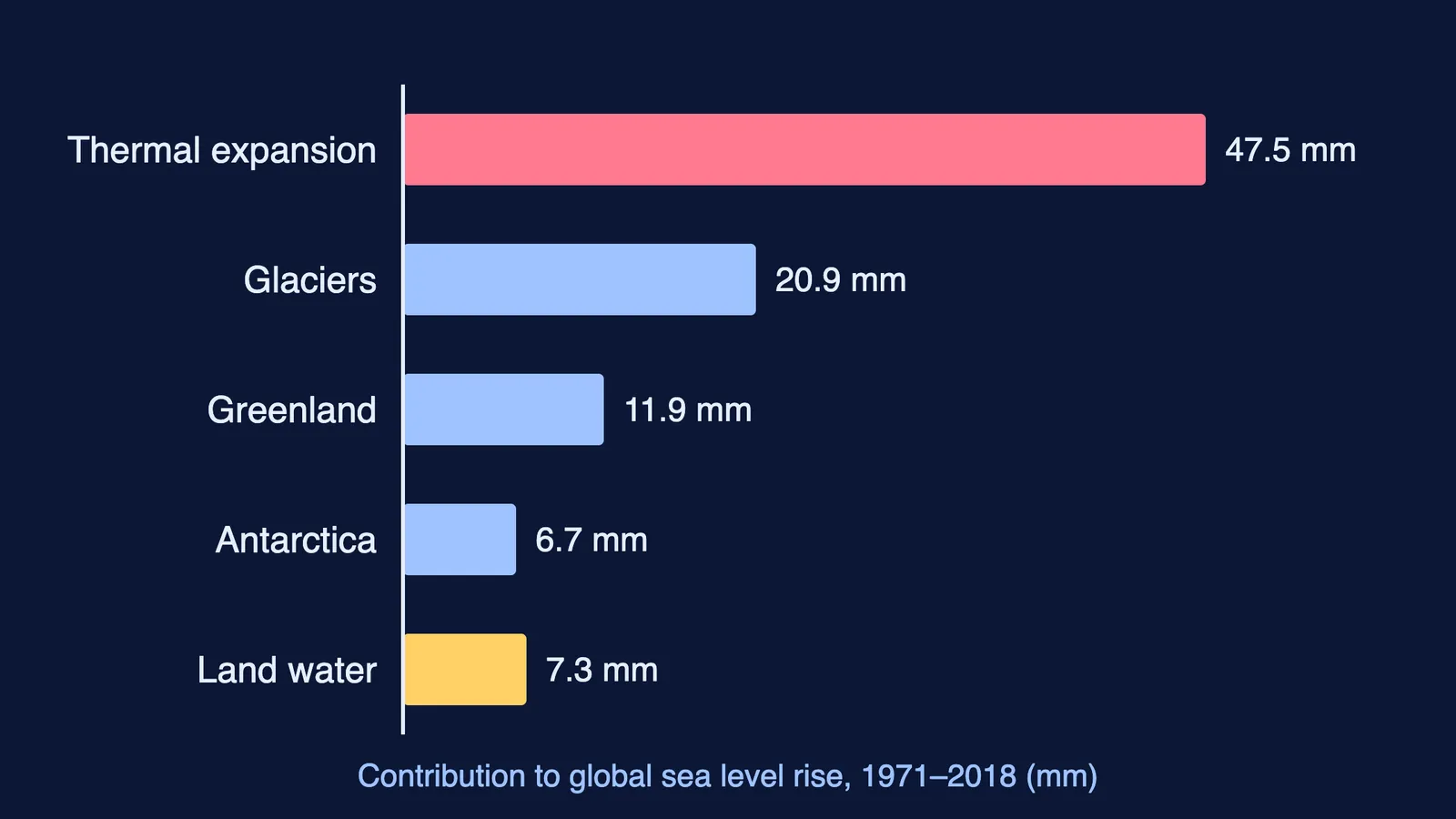
The IPCC's sea-level budget, Table 9.5 of Chapter 9 with its published corrections, splits the measured contributions over 1971–2018 like this:
Thermal expansion of seawater: about 50%
Glaciers outside the ice sheets: about 22%
Greenland ice sheet: about 13%
Antarctic ice sheet: about 7%
Changes in land water storage: about 8%
These contributions sum to about 94 mm, short of the roughly 110 mm observed, so this budget does not fully close. Over the longer 1901–2018 window, glaciers (41%) edge out thermal expansion (38%), according to the chapter's executive summary. The mix is shifting: according to the chapter's published corrections, melting land ice (glaciers plus ice sheets) was the largest contributor over 2006–2018.
Why doesn't melting sea ice raise sea level?
Floating ice obeys Archimedes' principle: it displaces its own weight of water. NASA's Earth Observatory puts it plainly: “Because it is already floating in the ocean, sea ice is already displacing its own weight.” When it melts, its water roughly fills the hollow it was already pushing into the sea, like ice cubes melting in a full glass. Why ice floats at all comes down to hydrogen bonds; see why ice floats, built as a 3D lattice.
There is one small correction. Sea ice is mostly fresh water, which is less dense than salty seawater. The National Snow and Ice Data Center describes a 2007 study by Peter Noerdlinger and Kay Brower in Geophysical Journal International which found that the meltwater takes up about 2.6% more volume than the same weight of salt water. NSIDC's verdict is that sea ice melt is not a significant contributor to sea level rise, though its contribution is not nothing.
Worked example: turning lost ice into millimetres
NASA's GRACE satellites show Greenland losing about 264 billion tonnes of ice a year and Antarctica about 135 billion tonnes a year, averaged over 2002–2025 (NASA ice sheets indicator).
The IPCC converts ice to sea level at 362.5 gigatonnes of ice per millimetre of global rise (Chapter 9, footnote 3). One gigatonne is a billion tonnes.
Greenland: 264 ÷ 362.5 ≈ 0.73 mm a year. Antarctica: 135 ÷ 362.5 ≈ 0.37 mm a year.
Together that is about 1.1 mm a year, roughly 30% of the 3.7 mm a year the IPCC measured for 2006–2018. The periods differ, so treat this as a rough check.
Now scale it up. If the whole Greenland ice sheet melted, sea level would rise about 7.4 metres; Antarctica holds about 58 metres (NSIDC ice sheet quick facts). For 2100, the IPCC's central projections, relative to 1995–2014, are 0.38 metres for very low emissions and 0.77 metres for very high emissions, counting only processes it can project with medium confidence; poorly understood ice-sheet processes could add more (Chapter 9). Closer to home, mountain glaciers are part of that story too: read why Himalayan glaciers are shrinking every year.
If you want to practise unit-chain estimates like this one, the Fermi Problem Library has worked problems with a step-by-step solver that explains the reasoning rather than printing an answer.
Does it raise sea level? A four-question check
Is the ice resting on land, as a glacier or ice sheet? When it melts or slides into the sea, yes, it raises sea level.
Is the ice already floating, as sea ice, an iceberg or an ice shelf? Almost no direct effect, apart from the small freshwater correction.
Is the ocean getting warmer? Then sea level rises through thermal expansion even if no ice melts at all.
Is water leaving land stores, such as pumped groundwater that drains to the sea? Yes, the IPCC counts it under land water storage.
If you learn better by watching ideas move, the Fermi Simulation Lab has interactive simulations for the ideas that are easier to see than to read.
Next time someone says the Arctic melting will flood the coasts, ask which ice they mean: floating or on land.


