

On this page
Before you read on, make a prediction. Take 100 g of liquid water at 0 °C and 100 g of ice at 0 °C. Which takes up more space? Most solids are denser than their liquids, so a fair guess is that ice sinks. It doesn't, and the reason is the shape of one small molecule.
Is ice denser than liquid water?
No. The University of Illinois Physics Van gives the density of water at 0 °C as 0.9998 g/cm³ and the density of ice at the same temperature as 0.9167 g/cm³. Ice is the less dense phase, so it floats.
From those two numbers, the density drops by about 8% on freezing, which means the same mass of ice takes up about 9% more space than the water it came from.
How does the hydrogen-bond lattice make ice float?
A water molecule is bent: oxygen holds two hydrogens and two lone pairs, which is why its bond angle sits below the tetrahedral value (see how the bond angles of H2O, OF2 and Cl2O compare). In ice, each molecule uses all four of those directions. It points its two hydrogens at two neighbours and accepts hydrogen bonds from two more, so every oxygen ends up with four neighbours arranged in a tetrahedron, as the properties of water reference describes.
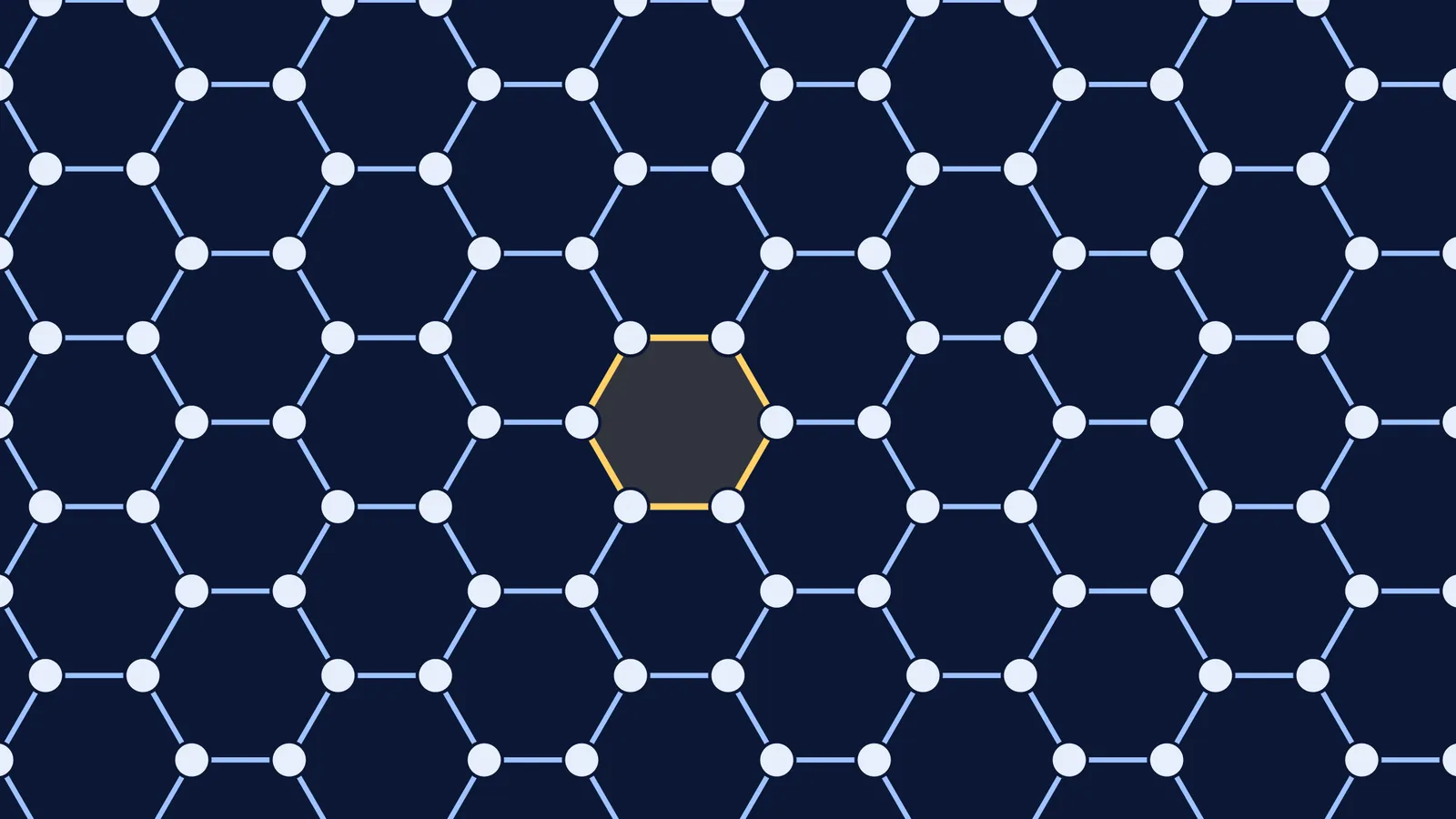
The geometry is very regular. In ordinary ice (ice Ih), the angle between bonds is very close to the tetrahedral angle of 109.5°, and the distance between neighbouring oxygen atoms is about 275 pm, according to the phases of ice reference. It describes crinkled layers of hexagonal rings, an oxygen at each corner, that leave almost enough room for another molecule inside.
Tetrahedral angles cannot close a flat ring of six, so each ring puckers. When the layers stack, the rings line up into straight hexagonal tunnels through the crystal. Look down them, as in the diagram above, and you see mostly empty space. That empty space is where the extra 9% of volume goes.
Why is liquid water denser than ice?
When ice melts, part of the rigid network breaks. Molecules are no longer pinned to fixed sites, so some fill the cavities the lattice held open (properties of water), and the same mass fits in less volume.
Liquid water is densest at about 3.98 °C, at 0.99997 g/mL, according to the same page, because tiny ice-like hexagonal structures still form near 0 °C (phases of ice). Floating ice also insulates the water below, so deep lakes can stay near 4 °C at the bottom through winter.
How do you build the ice lattice in 3D at home?
You need modelling clay (or soaked chana) and about 35 toothpicks. Each ball is an oxygen atom; each toothpick is a link between two molecules.
Make 12 balls of the same size.
Push four toothpicks into each ball: one straight along an axis, three spread the other way like a tripod. Aim for equal angles between all four, close to 109.5°.
On each ball, mark two of the four toothpicks with a pen. Those are the ball's own O–H bonds. The other two are where a neighbour's hydrogen will dock.
Join six balls into a ring with the tripod legs, alternating the single toothpick up, down, up, so every shared toothpick has one marked end. The ring puckers instead of lying flat; that is correct.
Set a second ring of six directly above, joining the lower ring's three upward toothpicks to the upper ring's three downward ones.
Hold the model at eye level and look straight down the vertical toothpicks. You should see a hexagonal tunnel. Push a pencil through it.
Then test yourself:
How many neighbours does each ball have? (Four, counting free ends.)
Pull out a few toothpicks, the way melting breaks bonds, and squeeze the balls together. Does the model take up less space?
Worked example: how much does frozen water grow?
Take 1 litre (1000 cm³) of water at 0 °C, using the densities from the Physics Van answer.
Mass = 1000 cm³ × 0.9998 g/cm³ = 999.8 g.
Freeze it. The mass stays the same, so volume = 999.8 g ÷ 0.9167 g/cm³ ≈ 1090.6 cm³.
The ice is about 91 cm³ bigger, roughly 9%. That is why a glass bottle filled to the brim can crack in the freezer.
The same two numbers tell you how much of floating ice sits under fresh water: 0.9167 ÷ 0.9998 ≈ 0.917, so about 92% of the ice is below the surface. The full method is in our post on what fraction of a floating body is under water.
Where to go next
Crystal structures are hard to picture from a flat textbook figure. The Fermi Simulation Lab has interactive simulations for ideas that are easier to see than to read, and Fermi's AI tutor can draw the figure and check your understanding as it goes. Next, try why cis and trans but-2-ene can't twist into each other.


