On this page
Every glacier keeps a yearly budget. Snow that falls and survives the summer adds ice; melting takes ice away. A glacier grows when its snow income beats its melt spending, and shrinks when melting wins. In the Himalaya, melting has been winning for decades, and the gap is getting wider.
Are Himalayan glaciers really shrinking faster now?
Yes. A 2019 study in Science Advances led by J. M. Maurer of Columbia University found that glacier ice loss rates across the Himalayas have doubled over the past four decades, which the authors describe as consistent with regional atmospheric warming.
Hindu Kush Himalaya glaciers disappeared 65% faster in 2011–2020 than in the previous decade, according to ICIMOD's 2023 HI-WISE assessment.
Between 1990 and 2020, the region's glaciers lost about 12% of their area and 9% of their estimated ice reserves, ICIMOD reported in March 2026. The same report says the smallest glaciers, under 0.5 km², are shrinking fastest, and about three-quarters of the region's glaciers are that small.
Why are Himalayan glaciers shrinking every year?
Three things push the budget into the red.
Warmer air adds heat to the ice
Warm air hands heat to the glacier surface, so more of the ice reaches 0 °C and melts. Maurer's team found the doubling of Himalayan ice loss consistent with regional atmospheric warming.
Less winter snow means less income
Snow cover across the Hindu Kush Himalaya fell to 27.8% below the long-term average in 2026, a record low and the fourth below-normal year in a row, according to ICIMOD's Snow Update 2026. Snow does two jobs for a glacier: it adds mass, and its white blanket reflects sunlight away. Thin snow fails at both.
One year is not the whole story. In that same report, the Ganges basin was 16.3% above normal while ten of twelve basins were below it, which is why scientists judge glaciers over decades, not single winters.
Soot and dust darken the snow
A dark surface absorbs more sunlight than a white one, the same idea behind why black bodies absorb and emit radiation so well. A 2025 study in JGR: Atmospheres by A. S. Chandel, C. Sarangi and colleagues used satellite data and measurements at Mukteshwar in Uttarakhand to study pre-monsoon dust storms. Storms whose dust travelled through the polluted air over the Gangetic plains brought twice the usual black carbon (soot), and the estimated drop in snow albedo doubled during dust events compared with background conditions.
How does albedo make glaciers melt faster?
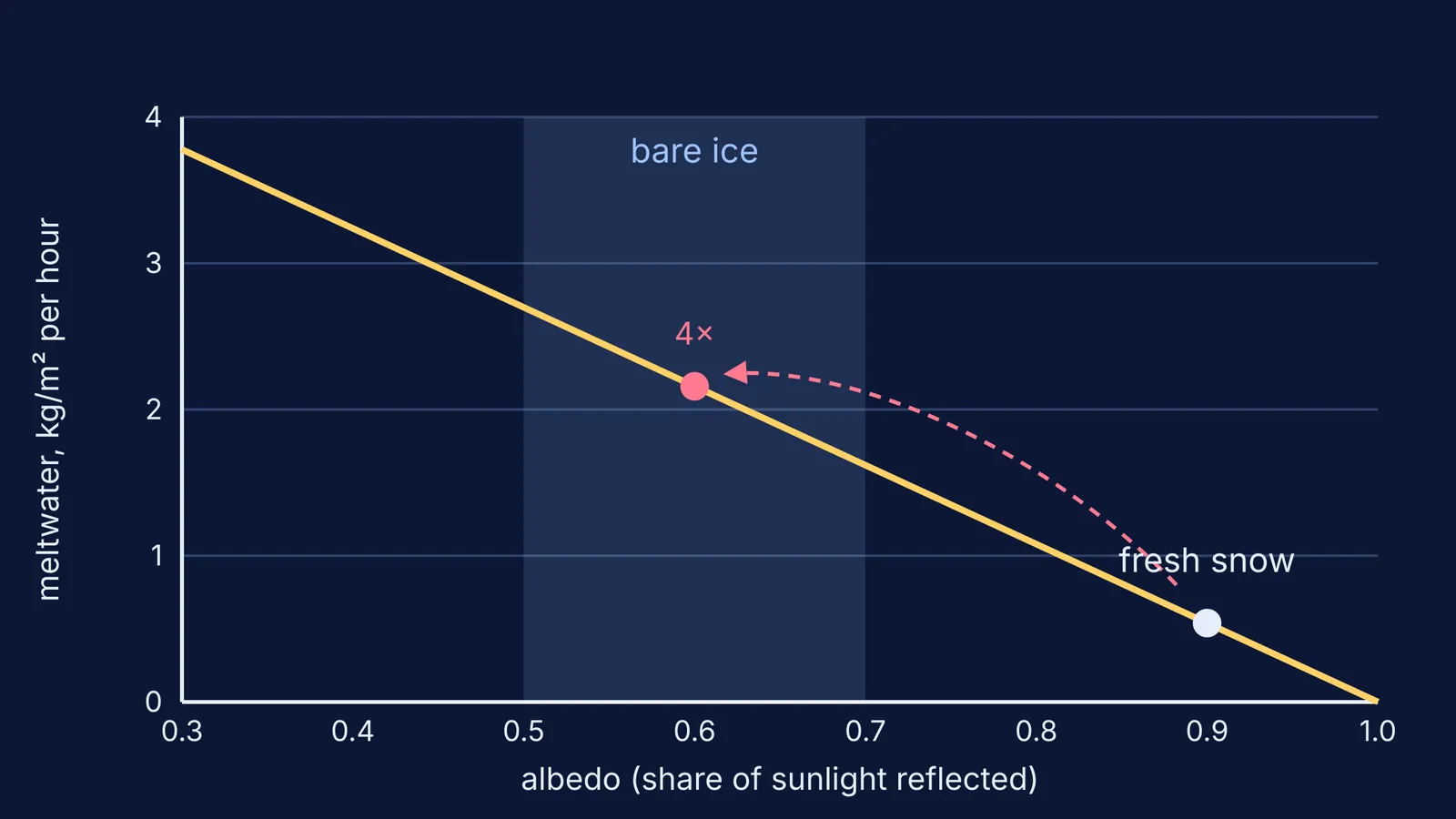
Albedo is a unitless number that says how well a surface reflects solar energy, as defined by the US National Snow and Ice Data Center. NSIDC says snow-covered sea ice reflects as much as 90% of incoming sunlight, while bare sea ice has an albedo of about 0.5 to 0.7. Glacier ice behaves similarly.
A worked example: assume 500 W/m² of sunlight falls on a glacier for one hour (a round number chosen for the example).
Energy arriving: 500 × 3600 = 1,800,000 J per square metre.
Fresh snow, albedo 0.9, absorbs 10%: 180,000 J.
Bare ice, albedo 0.6, absorbs 40%: 720,000 J.
Melting ice takes 333.5 J per gram, the value measured by the US National Bureau of Standards.
Snow-covered surface: 180,000 ÷ 333.5 ≈ 540 g of meltwater, about half a litre.
Bare ice: 720,000 ÷ 333.5 ≈ 2,160 g, about 2.2 litres.
Same sunlight, four times the melt. The example assumes the surface is already at 0 °C and all absorbed energy goes into melting, so real numbers are lower, but the ratio is the point. If the unit of latent heat trips you up, see specific latent heat, its units and typical values.
What does glacier loss mean for Asia's rivers?
About two billion people in Asia depend on water from the region's ice and snow, and on current emissions trajectories its glaciers could lose up to 80% of their current volume by the end of the century, according to the HI-WISE assessment. The glaciers are the source of at least ten major Asian river systems, ICIMOD says. The warming behind this comes from Earth's energy balance; our explainer on how Earth's temperature is set by radiation balance shows the physics.
How do you explain glacier retreat in an exam answer?
Use this four-step frame:
Budget: a glacier shrinks when melting (ablation) exceeds snowfall (accumulation).
Causes: warmer air, less winter snow, and soot or dust on the surface.
Physics: lower albedo means more absorbed sunlight; each gram of ice needs about 334 J to melt.
Effect: a feedback loop that speeds melting, and less dependable river water downstream.
One line:"Himalayan glaciers shrink because warmer air and darker, thinner snow make them absorb more energy each summer than winter snow can replace."
Albedo and energy balance are easier to see than to read. The Fermi Simulation Lab has interactive simulations for ideas like these, and the Fermi Concept Library gives each concept, from latent heat to radiation, its own lesson.
Next time you see a retreating glacier, read it as a budget: less snow in, more sunlight soaked up.