

On this page
We live on a comfortably warm planet, but how much of that heat comes straight from the Sun, and how much is trapped by our atmosphere? To answer this, we can calculate how hot the Earth would be if it were a simple rock floating in space, absorbing solar energy and radiating heat back into the void.
When we balance the energy coming in with the energy going out, we can estimate Earth's temperature from radiation balance. Without the greenhouse effect, Earth's average surface temperature would be about 254 K (−19 °C). That is far below freezing, and life as we know it would not exist.
Here is the step-by-step physics of how we arrive at that number.
What is the incoming solar energy?
The Earth intercepts a continuous stream of energy from the Sun. The amount of solar energy arriving at the top of our atmosphere is called the solar irradiance, or the solar constant, often written as S. According to the NASA Earth Fact Sheet, S is about 1361 W/m². Because Earth's orbit is slightly elliptical, the actual amount of sunlight we receive fluctuates throughout the year. The solar constant represents an average over this orbital path. (Earth's incoming radiation also changes slightly over thousands of years, as explained by Milutin Milankovic and the orbital cycles behind ice ages).
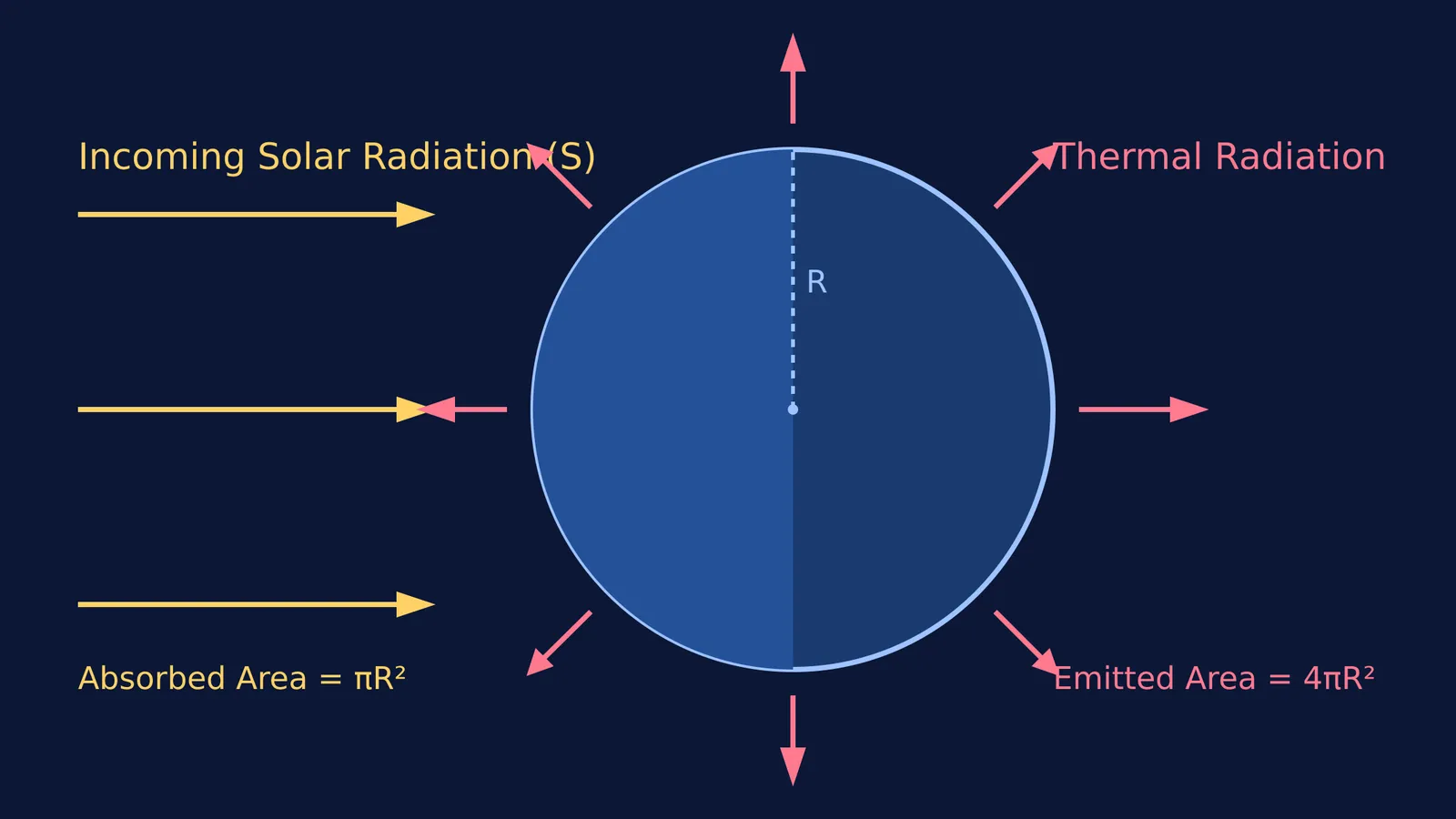
Earth is a sphere of radius R, but it intercepts sunlight exactly like a flat disk facing the Sun. If you look at Earth from space, it appears as a circular silhouette. The cross-sectional area catching this incoming light is therefore πR².
However, not all of this incoming energy is absorbed by the planet. Clouds, ice caps, and oceans reflect a significant portion of it back into the darkness of space. This reflected fraction is called the Bond albedo. Earth's Bond albedo is 0.294, meaning it reflects roughly 30% of incoming light before it can warm the surface.
Therefore, the total power Earth absorbs is the solar constant times the cross-sectional area, minus the reflected part: Absorbed power = πR²S(1 − albedo)
How much heat does Earth radiate?
If Earth only absorbed energy, its temperature would continue to rise indefinitely. To maintain a stable climate over time, it must lose energy to space at the exact same rate that it receives it. It does this by emitting longwave thermal radiation, primarily in the infrared part of the electromagnetic spectrum.
Unlike the incoming sunlight which only hits a flat disk's worth of area on the day side, Earth radiates heat outward in all directions from its entire spherical surface. Both the day and night sides of the planet are constantly losing heat to space. The total surface area of a sphere is 4πR².
The Stefan-Boltzmann law tells us that a perfect black body radiates power proportional to the fourth power of its absolute temperature (T). The power emitted per square metre is given by σT⁴, where σ (the Stefan-Boltzmann constant) is roughly 5.67 × 10⁻⁸ W/(m²·K⁴).
Therefore, the total power Earth emits is the power per square metre multiplied by the total surface area: Emitted power = 4πR²σT⁴
How do we estimate Earth's temperature from radiation balance?
Because Earth's global average temperature is relatively stable year after year, it is in a state of radiative equilibrium. This means the absorbed solar power must exactly equal the emitted thermal power.
Setting them equal gives us the fundamental radiation balance equation: πR²S(1 − albedo) = 4πR²σT⁴
Notice that the term πR² appears on both sides of the equation. If we divide both sides by πR², the size of the planet cancels out entirely!
S(1 − albedo) = 4σT⁴
To find the theoretical baseline temperature, we rearrange the formula to solve for T: T = [ S(1 − albedo) / (4σ) ]^(1/4)
If you are working through the algebra of heat transfer and finding the fourth roots tricky, the Fermi Problem Library has worked problems with a step-by-step solver that explains the reasoning.
What is the greenhouse effect difference?
When we plug NASA's measured numbers into our rearranged equation — S = 1361 W/m² and an albedo of 0.294 — the math gives us a theoretical black-body temperature of 254.9 K. NASA lists the exact black-body equilibrium temperature as 254.0 K (about −19 °C), a slight difference due to complex geometric and orbital averaging over time.
But step outside, and you will quickly notice Earth is much warmer than a freezing −19 °C. The actual average surface temperature of our planet is about 288 K (15 °C).
Why is there a massive 34 K difference? The calculation above assumes Earth is a bare rock. It completely ignores our atmosphere. While gases like nitrogen and oxygen let solar radiation pass through easily, trace greenhouse gases — primarily water vapour, carbon dioxide, and methane — absorb the outgoing thermal infrared radiation and re-radiate it back down towards the ground. This mechanism traps heat near the surface, elevating the actual temperature well above the theoretical baseline. For a deeper look at how scientists first proved the atmosphere traps heat, read about Guy Callendar and the first evidence of CO2 warming.
A checklist for any planet
If you want to master these equations, a great way to study is to apply the exact same radiation balance model to Mars or Venus. You can see directly how distance and albedo shift the final numbers. To do this yourself, follow this checklist:
Find the planet's solar constant S by scaling Earth's 1361 W/m² by the inverse square of the planet's distance from the Sun.
Look up the planet's Bond albedo (for example, Venus reflects highly due to thick clouds; Mars does not).
Plug your new S and albedo into the radiation balance equation: T = [ S(1 − albedo) / (4σ) ]^(1/4).
Compare your theoretical T with the planet's actual measured surface temperature to find the strength of its greenhouse effect.
By understanding the bare-rock baseline, we can measure exactly how much work a planet's atmosphere does to keep it warm and habitable.


