

On this page
When you boil water or melt ice, the temperature stays constant while the phase changes. The energy driving this change is called latent heat. Water has unusually high latent heat values, which is why oceans regulate Earth's climate and why boiling a kettle takes much longer than heating it up. Understanding these values is crucial for students tackling thermodynamics and phase change problems in their physics coursework.
What are the latent heat of fusion and vaporisation of water values?
The specific latent heat of fusion for water is about 334 kJ/kg, according to the NIST Chemistry WebBook. This is the energy required to convert one kilogram of solid ice at 0 °C into liquid water at 0 °C without any change in temperature.
The specific latent heat of vaporisation for water is approximately 2260 kJ/kg at standard atmospheric pressure, as recorded by NIST. This is the amount of energy required to convert one kilogram of liquid water at 100 °C into steam at 100 °C, again without a temperature change.
Because these values are so large, water acts as an excellent coolant in both natural and artificial systems. When ice melts in a drink, it absorbs 334 kilojoules of heat per kilogram from the surrounding liquid, cooling the drink effectively. Conversely, when steam condenses on your skin, it releases a massive 2260 kilojoules of heat per kilogram. This rapid energy transfer is why steam burns are significantly more severe than burns caused by boiling water.
Why is the latent heat of vaporisation of water so high?
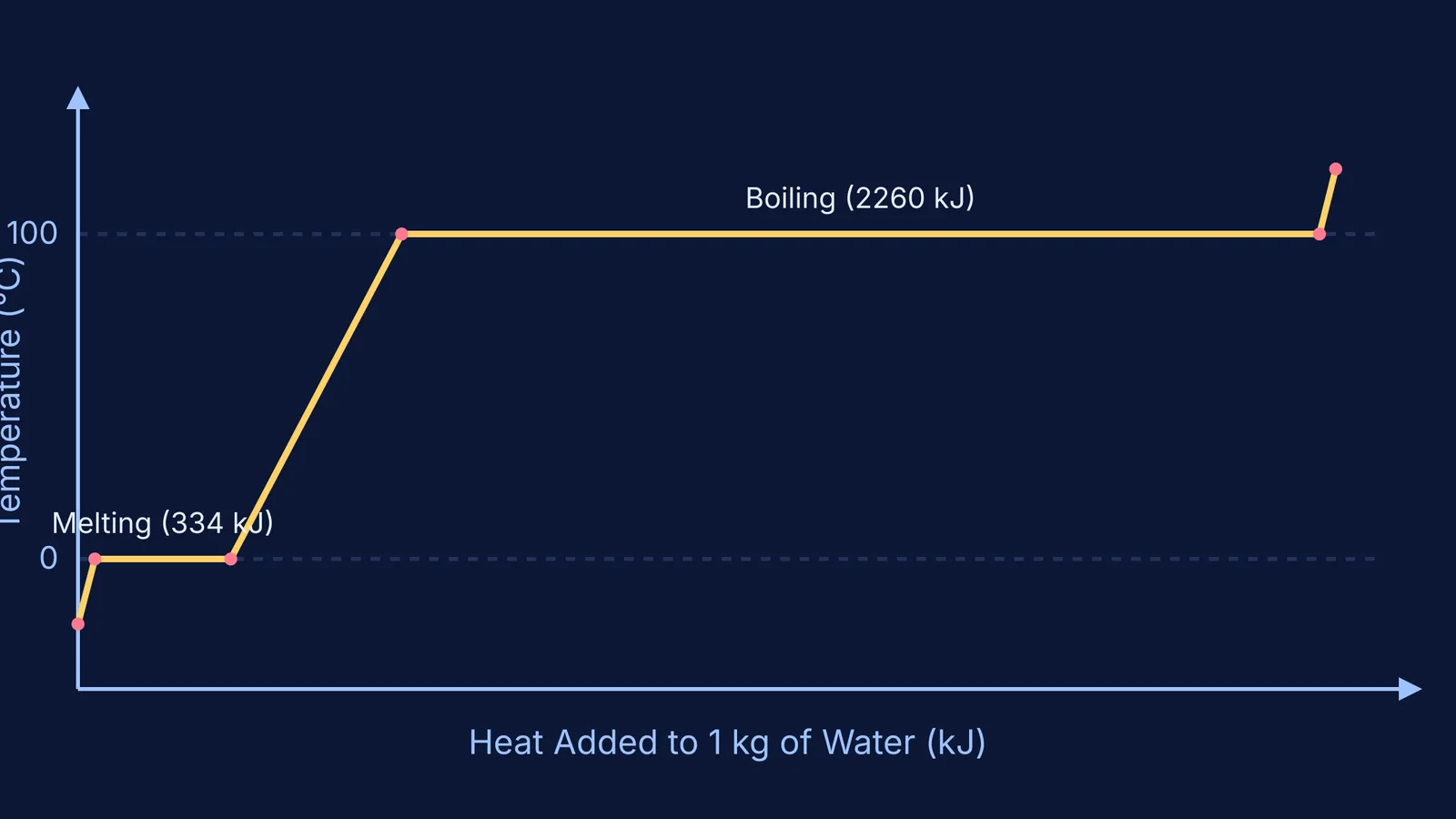
Melting 1 kg of ice takes 334 kJ, but boiling 1 kg of water takes nearly seven times as much energy (2260 kJ), according to the NIST Chemistry WebBook. This massive difference comes down to what happens to the molecules during each phase change.
In solid ice, water molecules are locked in a rigid crystal lattice held tightly together by hydrogen bonds. When ice melts into a liquid, only a fraction of these hydrogen bonds break. The molecules gain enough freedom to slide past one another and flow, but they remain close together in the liquid state.
When water boils, however, every remaining hydrogen bond must be entirely broken. The water molecules must be completely separated from one another and pushed apart against the pressure of the surrounding atmosphere to form a gas. Doing this requires an enormous input of work, resulting in a much higher latent heat of vaporisation. This process relates closely to measuring ΔU and converting it to ΔH in thermodynamics, where the work done by expanding gases is fully accounted for.
How do you calculate total heat in phase change problems?
Phase change numericals in physics often ask for the total heat required to take ice below freezing to steam above boiling. A common mistake is confusing the heat that changes temperature (sensible heat) with the heat that changes phase (latent heat).
Here is a plan to calculate the energy needed to turn 1 kg of ice at −10 °C into steam at 100 °C, using standard values from the NIST Chemistry WebBook:
Warm the ice to 0 °C: Use Q = mcΔT. Ice has a specific heat capacity of about 2.1 kJ/kg·K. For a 10-degree rise, Q = 1 × 2.1 × 10 = 21 kJ.
Melt the ice: Use Q = mL, where the latent heat of fusion is 334 kJ/kg. Q = 1 × 334 = 334 kJ.
Warm the water to 100 °C: Use Q = mcΔT. Liquid water has a specific heat capacity of about 4.2 kJ/kg·K. For a 100-degree rise, Q = 1 × 4.2 × 100 = 420 kJ.
Boil the water: Use Q = mL, where the latent heat of vaporisation is 2260 kJ/kg. Q = 1 × 2260 = 2260 kJ.
Add them up: The total heat is 21 + 334 + 420 + 2260 = 3035 kJ.
Notice that boiling takes up nearly 75% of the total energy budget in this scenario. Understanding this heat transfer is also essential for estimating the time for ice to form on a pond in winter, as the latent heat of fusion must be removed through the ice layer.
If you are unsure where to apply these formulas, the Fermi Problem Library has worked problems with a step-by-step solver that explains the reasoning rather than printing an answer. This helps you master the transitions between sensible and latent heat.


