

On this page
A stack of identical books on a table can lean out so far that the top book sits completely beyond the table edge, with nothing under it but air. You need only four books to do it. The trick is to build from the top down, so that each set of books balances exactly on the edge of the book below. The overhang then grows like the harmonic series, 1 + 1/2 + 1/3 + …, which has no upper limit, but grows painfully slowly.
How far can one book stick out over a table edge?
A body resting on an edge stays put as long as its centre of mass is above the supporting surface. If the centre of mass moves past the edge, the weight acting through it makes a turning moment about the edge that nothing can balance, and the body tips. That is the same rule that keeps a leaning tower standing, worked in why the Leaning Tower of Pisa does not fall.
A uniform book of length L has its centre of mass at its middle. Slide it out until the middle is exactly over the edge, and it overhangs by L/2. That is the limit for one book. For a stack, the rule is applied to every level at once: the combined centre of mass of all the books above any surface must lie over that surface. For uniform books in a uniform field the centre of mass and centre of gravity are the same point, as centre of gravity vs centre of mass explains.
Why does the top book stick out the most?
Build the stack from the top. Number the books 1, 2, 3, … going down.
Book 1 on book 2. Book 1 can stick out L/2 beyond book 2. Its centre of mass is then exactly above the edge of book 2.
Books 1 and 2 on book 3. The centre of mass of book 1 is at the right edge of book 2. The centre of mass of book 2 is at its own middle, L/2 to the left of that edge. The pair's centre of mass is the average of the two: (0 + L/2)/2 = L/4 to the left of the edge of book 2. Put that point on the edge of book 3, so book 2 sticks out L/4 beyond book 3.
The general step. Suppose the top k books have their joint centre of mass exactly over the edge of book k + 1. Book k + 1 adds one mass whose centre is L/2 behind that edge. The new centre of mass of k + 1 books is (k × 0 + 1 × L/2)/(k + 1) = L/(2(k + 1)) behind the edge. Put that point over the edge of book k + 2.
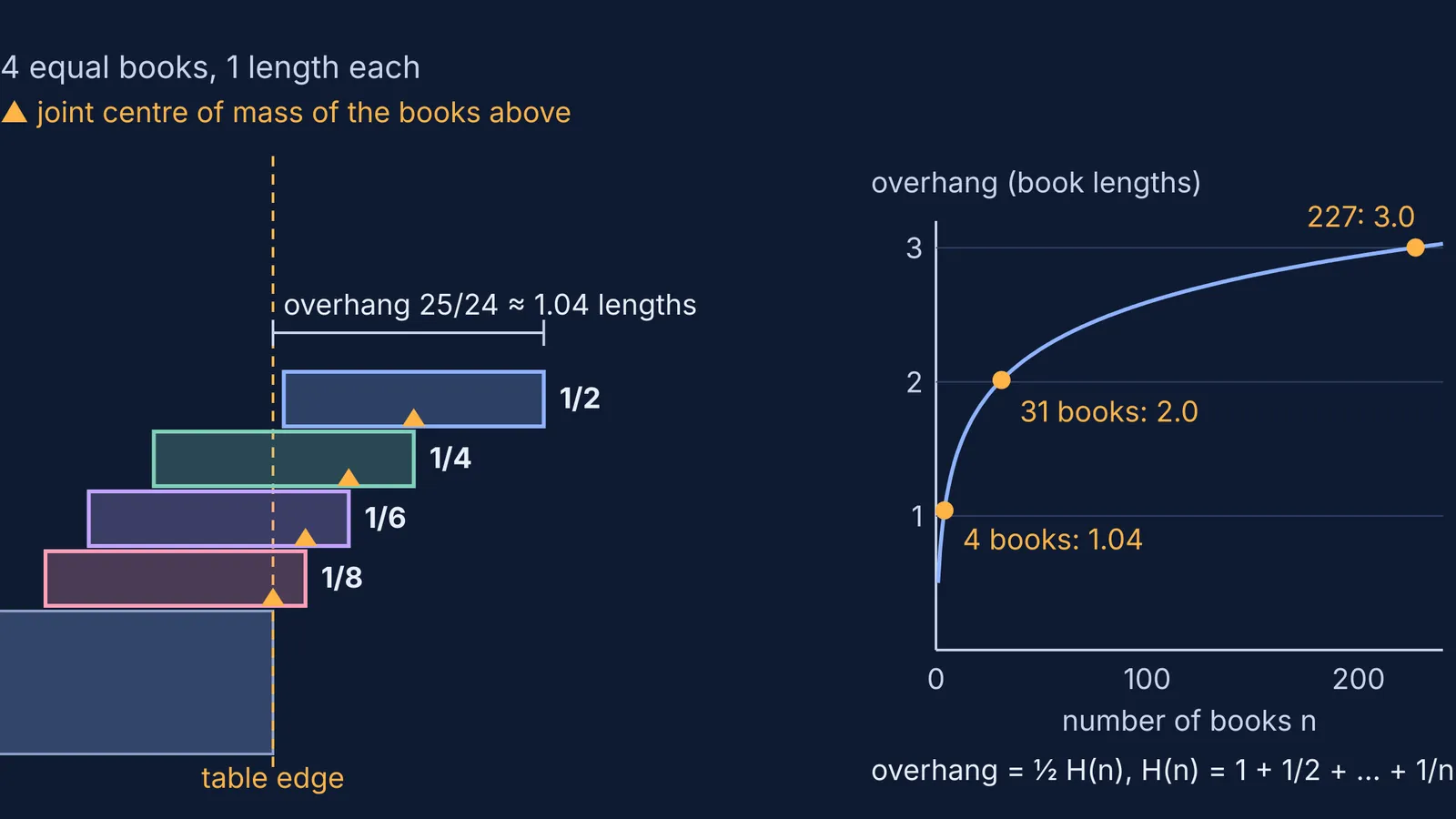
So the k-th book from the top sticks out L/(2k) beyond the book below it. The steps are L/2, L/4, L/6, L/8, … The largest step is at the top, which surprises most people, who tend to draw the big steps at the bottom.
The total overhang of n books is the sum of the steps:
overhang = (L/2)(1 + 1/2 + 1/3 + … + 1/n) = (L/2) Hₙ
where Hₙ is the n-th harmonic number. The Wolfram MathWorld entry on the book-stacking problem gives the same result, d = ½Hₙ book lengths.
Worked example: how far do four 21 cm books reach?
Take four identical books, each L = 21 cm long.
Steps from the top. L/2 = 10.5 cm, L/4 = 5.25 cm, L/6 = 3.5 cm, L/8 = 2.625 cm.
Total overhang. 10.5 + 5.25 + 3.5 + 2.625 = 21.875 cm, about 21.9 cm.
In book lengths. ½(1 + 1/2 + 1/3 + 1/4) = ½ × 25/12 = 25/24 ≈ 1.042 L.
Where is the top book? Its outer end is 21.875 cm beyond the table edge, so its inner end is 21.875 − 21 = 0.875 cm beyond the edge. The whole top book is past the table.
Check the balance at the table. Measure positions from the table edge, positive outwards. The centres of the four books, top to bottom, are at 11.375, 0.875, −4.375 and −7.875 cm. Their average is 0, so the whole stack's centre of mass sits exactly above the table edge, as the method requires.
Three books give only 11/12 ≈ 0.917 L, so the fourth is what carries the top book clear.
How many books do you need for 2 or 3 book lengths?
The harmonic series diverges: add enough terms and the sum passes any number you choose. So in principle a stack of this kind can reach out as far as you like. In practice it grows about as fast as a logarithm, because Hₙ ≈ ln n + 0.577 for large n. Counting with python3, the smallest stacks that reach a given overhang are:
1 book length: 4 books
1.5 book lengths: 11 books
2 book lengths: 31 books
2.5 book lengths: 83 books
3 book lengths: 227 books
5 book lengths: 12,367 books
The 4 and 31 agree with the counts on the MathWorld page linked above. Each extra half a book length multiplies the number of books by about e ≈ 2.7. Ten book lengths would need around 2.7 × 10⁸ books.
Is the harmonic stack the largest overhang possible?
No. The ½Hₙ result is the largest overhang for stacks with one book per level, each resting on the one below. If you allow several blocks side by side on a level, some acting as counterweights behind the edge, you can do far better. Mike Paterson and Uri Zwick showed in their paper "Overhang" (American Mathematical Monthly, 2009) that such stacks can reach an overhang that grows like n^(1/3), a cube root, rather than like ln n. For large n the cube root wins by a huge margin. So call the harmonic stack the limit for a single column, not the maximum overhang.
What does the ideal stack leave out?
No safety margin. Every centre of mass sits exactly on an edge, so the stack is only just balanced. Real stacks need each step a little shorter.
Identical, uniform books. The L/(2k) steps assume every book has the same mass and its centre of mass at its middle. A book heavier on one side changes every step.
Rigid books. Soft covers bend at the edge, which moves the support point inward.
If you want to practise more centre-of-mass and toppling problems of this kind, the Fermi Problem Library has a step-by-step solver that explains the reasoning at each stage.
Quick checklist
One book can overhang L/2: its centre of mass on the edge.
Working down, the k-th book from the top sticks out L/(2k) beyond the next.
Total overhang of n books: (L/2)(1 + 1/2 + … + 1/n).
Four books give 25/24 L, so the top book clears the table.
2 lengths needs 31 books and 3 lengths needs 227.
More than one block per level beats the harmonic stack.


